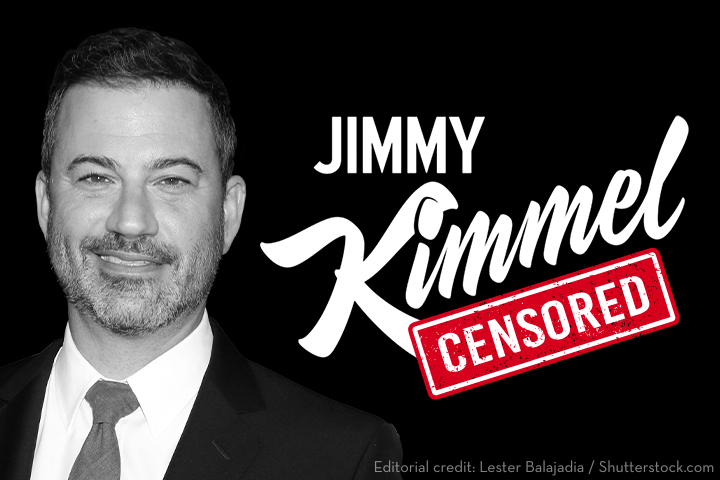
With humor and humility, Jimmy Kimmel returned to the airwaves last night, offering a unifying plea for the public to continue to make their voices heard for free speech.
After his six-day suspension by Disney and ABC, which caved to threats from FCC Commissioner Brendan Carr, and the ensuing public outcry from across the political spectrum, Kimmel delivered an opening monologue that was solemn and conciliatory, mixed with his trademark satire and barbs at politicians like Senator Ted Cruz.
He apologized for any offense his comments about Charlie Kirk’s murder may have caused, saying that was never his intention. Holding back tears, he spoke about his Christian faith, and Erika Kirk’s public forgiving of her husband’s murderer over the weekend, which he called a “selfless act of grace,” and which he said he found deeply touching.
Whether one likes Kimmel’s brand of humor or his choice of approach to such a highly anticipated TV event, it is undeniable that he delivered a uniquely unifying and rousing message centered on the vital and universal principle of free speech. Kimmel returned to the theme multiple times to make clear to viewers that free speech protects and binds us all, and we ignore it at our collective peril.
Kimmel’s return was in many ways a victory for free speech and its advocates, who had fiercely coalesced against his suspension. The threat from the FCC that precipitated the show’s suspension constituted such brazen government interference that it served to unite an otherwise fractious chorus from across the political spectrum, at least on this one issue.
Recognizing the importance of that unique alignment, Kimmel thanked the multitudes who expressed support for him—fellow late night comedians, celebrities across the entertainment industry, people from throughout his personal life and career, and fans. “You supported our show,” he said, “cared enough to do something about it. To make your voices heard so that mine could be heard. I will never forget it.”
Kimmel also uplifted the role that voices from across the political spectrum played in the groundswell of public outrage. “Maybe…, most of all,” he noted, “I want to thank the people who don’t support my show and what I believe, but support my right to share those beliefs anyway.” He remarked that this was somewhat unimaginable, but rattled off a number of conservatives as he thanked them for speaking out, including Republican politicians like Senators Cruz, Rand Paul, and Mitch McConnell, and commentators like Ben Shapiro and Joe Rogan.
In so doing, Kimmel tried to bridge today’s political divides, emphasizing how free speech is a widely shared value, and that government censorship is something all Americans must and do oppose. “I barely paid attention in school,” he shared, “but one thing I did learn from Lenny Bruce and George Carlin and Howard Stern is that a government threat to silence a comedian the president doesn’t like is anti-American. That’s anti-American. And I’m so glad we have some solidarity on that…”
More than once Kimmel emphasized that people need to speak against these abuses, particularly when it comes to free speech. He took the opportunity to call out President Trump for “openly rooting” for NBC to fire its late night hosts, Jimmy Fallon and Seth Meyers, calling his viewers to pay attention. “I hope that if that happens, or if there’s even any hint of that happening, you will be 10 times as loud as you were this week.”
“We have to speak out,” he added, “because he’s not stopping.”
Kimmel also lamented the president’s threats to journalists and news organizations and his efforts to bully them, as well as a recently announced plan by the Pentagon to force journalists to sign a pledge to only report on information that the government explicitly approves. On this, Kimmel was emphatic: “They want to pick and choose what the news is.”
He reinforced for viewers how alarming such a plan is: “I know that’s not as interesting as muzzling a comedian; but it’s so important to have a free press, and it is nuts that we aren’t paying more attention to it.”
Kimmel’s effort to appeal to shared principles and values may not carry water for long, and it may not reach far and wide — especially as two national broadcasters did not agree to bring the show back in certain areas of the country.
Still, his was a rare attempt to remind Americans of different political beliefs that they share common commitments to, among other things, the First Amendment and its protections for political satire, and that all have a stake in what happens to freedom of speech in the country.
Kimmel’s return could become a watershed moment in the current free speech crisis propelled by the Trump administration, a moment reminiscent of when Harvard first responded to the government’s efforts to bully it, refusing to capitulate, and for which it received strong public support.
For this, Kimmel deserves to be applauded. We can only hope his inspiring words are contagious and that his appeal begins to catalyze a louder opposition, more consistently attuned to these worsening government threats to free speech by the Trump administration.
If so, Kimmel may have the last word: “My show is not important,” he said. “What is important is that we get to live in a country that allows us to have a show like this.”