What do people mean when they say “hate speech”?
One of the most common questions we receive in our workshops on freedom of speech is about hateful speech. What is hate speech? Is it illegal? The following explains some of the basic definitions used when referring to hate speech and provides two examples from college campuses to illustrate how these definitions have been used in practice.
Is hate speech illegal?
Many people assume hate speech is illegal, but it isn’t – not in the United States. There are a few kinds of speech that fall outside of First Amendment protection, which will be explained below, but hate speech is not one of them.
The statement “this is not free speech, it’s hate speech” doesn’t describe the legal status of speech.
In our Law section of the Campus Free Speech guide, PEN America writes:
There is no legal definition of hate speech in the United States, nor is there any formal definition under international human rights law. While many countries have legal restrictions on certain types of hateful speech, other countries with strong legal protections similar to the U.S. First Amendment typically do not. In the United States, hateful language and offensive speech are protected from government interference under the First Amendment.
What does it mean to say speech is “protected?” And is there “unprotected speech?”
Protected speech in the United States means that the government may not censor or unduly restrict or punish such expression.The U.S. Supreme Court has consistently ruled that hateful or offensive speech is constitutionally protected from legal ramifications unless, for example, it incites imminent violence or unlawful action, constitutes “true threats” against individuals, is obscenity, as legally defined, or is defamatory – these are types of unprotected speech. For definitions of each of these terms see the Law section in this guide.
It’s important to note that protected speech does not always equal “good” speech. Speech can be unpleasant, controversial, or even hateful and be legally protected speech.
Conversely, speech can be inoffensive or mundane and not be legally protected.
In the United States, protected speech is our default setting (called a “presumption”). There are exceptions to the presumption, but “hate speech” is not one such exception in the law.
If hate speech isn’t a legal category of speech, what about hate crimes?
Hate speech often gets confused with hate crimes, which are illegal mostly under various state criminal laws, and also under some federal laws. A hate crime always involves a crime, like assault or vandalism. Hate crimes do not criminalize speech or beliefs, however hateful, though both can provide evidence as to whether a crime should be considered a hate crime.
What makes it a hate crime is the motive. If the criminal act is driven by bias or hatred toward a legally protected characteristic of someone’s identity, like their race, religion, ethnicity, disability, national origin, gender identity, or sexual orientation, state or federal laws may increase the penalties attached to a criminal conviction because of that bias. The rationale behind such enhanced penalties is that hate crimes, in addition to targeting specific individuals, target and harm a wider affected community. They are deemed to have a greater impact.
Federal Hate Crime Law
Two murders in 1998 became the catalyst for federal hate crime legislation, that of Matthew Shepard, a gay college student, and James Byrd, a 49-year old Black man. Their brutal murders eventually lead to the passage of the Matthew Shepard and James Byrd, Jr. Hate Crimes Prevention Act in 2009. This act expanded federal hate crime law to include crimes motivated by the victim’s actual or perceived sexual orientation, gender, gender identity, or disability.
Criminal acts motivated by bias or hate toward someone’s actual or perceived identity, can fall under state or federal hate crime laws. The list of legally protected characteristics can vary state to state, or under federal law. And these laws often bring increased penalties.
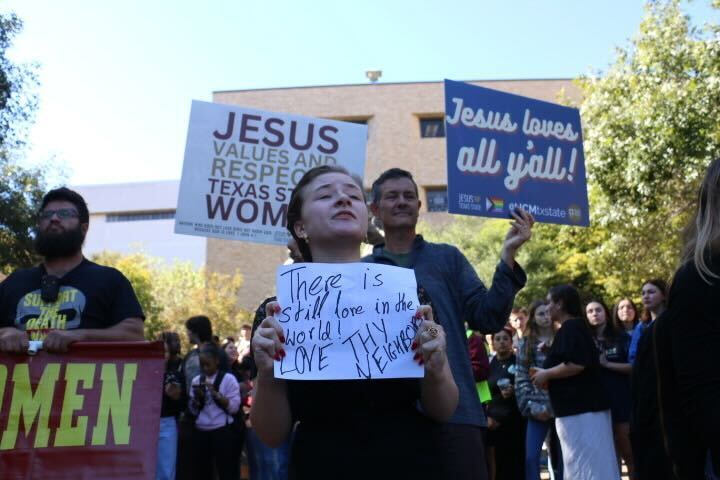
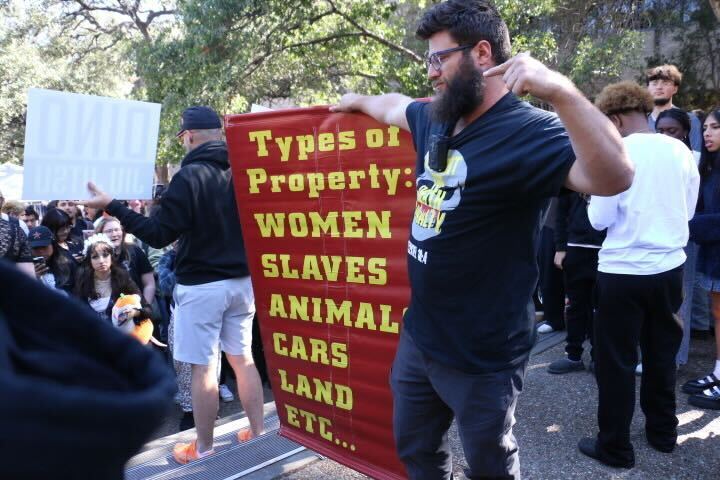
Students at Texas State University stage a peaceful counterprotest on Nov. 6, 2024 after outside demonstrators displayed hateful signs on campus following the presidential election. (Meg Boles/The University Star)
Texas State University students counterprotest hateful signs
The day after Donald Trump won the 2024 election, two men stood in the middle of the Texas State University campus holding hateful, misogynistic, and homophobic signs. One sign read “Homo Sex is Sin” on one side, stating that sodomy is “Worthy of Death” on the other. A second red sign read “Women are Property,” listed “Woman, Slaves, Animals, Cars, Land, etc.” as types of property on the back. The men reportedly identified themselves as members of a group called Official Street Preachers and were not affiliated with the university.
The following day, Texas State University’s president, Kelly Damphousse, wrote a letter to the university community, directly acknowledging the incident and condemning the men’s messages. Damphousse also noted that other Texas schools had recently seen similar incidents and that he had witnessed several similar events over his 30 years on college campuses. He explained why the two men were not forcibly removed from campus: “[Texas State University] is required by law to make public outdoor campus spaces open to what are known as ‘expressive activities,’ even by external groups with whom none of us agree.” He directed students to information on free expression on the university’s website, to the site for reporting incidents, and to the counseling center.
What the students did in response to protected, hateful speech:
Students organized a peaceful counterprotest, with 100+ students surrounding the men with their own signs including one reading “There is still love in the world. Love thy neighbor!” University officials, including trained University Police Department officers, monitored the event and escorted the men off campus at the end of the protest to ensure their safety. As they left, students and protesters followed them and one report stated that students took the original protesters’ signs.
The students’ peaceful and strong response to hateful rhetoric on campus is a positive example of counterspeech, although if true, the removal of the protesters’ signs by some students fell short of ideal free expression practices. The large turnout, significantly outnumbering the two men engaging in hateful expression, also demonstrated broad community opposition to the offensive messages. The event was closely monitored by trained University Police Department officers, who were prepared to ensure both public safety and the protection of lawful speech, providing a model for how other schools might manage similar protests.
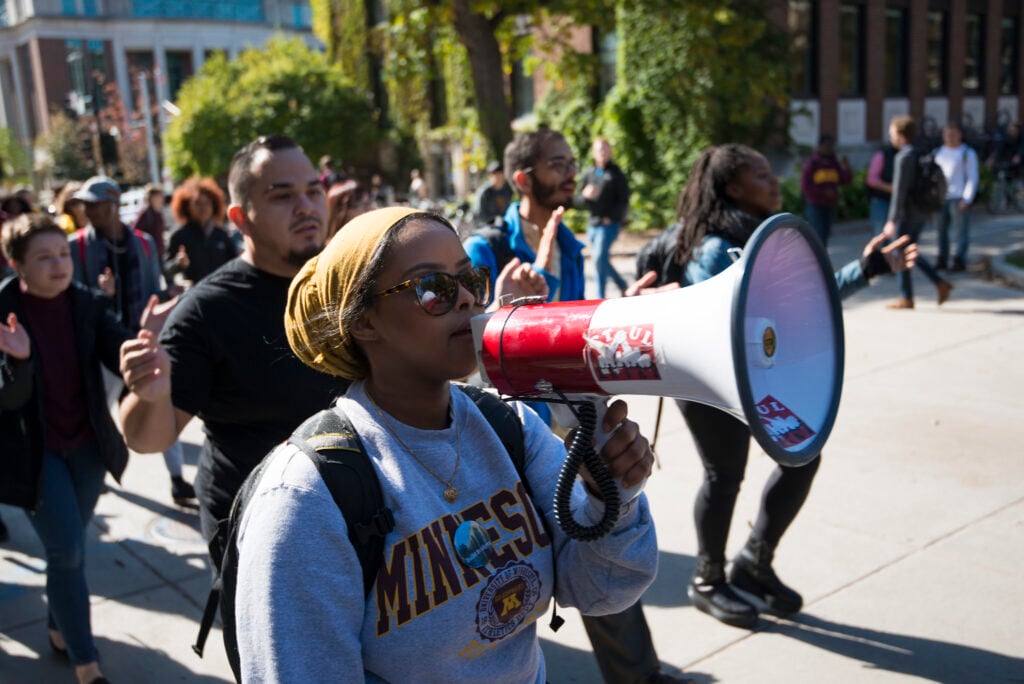
For more information about organizing a peaceful protest, see our blog “How Do I Plan a Protest on Campus?”
Ohio State University confronts antisemitic and racist graffiti
In November 2022, vandals defaced a stairwell in Hitchcock Hall, an engineering building on Ohio State University’s main campus, with antisemitic and racist graffiti. A school employee discovered the messages after the weekend and called state police. The officer’s report noted a swastika and other Nazi symbols, and the phrase “White Power Zone” on the basement level. Someone had also spray-painted the phrase “Whites Only” in red and an anti-Black slur on another floor. The affected areas contained no cameras, and campus workers removed the graffiti.
Ohio State President Kristina M. Johnson released a university-wide statement the following day that read, in part, “There is no room for hate in our home. …The university is where we work and live—and we will not tolerate violations of the values, principles and behaviors that constitute the Shared Values we agree to uphold when we become part of Ohio State.” Various student government leaders, faculty, and administrators also signed the letter. The message encouraged students to report expressions of hate to the Office of Institutional Equity, contact public safety if they felt threatened, seek support if needed, and provide support to others.
Students expressed disappointment at the graffiti, disturbed at its proximity to their daily lives, with one student stating, “I don’t feel safe where I should feel safe.”
What the university did in response to vandalism:
The First Amendment does not protect the desecration of private property, so this incident did not constitute protected speech. After the vandalism was discovered, President Johnson:
- Responded swiftly and clearly, issuing a statement the next day.
- Forcefully denounced the hateful vandalism and re-affirmed the shared values of Ohio State.
- Connected the incidents on campus to a national rise in hateful expression on campuses.
- Educated the campus community about how to report such acts.
- Shared support resources including counseling services to support those affected by the graffiti.
- Signaled broader community support by having multiple stakeholders on campus also sign the statement.
In this case, police conducted an appropriate investigation in an attempt to identify the vandals. After such events, it is important that administrators hold those responsible accountable and maintain open lines of communication with affected students, faculty, and staff to foster a safer and more inclusive campus climate.
Disclaimer: Nothing on this website constitutes, nor should be construed, as legal advice on any matter. All content on the website is for informational purposes only. PEN America is not liable for any errors or omissions in the information and is not liable for any injuries or damages related to the display of the information on this website.
Campus Free Speech Guide
Get principled guidance for how campuses can best remain open to all voices.
-
The Law and Campus Free Speech
-
Hateful Speech and Expression on Campus
-
Speakers and Events on Campus
-

Faculty Speech and Expression
-
Campus Climate
-

Protests on Campus