
How do you plan a peaceful protest on your campus when you’ve got something to march about?
Peaceful protest is a powerful tool for political statements and a constitutionally protected form of expression. When well-organized, a public demonstration can broadcast your message to a wide audience. To be effective, your protest should be organized and well planned. Here are some steps to follow to make sure your protest is safe and accessible.
1. Assemble & Decide
Gather like-minded people and decide if a protest action is necessary and the right mode to get your message across. A traditional protest isn’t the only way to make your voice heard. You can also try:
- Counter-events or teach-ins: Host an alternative program that highlights your perspective, values, or expertise, and creates space for dialogue.
- Engaging in artistic free expression: A mural, song, dance, or other creative form can draw attention to the issues you care about and invite dialogue.
- Social media campaigns: Amplify your message online while keeping the focus on actionable goals and maintaining message clarity.
- Op-eds or open letters: Publish a clear, evidence-based argument in a student paper, blog, or local outlet to influence debate beyond the protest itself.
Key Questions To Consider Before Taking Action
- What is our central message or goal?
- Who is our intended audience, and how can we reach them effectively?
- What are the safety and accessibility plans for participants?
- If you or any potential participants are non-citizens on visas or other documented status, are you aware of the possible risks of arrest, detention, or deportation? While non-citizens do have First Amendment speech protections, there have been cases where non-citizens involved in protests were arrested, and organizers should factor in this risk and communicate it to participants as needed.
- Do we understand the school’s policies, and have we notified the right offices?
- How will we measure success—awareness, engagement, policy change?
- Who will serve as the main point of contact for campus officials or media?
- What steps will we take if tensions rise or conflict occurs?
Example: Creative Campus Protest
Carnegie Mellon Students Organize a Creative, Coordinated Protest to Defend a Free Expression Space
This was the first time students had been restricted from the Fence in 100 years and they responded quickly by constructing a fence of their own and re-creating slogans from the history of the Fence, interspersed with their own messages like “Free speech is CMU history/We shall overcome.” They placed the new fence facing Warner Hall, a building on campus that houses the Office of the President.
In July 2025, Carnegie Mellon University students coordinated an inventive protest to speak out against the decision to restrict access to the “Fence,” a more than 100-year-old icon at the university where students would paint messages ranging from political slogans to marriage proposals. The restriction against painting on the fence came after messages appeared on the fence to protest President Donald Trump’s visit to CMU for an Energy and Innovation Summit.
The demonstration drew widespread attention, generated significant media coverage, and achieved a direct response from the university president. The president, in a community-wide letter, pledged to create a Fence Working Group composed of students, faculty, staff, and alumni who would consider how the Fence can balance the “meaningful campus tradition” alongside “clarity, accountability and respect.” The Fence was also reopened for messages. This case is a strong example of how careful planning and a symbolic, creative strategy can help amplify a protest’s impact, leading to desired outcomes.
2. Plan Your Protest Goals
Once you decide a protest is the best action, designate a leadership team or clarify roles within the group. As organizers, you should identify the goals you hope to accomplish, what message you want to convey, and the audience you want to reach.
3. Research Protest Policies
Familiarize yourself with your school’s policies on assembly and expressive activity. Understanding these rules will help ensure your demonstration is both safe and compliant. Check resources such as:
- Your student handbook or code of conduct
- The Dean of Students Office or Student Affairs Office
- The campus free expression or public assembly policy on your school’s website
If you’re unsure, contact your Dean of Students or Student Affairs representative for guidance on time, place, and manner restrictions that may apply.
What are Time, Place, and Manner Restrictions?
Universities and colleges can enforce reasonable time, place, and manner restrictions on protests as long as those restrictions do not discriminate against any particular content or viewpoint. They must also be narrowly tailored to serve a significant government interest, and must leave open ample alternative channels for communicating the speakers’ messages.
4. Choose Your Approach
Protests can take different forms, and each approach comes with its own considerations. Think carefully about what tactic best fits your goals and community. Possibilities include:
Silent demonstrations or vigils: A visible but nondisruptive presence can convey a strong message without interrupting campus operations.
Outdoor rallies or marches: Gather in a designated campus space or public area to draw attention to your cause; be sure to comply with any time, place, and manner restrictions.
Coordinated walkouts: Leaving class, a meeting, or another organized setting can demonstrate unity if planned carefully. However, note that walking out of an academic class could result in attendance penalties or disciplinary action, depending on your school’s policies. Review your student handbook or consult your instructor or Dean of Students to understand the potential consequences.
Special Considerations
- Ensure the event location is accessible for individuals with disabilities (ramps, seating, restrooms).
- Provide translation or interpretation for multilingual participants when possible.
- Offer alternative ways to participate (such as virtual streaming, social media amplification, or sign-making stations) for those who cannot physically attend.
- Consider the timing, weather, and potential health or safety risks for all attendees.
Example: Peaceful Campus Rally & March
Colorado State University Faculty and Students Hold a Peaceful Rally for Academic Freedom
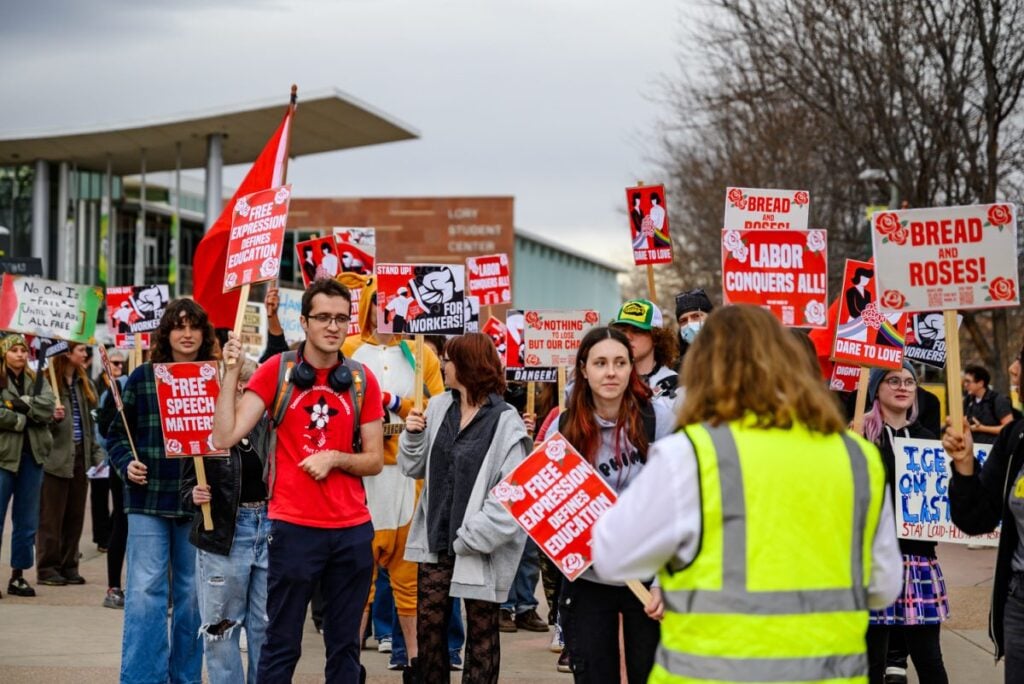
In November 2025, faculty and students at Colorado State University organized a campus-wide gathering in connection with a national “AAUP Day of Action for Higher Education” to rally in support of academic freedom and speak out against legislative and political pressures on higher education. They chose to blend several approaches in their campaign, including organizing a sign-making party, tabling in the Lory Student Center Plaza, leading an outdoor rally with faculty and student speeches, marching through campus, and hosting a free movie screening.
The event remained peaceful and focused throughout, complying with university guidelines, drawing a lot of attendees across the various programs, and generating coverage in the campus newspaper. A well-planned rally can help campus communities show solidarity, elevate their concerns, and engage a broad audience peacefully.
5. Notify
Let your school know the details of when and where you are choosing to lead your protest so they can help ensure safety for everyone involved.
6. Publicize
Get the word out. A large turnout, a media presence, and a crowd of onlookers will bring more attention to your event. Before, during, and after the protest, you may choose to tell your story through social media, media interviews, or written publications.
7. Know Your Rights
Make sure that you and your fellow protesters know your rights so you can properly advocate for yourselves during and after the event. If you choose to engage in acts of civil disobedience, understand the possible consequences.
8. Remain Peaceful
While free speech is protected under the law, violent protest puts you at serious legal and academic risk and can undermine your message. You may face arrest or disciplinary repercussions for engaging in violence or unlawful acts. Staying calm and coordinated will help your message be heard clearly and respectfully.
Example: Students Remaining Peaceful while Protesting
Elgin Community College Students Sustain Peaceful Counterprotests to Oppose Anti-LGBTQ Messaging
In 2017, 2018, and 2019, students at Elgin Community College repeatedly showed how remaining peaceful and nonviolent in their counter-protests can be an effective and principled response to speech they find offensive. Over the course of three years, representatives from Heterosexuals Organized for a Moral Environment (H.O.M.E.), an anti-LGBTQ+ group, visited campus to promote conversion therapy.
While some students and faculty would debate, shout at, or ridicule the representatives, a student group called Students Who Are Not Silent (SWANS) used community building tactics to peacefully demonstrate support for LGBTQ+ people. Their responses included decorating the protest area with rainbow flags, sharing food and music to create an affirming atmosphere, sharing information about LGBTQ+-affirming resources like the Trevor Project, and letting their peers know that they can avoid H.O.M.E. ‘s table if they choose to.
With support from faculty, students also hosted alternate gatherings in an auditorium to provide resources and solidarity for LGBTQ+ students. Across all three years, the students remained peaceful, coordinated, and focused on supporting each other. This is a positive example of how students can successfully channel protests into creative, non-disruptive forms of expression to assert their values without escalating tensions, provoking disciplinary action, or resorting to censorship of opposing viewpoints.
9. Protest
Do it! Speak out on issues that you are passionate about. Be sure to document your protest—gather photos, videos, and evidence of your conduct, so that you have a clear record of events if questions arise later.
If you’re threatened or punished for your role in a campus protest, consider consulting with a lawyer or reaching out to a free expression organization such as the American Civil Liberties Union (ACLU), FIRE or PEN America, who may be able to advise and advocate for you.
Disclaimer: Nothing on this website constitutes, nor should be construed, as legal advice on any matter. All content on the website is for informational purposes only. PEN America is not liable for any errors or omissions in the information and is not liable for any injuries or damages related to the display of the information on this website.
Campus Free Speech Guide
Get principled guidance for how campuses can best remain open to all voices.
-
The Law and Campus Free Speech
-

Hateful Speech and Expression on Campus
-

Speakers and Events on Campus
-

Faculty Speech and Expression
-
Campus Climate
-

Protests on Campus