This is a private event. Please email [email protected] for more information to confirm registration. A livestream of the event will also be available here.
Across continents—from Russia to Iran, from Hungary to Venezuela—journalists have learned to read the early signals of autocracy: the slow normalization of censorship, the weaponization of “national security,” and the gradual erosion of the importance of facts. Many journalists who came to the United States to escape repressive regimes are now seeing familiar signs around them.
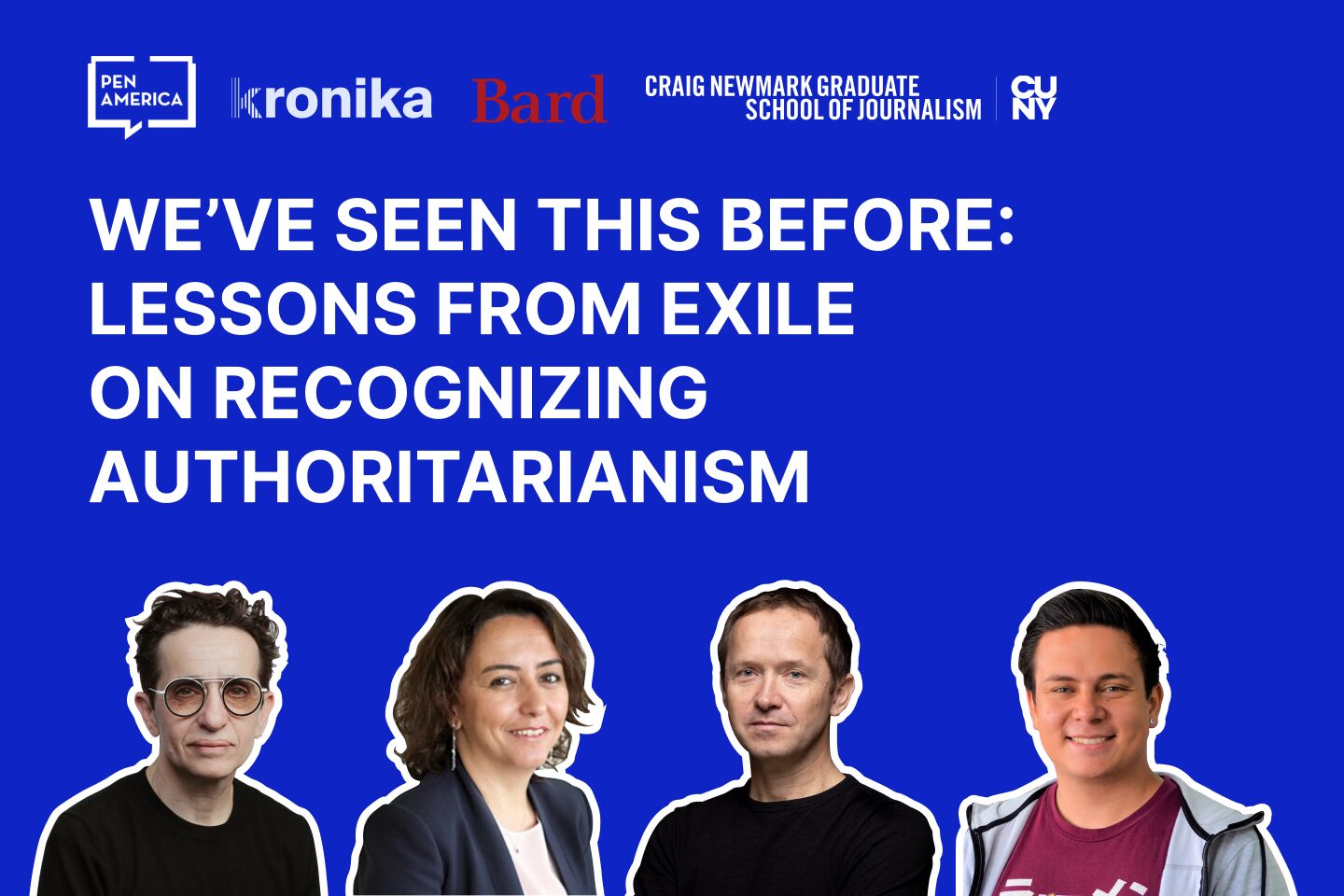
This evening marks the public launch of Kronika, a platform born from the Russian Independent Media Archive (RIMA) and built to safeguard journalism and public memory wherever they are at risk. At the center of the program is a conversation with a founder of the project M. Gessen, András Pethő (Direkt36, Hungary), Ramón Zamora (El Periódico/Central America Independent Media Archive, Guatemala), and Sevgi Akarçeşme (Türkiye, in exile in New York)—journalists and thinkers who witnessed the rise of authoritarian regimes firsthand.
Moderated by PEN America’s Liesl Gerntholtz, managing director of the PEN/Barbey Freedom to Write Center, the conversation will explore the panelists’ experiences as journalists and Kronika as a tool to protect public memory. The event is also a call to connection—inviting journalists in exile and American journalists to work together to track and document the warning signs of autocracy.
We will discuss:
- What can those who have already lived through autocracy teach us about recognizing it before it takes hold here?
- How can exiled journalists and U.S. reporters work together to document, interpret, and resist these warning signs?
- What civic infrastructure—archives, tools, collaborations—do we need so truth remains public?
Kronika—a joint project of Bard College and PEN America—is a civic tech project that builds tools to protect endangered media against state censorship. It grew out of RIMA and is expanding its mission globally: AI-assisted, bilingual archiving; practical tools for newsrooms in exile; and partnerships that keep the public record accessible. Kronika is funded by the Edwin Barbey Charitable Trust.