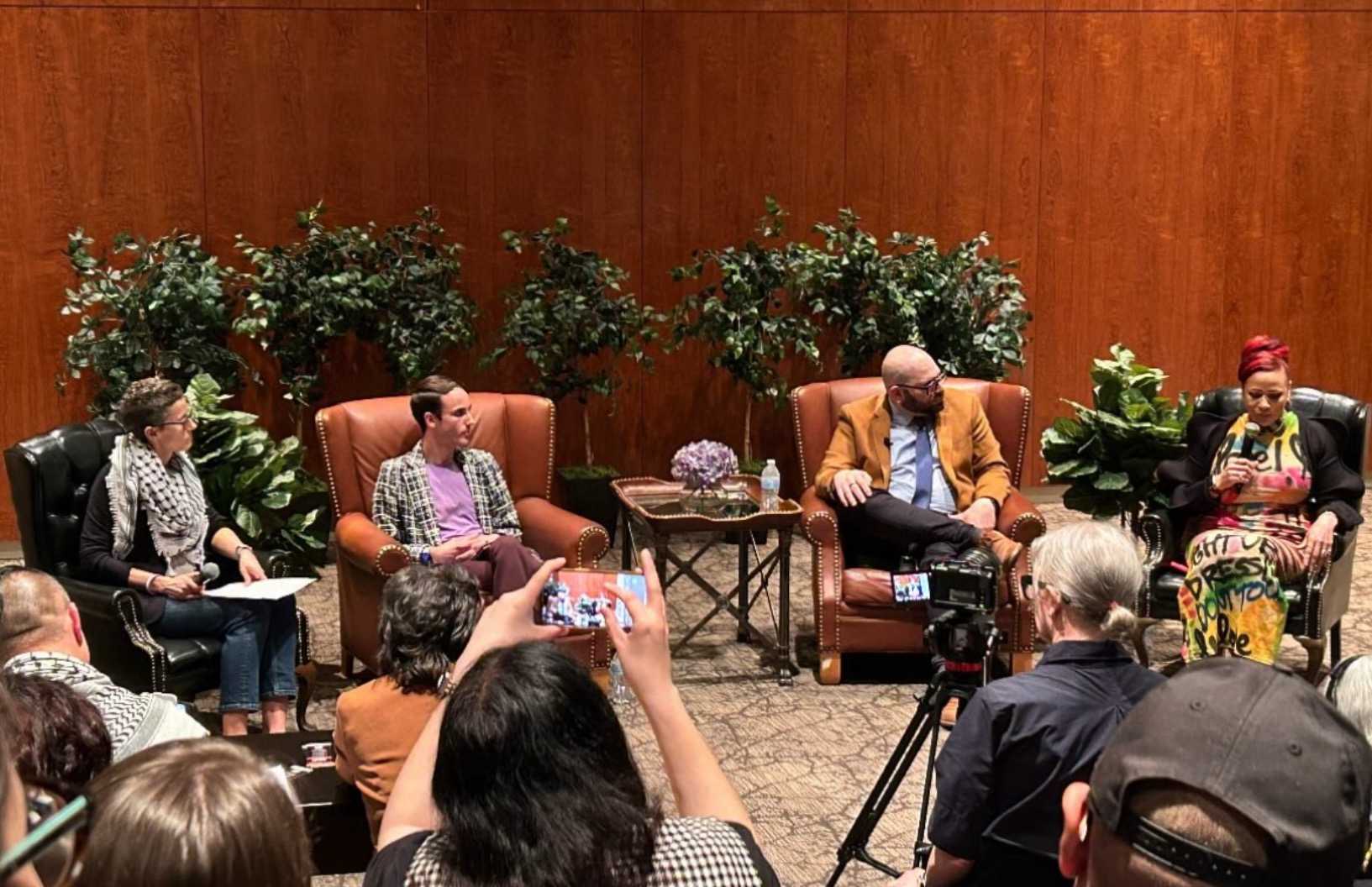
“We do not come to be polite. We come to be truthful,” Dr. César Cruz said in his prayer that began a panel discussion held on March 10 at the University of Texas, Austin. Part of that truth, according to panelist Nikole Hannah-Jones, the creator of The 1619 Project, is that attacks on higher education in Texas and across the nation have “the intent to erode democracy.”
The panel addressed two recent developments at UT Austin: the Board of Regents’ adoption of a policy limiting the teaching of vaguely defined “controversial topics,” and the university’s move to eliminate seven ethnic and gender studies departments, consolidating them into two more general departments. The panel’s two sponsors, the departments of African & African Diaspora Studies and Mexican American & Latina/o Studies, are among those affected.
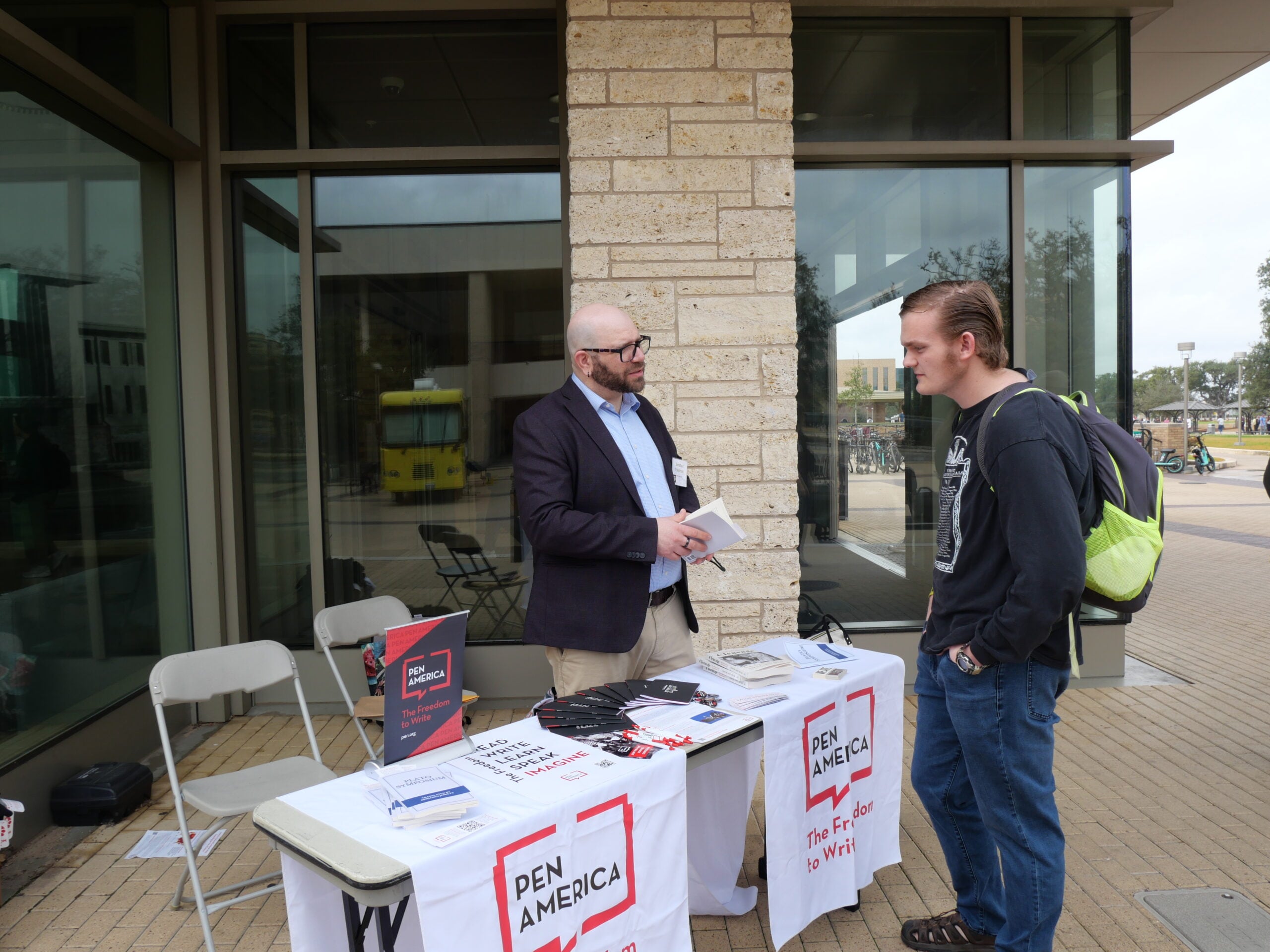
Throughout the evening, each of the panelists — Hannah-Jones, PEN America’s Jonathan Friedman, and Cameron Samuels, a UT Austin student and the executive director of Students Engaged in Advancing Texas, spoke about why the university’s recent moves harm students and pose danger to society as a whole. Lauren Gutterman, associate professor of American and Women’s, Gender, and Sexuality Studies, moderated the panel.
Gutterman began by tying the rash of public school book bans in the U.S. since 2021 to attacks on higher education, naming Texas as “one of the primary battlegrounds in attacks on public K-12 and higher education, from laws resulting in the banning of ‘critical race theory’ and The 1619 Project in K-12 schools, to the end of DEI programs, the weakening of tenure, and the end of shared faculty governance in Texas’s public universities.”
Friedman emphasized this point as he called for greater coalition building and solidarity across education sectors. Friedman reflected on missed opportunities on college campuses where “there are all these people who care about books, but they were not really paying much attention to what was happening in the schools down the street a few years ago, because they’ve been conditioned to pay more attention to their research. … But if you could get faculty to care about book bans, and if you could get teachers and students to care about universities, boy, that’d be an incredible force.”
Friedman explained that the situation at UT Austin can’t be understood in isolation, stating, “This is a widespread effort to put boundaries around how we think and how we talk. … What’s really happening here is nothing short of an effort to exert control over people’s minds.” Hannah-Jones concurred, noting the power of ideas as “actually the most dangerous thing in the world. They’re more powerful than weapons. They’re more powerful than violence… The more that you learn, the more that you challenge power, and you challenge the way things are.”
Hannah-Jones further stressed the anti-democratic nature of this attack on education, pointing to the high numbers of books featuring characters of color and queer characters that are banned in schools. By attacking the most marginalized members of society, bans weaken preexisting coalitions and prevent new ones from forming. “They use inequality, they use marginalization to convince us to allow them to take away our rights, because we’re so worried about someone who we don’t think should have the same rights as us getting theirs,” she said, urging the audience to stand up for trans individuals and marginalized voices. She added, “In an authoritarian country, there are no protections for you, no matter who you are.”
For guidance on how to respond to the present crisis, the panelists urged attendees to look to the past. “Censorship has been here before, and we can learn from our ancestors,” Samuels said, praising historical student leaders including the Student Nonviolent Coordinating Committee and Mary Beth Tinker, known for the 1969 Tinker v. Des Moines Supreme Court case that recognized the First Amendment rights of students in schools.
Samuels began speaking out at local school board meetings in Texas when they were just 17 years old, has testified before the U.S. Senate about the harmful nature of book bans, and, through SEAT, has since galvanized hundreds of other students to advocate for their rights. They highlighted the need “to flip the narrative [that certain books are inappropriate]. … We need to tell our stories just as the farm workers in California did in the 60s, telling stories about what it meant to be undocumented, what it meant to be paid not fair wages, what it meant to live in a country that promises something but is failing that promise.”
Hannah-Jones reminded the crowd that the departments that UT Austin will consolidate “were born of revolutionary times and revolutionary actions.”
“They came from protest. They came from forcing universities to recognize that these were legitimate courses of study,” she said, asking the students in the room to recognize that they must also fight for their right to learn. “Is it going to be on your watch that we lose the things that these revolutionary people fought for and gained? Don’t look to us. The answer is in yourselves.”
Likewise, she urged the professors in the audience not to comply with the university’s censorial policies. “You have to teach the thing they tell you not to teach,” she said. “What are we willing to risk in this moment? It’s not saying, ‘Well, how close can I get to the line before I cross it?’ Cross the fucking line.”
An empty chair accompanied those on stage, in keeping with PEN International tradition to symbolize writers who cannot be present because they are imprisoned, disappeared, threatened or killed. Friedman dedicated the chair to detained Egyptian poet and lyricist Galal El-Behairy, the 2025 PEN/Barbey Freedom to Write Award honoree. El-Behairy has been called “the poet of Egyptian universities,” Friedman explained, and he used his art for peaceful protest on campuses. March 5 marked eight years of his imprisonment for writing the lyrics to a song mocking Egyptian president Abdel Fattah El-Sisi in 2018.
Though the evening highlighted the countless ways that Texas higher education is in a moment of peril, the panelists each emphasized that there’s still hope. Samuels called on the audience “to show up on the front lines of democracy to defend our constitutional rights, because if we don’t, then who will? … Each of you have a special superpower, you have an audience, you have a platform, you have a circle of people, you have a profession, you have some way that you can tie to the way that you show up so that it matters most, not only for other people, but for yourself and for the whole community.” This is how change will happen.
“I am so excited for the victories that are coming in 2026 and 2027 in Texas,” Cruz said. “You will spread hope and joy like wildfire.”