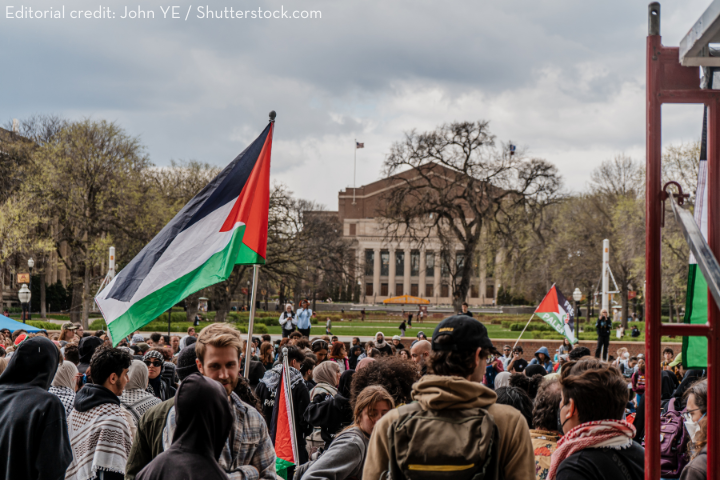

As college campuses grapple with protests, “free speech zones,” where schools limit activities such as pamphleteering or demonstrations to contained areas on campus, may sound like a good thing. And they’ve been back in the news recently, with campuses like the Alamo Colleges District in Texas this fall proposing new rules confining political demonstrations to “free expression zones,” and UCLA’s 2025 protest policy similarly expanding the use of “designated areas for public expression” while tightening restrictions on encampments. These developments show that “free speech zones” are not just relics of the past, but are a re-emerging tool some campuses are embracing when trying to manage protest activity.
But is a free speech zone constitutional? Before we answer that question, let’s go over some background information.
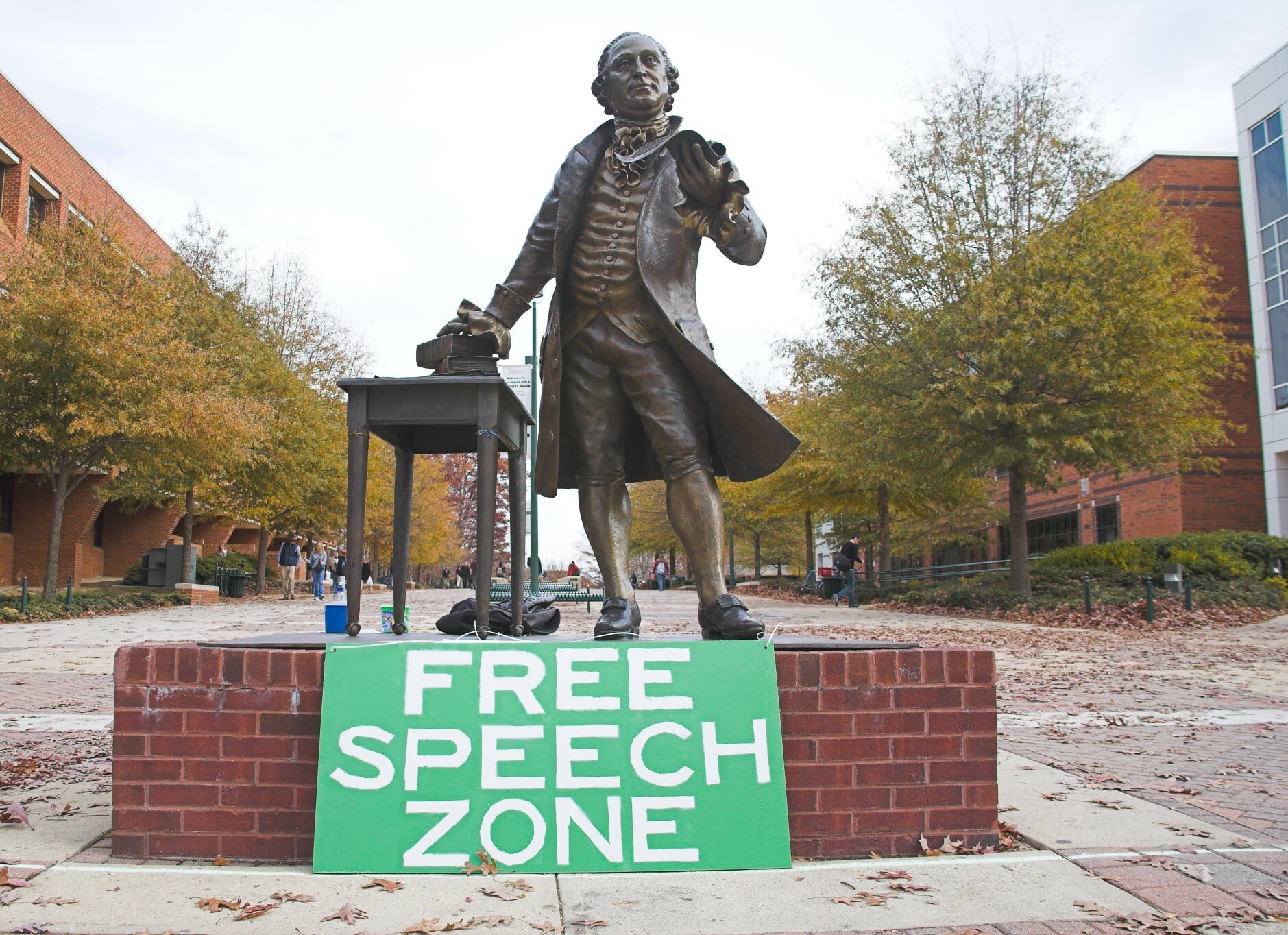
What Is a Free Speech Zone?
A free speech zone is a specially designated area on a campus or in other public places where expressive activities, such as protesting or distributing leaflets, can occur. Because this zone designates a certain area where a person may express their free expression rights, the creation of such a zone falls under the campus’s time, place, and manner policies.
What are Time, Place, and Manner Restrictions?
Universities and colleges can enforce reasonable time, place, and manner restrictions on protests as long as those restrictions do not discriminate against any particular content or viewpoint. They must also be narrowly tailored to serve a significant government interest, and must leave open ample alternative channels for communicating the speakers’ messages.
Why Have Free Speech Zones?
Free speech zones emerged on college campuses in the 1980s and 1990s. The reasoning often used to create the zones has been that they maintain order and safety, and prevent significant disruption to the operations of the institution. On campuses, this can mean students’ ability to access their classrooms, hear their instructor, and study without loud disruption.
However, in a 1981 decision, Widmar v. Vincent, the Supreme Court ruled that public university campuses often have characteristics of public forums–that is, where such universities have created forums generally open to all students, they cannot subsequently deny or limit access to some students without violating the constitution, except in very limited circumstances. They can impose reasonable time, place and manner restrictions, but can never engage in viewpoint discrimination, which restricts specific beliefs, perspectives or ideologies. They can only impose content-based restrictions, which apply more generally to certain subject matter, regardless of the speakers’ perspectives, if such restrictions are narrowly drawn and, serve a significant university interest, like safety or preventing substantial disruption. And finally, universities also must leave open ample alternative channels for students to communicate their messages elsewhere on campus.
What are the Four Types of Forums?
Courts analyze whether a speech restriction is lawful depending upon the type of place you are in:
- Traditional Public Forums: Spaces such as parks, sidewalks and areas that have traditionally been open to political speech and debate. In these areas, speakers enjoy the strongest First Amendment protections and speech can’t be restricted based on content or viewpoint.
- Designated Public Forums: Spaces where the university chooses to allow speech generally. These are treated the same as traditional public forums and speech can’t be restricted based on content or viewpoint.
- Limited Public Forums: Spaces where the university allows certain types of speech by certain groups (e.g, Department of History bulletin board). Restrictions can be based on content (subject matter), but must be viewpoint neutral.
- Nonpublic Forums: Spaces not made available for public expression (e.g., faculty offices). Restrictions on speech can be based on content, but not on viewpoint.
Although a free speech zone may sound like it enhances free speech on campus, in reality it limits the areas where one may engage in their expressive rights to a particular place, thereby restricting expressive rights elsewhere.
Was This ‘Free Speech Zone’ Policy Constitutional?
Pierce College (2016-2018)
In November 2016, Kevin Shaw, a student at Pierce College, a community college in Los Angeles, was barred from passing out copies of the U.S. Constitution on campus because he was not within the school’s designated 600-square-foot “free speech zone.” After filing a lawsuit in March 2017, the Department of Justice supported him in a statement of interest, agreeing that the college’s policies specifying the time, place, and manner for allowable protests were unconstitutional. The case was settled in December 2018, with the Los Angeles Community College District agreeing to abandon the tiny area allotted for students to exercise their right to free speech and ultimately to revoke a policy that declared all land on the district’s nine campuses as nonpublic forums with speech restrictions.
PEN America’s Position on Free Speech Zones
PEN America does not support designating specific areas as exclusive zones for student protest and other expressive activity, since limiting activity to these zones inhibits speech. Their existence allows schools to shut down expression outside those areas, which may violate the First Amendment. These zones also send students the message that free speech is something to be corralled and contained, restricted only to permitted locations.
So, Are Free Speech Zones Constitutional?
Yes, provided that any time, place and manner restrictions applicable to such zones are reasonable and:
- Do not discriminate based on viewpoint or content,
- Are narrowly tailored to serve a significant governmental interest (in the case of campus, for instance, to prevent disruption to learning or for clear safety reasons), and
- Leave ample alternative channels for communicating the speakers’ messages.
Regardless of constitutionality, many free speech organizations, including PEN America, believe that the very notion of a free speech zone chills speech because it limits allowable expression within only certain areas, thereby allowing campus officials to prohibit and punish speech and expressive activities everywhere outside of these zones.
Disclaimer: Nothing on this website constitutes, nor should be construed, as legal advice on any matter. All content on the website is for informational purposes only. PEN America is not liable for any errors or omissions in the information and is not liable for any injuries or damages related to the display of the information on this website.
Campus Free Speech Guide
Get principled guidance for how campuses can best remain open to all voices.
-
The Law and Campus Free Speech
-
Hateful Speech and Expression on Campus
-
Speakers and Events on Campus
-

Faculty Speech and Expression
-

Campus Climate
-
Protests on Campus