
The Law and Campus Free Speech
Federal and state measures impact the rights of students, faculty and staff.
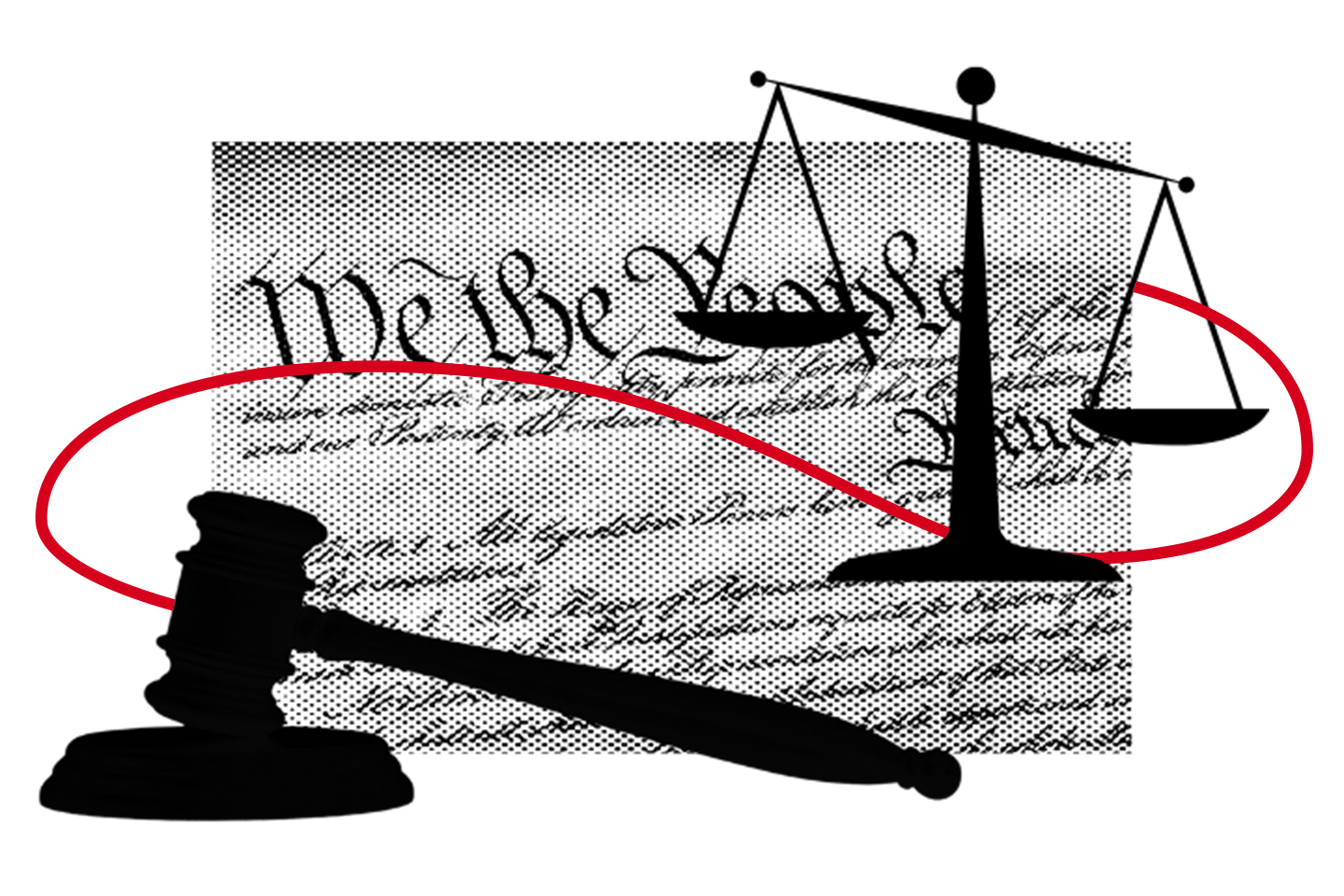
The First Amendment
The First Amendment of the United States Constitution states:
Congress shall make no law respecting an establishment of religion, or prohibiting the free exercise thereof; or abridging the freedom of speech, or of the press; or the right of the people peaceably to assemble, and to petition the Government for a redress of grievances.
Under the First Amendment, people have the right to create, publish, convey, and receive information; to express their views; to speak freely, and to be free from government retaliation for their expression.
These fundamental rights extend to all individuals in the United States, regardless of their religion, gender, race, citizenship, or sexual orientation. The First Amendment also protects public and private entities, in addition to individuals, from retaliation or censorship from the government. But it’s important to remember that the First Amendment protects only against government interference and not against private censorship.
Although free speech has long been recognized as an essential right and value in the United States, its protection from government interference is not absolute. Time, place, and manner restrictions may be placed on the exercise of expression–as long as those limitations do not discriminate against any particular content or viewpoint. Content-based restrictions limit speech based on its subject matter, while viewpoint-based restrictions limit speech based on ideology and perspective. Moreover, some very limited types of speech are not constitutionally protected at all, for example:
- Incitement to imminent violence or unlawful action: The Supreme Court in Brandenburg v. Ohio (1969) held that the government may only forbid advocacy of lawbreaking when it is “directed to inciting or producing imminent lawless action and is likely to incite or produce such action.”
- “True threats”: In Virginia v. Black (2003), the Court defined true threats as statements “communicat[ing] a serious expression of an intent to commit an act of unlawful violence to a particular individual or group of individuals.” In Counterman v. Colorado (2023), the Court clarified that the speaker does not need to have intended to threaten the recipient if they “consciously disregarded a substantial and unjustifiable risk that [their] conduct will cause harm to another” (i.e. if the threat was made recklessly).
- Obscenity: The Court’s three-part Miller v. California (1973) test says material is obscene if: “(a) the average person, applying contemporary community standards, would find that the work, taken as a whole, appeals to the prurient interest; (b) the work depicts or describes, in a patently offensive way, sexual conduct specifically defined by state law; and (c) the work, taken as a whole, lacks serious literary, artistic, political, or scientific value.”
- Defamation: Defamation consists of “false statements of fact that damage an individual’s reputation.” There are two categories of defamation: libel, which applies to written defamation, and slander, which applies to oral defamation. In New York Times v. Sullivan (1964), the Supreme Court held that a finding of libel against public officials and public figures requires “actual malice” (i.e. must have been published with reckless disregard to its truth). In Gertz v. Robert Welch, Inc. (1974), the Court established that the standard for defamation claims brought by private figures is negligence, which is lower than the “actual malice” standard established in Sullivan.
Other types of expression may be regulated or subject to legal consequences, such as that constituting discriminatory harassment or other forms of prohibited employment discrimination within a workplace.
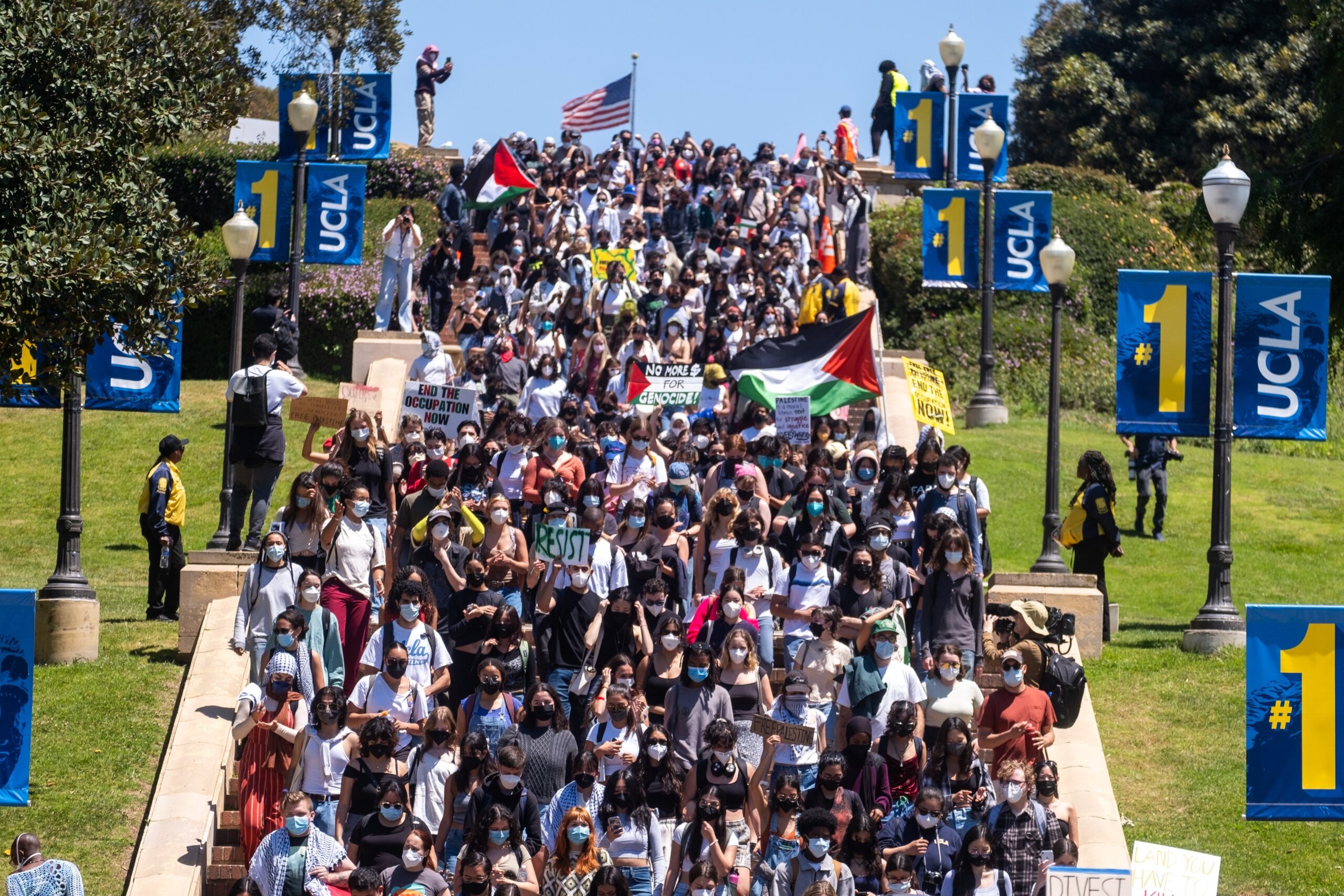
The First Amendment protects the right to assemble and express views through protest. That protection applies to protests at public universities and colleges, although, as noted above, administration and other government officials can place reasonable and narrowly-tailored time, place and manner restrictions on those rights and those restrictions must be content- and viewpoint-neutral.
While not required to do so by the Constitution, the majority of private universities and colleges also provide their students the right to free speech and protest.
It is important to note that free speech protections do not protect conduct that is otherwise unlawful, even if such actions are engaged in to communicate a message. For example, there is no First Amendment protection for vandalism, such as graffiti that defaces property without the owner’s permission, or destruction of property. Other conduct, such as blocking the movement of other people and protesting in a manner that substantially disrupts classes or other campus events, depending upon the context, are likely to be subject to restrictions or outright prohibitions and may not be protected by the First Amendment (or in the case of private universities, by similar free speech policies and principles).
Physical encampments, such as those involving tents for ongoing protest, are subject to time, place, and manner restrictions, and policies can be put in place that prohibit encampments without violating the First Amendment or other free speech rights. However, like all such restrictions, these policies must be content- and viewpoint-neutral. Policies that are content- and viewpoint-neutral on their face may still be unconstitutional if they are intended to suppress a particular viewpoint or if they are selectively enforced.
In addition to federal (and often state) constitutional protections, which are interpreted in case law set forth in court decisions, there are other federal and state statutes that bear on free expression. Two federal civil rights statutes are particularly relevant to campuses: Title VI of the Civil Rights Act of 1964 and Title IX of the Education Amendments of 1972. Title VI prohibits discrimination based on race, color, or national origin by institutions, including colleges and universities that receive federal funding, and Title IX prohibits discrimination based on sex in education programs and activities that receive federal funding. These laws can limit–and even penalize–certain types of expressive activity. Balancing free expression rights and legal prohibitions on certain types of discrimination can pose challenges to university administrations.
Public and Private Universities
Colleges and universities are held to different legal standards with regard to free expression rights depending on whether they are public or private. Public universities are governed by the First Amendment because they are deemed to be government actors, though they still may impose what are known as time, place, and manner restrictions on the exercise of those rights by students and others on campuses.
A public university may impose such restrictions on protest rights, for example, as long as the restrictions are reasonable and content- and viewpoint-neutral, are in the interest of preventing significant disruption or safety risks, and leave open other means of communication. A state university or college policy or enforcement action that regulates speech is presumptively unconstitutional unless the university can show that the particular policy, and how it is enforced, are viewpoint-neutral and narrowly tailored to achieve a compelling government interest.
When regulating speech, the context and venue in which the expression occurs can be an important factor—different guidelines or rules may apply to expressive activity in a classroom, versus in public areas, versus in student dormitories, and so forth, and that context will be relevant to understanding whether a given restriction or its means of enforcement is constitutional. Speech and assembly rights are usually broader in public spaces, often including sidewalks and campus quads, which have been considered traditional public forums.
Because private universities are not government entities, they are not bound by the First Amendment. This means that private institutions may impose stricter limitations on free expression. Still, most adhere to free speech principles similar to those mandated by the First Amendment because free speech is inherent to their mission. They enforce these principles through the rules, policies and procedures that they establish. Private institutions that receive federal funding must also adhere to federal anti-discrimination laws, such as Title VI and IX.
State governments may also pass statutes requiring private universities to protect free speech rights as a matter of state law, even when the US Constitution imposes no such requirement. For example, California’s Leonard Law means that private universities must adhere to the same protections as those afforded by the First Amendment. Congress also has the power to enact federal laws, such as anti-discrimination laws, that in some contexts can effectively restrict speech rights.
Campus Policies
In an effort to balance the value of absolute free speech and the value of providing a safe and supportive community for all students, some colleges and universities have adopted policies that regulate speech deemed hateful or offensive. Public institutions, however, must be sure that such policies do not contravene the First Amendment, which protects almost all speech from government censorship–even that which might be deemed hateful.
Private colleges and universities are able to impose greater restrictions on speech. However, they must uphold their stated mission, policies, and rules through their practices. Since these vary across states and institutions, students seeking to understand their expressive rights should review their institution’s free expression statements and relevant campus policies.
The limitations that both public and private campuses can impose on expressive freedoms are called time, place, and manner restrictions. These include limits on noise level or the number of protesters allowed in a public space, prohibitions against encampments or against blocking entrances to buildings, limits on making it difficult for other groups to use certain spaces intended for all students, and bans on early morning or late night protests. Under First Amendment analysis, these limitations must adhere to the following:
- Leave ample alternative channels open for communicating the restricted message
- Remain content- and viewpoint-neutral–content-based restrictions limit speech based on its subject matter, while viewpoint-based restrictions limit speech based on ideology and perspective
- Be narrowly tailored to achieve a compelling government interest. This means that the law or regulation must use the “least restrictive means” possible to achieve any such compelling government interest.
While private campuses do not have the same obligation under the law, PEN America recommends that they adhere to the same level of protection for speech that the First Amendment requires and that they ensure that their policies allow the campus to remain open to a broad range of diverse ideas and perspectives.
Federal Statutes
Beyond the constitutional protections of the First Amendment and private university commitments to free speech, the two most significant federal laws with impacts on free expression in higher education are Title VI and Title IX. As noted above, the former forbids discrimination on the basis of race, color, and national origin where federal funding is received, and the latter prohibits discrimination based on sex in educational programs and activities that receive federal funding.
The Office of Civil Rights in the Department of Education previously stated that these statutes and their implementing guidance and regulations are “not intended to restrict the exercise of expressive activities protected under the U.S. Constitution.” Rather, they apply in the context of discrimination, including harassment based on a protected characteristic–such as a person’s race, national origin, religion, sex, age, or disability. The offensiveness of speech alone is not sufficient to establish the existence of a hostile environment that violates the law. A hostile environment can be created when the harassment targets an individual or group bearing the protected characteristic and is “severe, persistent, or pervasive” and “sufficiently serious to deny or limit a student’s ability to participate in or benefit from an educational program.” Federal and state statutes also exist that criminalize certain kinds of harassment, if the harassment is of a recurring, invasive, violent, or abusive nature. Schools are obligated to take action against discrimination, including to remediate a hostile environment, based on the protected characteristics set forth in relevant law.
Title VI
Title VI of the Civil Rights Act of 1964 states:
No person in the United States shall, on the ground of race, color, or national origin, be excluded from participation in, be denied the benefits of, or be subjected to discrimination under any program or activity receiving Federal financial assistance.
This applies to both public institutions and to private institutions that receive federal funds.
Although Title VI does not protect against discrimination on the basis of religion, it has been interpreted to cover situations–for example, involving Jews, Muslims, Hindus, Christians, Buddhists, Sikhs, or other religious groups–when religious discrimination overlaps with discrimination on the basis of race, national origin, shared ancestry, or ethnic characteristics. Title VI thus applies to harassment or other forms of discrimination based on actual or perceived (1) shared ancestry or ethnic characteristics or (2) citizenship or residency in a country with a dominant religion or distinct religious identity. On Dec. 11, 2019, President Donald Trump issued an executive order that focused on applying Title VI to cases of antisemitism on college campuses and mandated consideration of a non-legally binding definition of antisemitism that includes, as examples, instances where the State of Israel is targeted in certain ways. In January 2025, President Trump issued an order reaffirming the 2019 Executive Order, and including additional measures for fighting antisemitism on campus. These orders have been the source of controversy, giving rise to disagreement over whether and when criticism of the State of Israel should be considered antisemitism.”
Title IX
Title IX of the Education Amendments Act of 1972 states:
No person in the United States shall, on the basis of sex, be excluded from participation in, be denied the benefits of, or be subjected to discrimination under any education program or activity receiving Federal financial assistance.
This applies to both public and private institutions that receive federal funds. Title IX’s impact on speech has been contentious, with some arguing that its implementation goes too far in its definition of sexual harassment and as a result has a chilling effect on speech, and others arguing that it does not go far enough to protect people from sexual harassment.
Changes have been made in policies interpreting Title IX under successive administrations. During President Trump’s first term, his administration narrowed the definition of sexual harassment under Title IX from the one used in the Obama administration. In 2024, President Joe Biden’s administration made changes that were designed to “significantly alter how colleges and universities respond to reports of sexual harassment and assault and expand protections for LGBTQ+ and pregnant students.” These changes were struck down under the second Trump presidency in early 2025 in a “Dear Colleague” letter that stated that campuses should return to the 2020 guidance and uphold the executive order issued by the administration on day one of the second Trump presidency that states there are “only two sexes, male and female.” Higher education administrators must negotiate these challenges and changing interpretations and their implications on free expression.
Hateful Language and Offensive Speech
There is no legal definition of hate speech in the United States, nor in international human rights law, which prohibits “incitement to discrimination, hostility or violence.” While many countries have legal restrictions on certain types of hateful speech, others with strong legal protections for free speech similar to the U.S. First Amendment typically do not. In the United States, hateful language and offensive speech are protected from government interference under the First Amendment. The U.S. Supreme Court has consistently ruled that such speech enjoys constitutional protection unless it incites imminent violence or unlawful action, or constitutes “true threats” against individuals.
It is important to distinguish between hate crimes and hateful speech. There are various federal and state-level hate crime statutes. For the purposes of data collection, the FBI defines a hate crime as a “criminal offense against a person or property motivated in whole or in part by an offender’s bias against a race, religion, disability, sexual orientation, ethnicity, gender, or gender identity.” As the FBI describes the concept: “a hate crime is a traditional offense like murder, arson, or vandalism with an added element of bias… Hate itself is not a crime.” In such cases, however, speech may be used as evidence of bias. State-level hate crime statutes are typically “penalty enhancement” statutes that increase the punishment for a defendant if the target of a hate crime is intentionally selected because of a victim’s protected characteristics.
Protest and Assembly
The First Amendment protects the right to assemble and express views through peaceful protest against government interference. Counter-protests are similarly protected. Those protections are strongest when protests occur in what is known as traditional public fora, such as a street, plaza, sidewalk or park, as long as entrances and exits are not blocked and other purposes for which those spaces are used are not interfered with. However, if expression veers into discriminatory harassment or assault, it is not protected.
College and university administrators have legal obligations to protect students from discrimination and they are responsible for maintaining order on campus. However, in meeting these legal obligations, they can not restrict or shut down speech simply because they do not like or agree with the speech. Even speech that may be offensive may not meet the bar for discriminatory harassment. Balancing the First Amendment right to protest and legal prohibitions on discrimination can pose challenges to university administrations. But even when lawfully seeking to shut down a protest, administrators should not use disproportionate force.
At public colleges and universities, the First Amendment’s protection of peaceful assembly and protest from government interference gives students and faculty a constitutional right to engage in debate and protest and to express themselves on campus. While administrators and staff also have First Amendment rights, there may be limitations on their expressive activities while they are acting in their capacity as employees of the university. In Garcetti v. Cabellos (2006) the Supreme Court determined that public employees, when making statements “pursuant to their official duties, they are not speaking as citizens for First Amendment purposes, and the Constitution does not insulate their communications from employer discipline.” At the same time, they do not lose all of their rights to free speech; instead, what is known as the Pickering-Connick test may be used to determine if the speech in question is protected by the First Amendment. The name is drawn from two free speech decisions from the U.S. Supreme Court: Pickering v. Board of Education (1968) and Connick v. Myers (1983). The test first looks to see if the employee is speaking on a matter of public concern; if so, the “balancing test” then looks to weigh the employee’s right to free speech against the employer’s interests in an efficient, disruptive-free workplace. Ultimately, it is important that university employees understand their institution’s policies when it comes to their expressive rights.
Public universities are bound by the First Amendment’s protection of free speech since they are state (and in some cases federal) institutions. When responding to student activism, they must not single out particular viewpoints for restriction, discipline, or disproportionate penalties.
Private universities, meanwhile, are not bound by the First Amendment. This means that private institutions may impose stricter limitations on protests. Still, most adhere to free speech principles similar to those mandated by the First Amendment through institutional rules, policies, and procedures.
Time, Place, and Manner Restrictions
Whether subject to the First Amendment or similar free speech policies set by private institutions, universities and colleges can enforce reasonable time, place, and manner restrictions on protests as long as those restrictions do not discriminate against any particular content or viewpoint. They must also be narrowly tailored to serve a significant government interest, and must leave open ample alternative channels for communicating the speakers’ messages.
Examples of these time, place and manner restrictions are:
- Barring protests late at night or early in the morning
- Limiting certain spaces, such as classrooms, from any kind of protest activity
- Setting noise level caps on expressive activities
- Designating certain areas as off-limits for postering
- Banning encampments from campus
Civil Disobedience
Civil disobedience is a form of nonviolent protest that involves willfully and knowingly violating certain laws. While it is not protected under the First Amendment, civil disobedience has a rich history in the United States as a powerful tactic used to great effect by abolitionists, suffragettes, the Civil Rights Movement, anti-war protestors, AIDS activists, and many other important social and political movements. By definition, civil disobedience involves illegal conduct, so individuals participating in it should thoroughly understand the potential consequences of their actions and be prepared to accept them. It is important to note that even peaceful protests that break law or policies can be subject to punishment.
Typical forms of civil disobedience involve intentionally flouting a law or regulation that the protester believes is unjust or intentionally violating time, place, and manner restrictions. When protesters violate campus rules and regulations, the university may discipline them according to institutional policies and procedures. Protesters who violate local, state, or federal law may face legal consequences, including but not limited to arrest, fines, and criminal charges. Campus administrators may determine appropriate consequences for breaches of campus policies; however, they must act within the scope of their policies, apply them consistently irrespective of the viewpoint of the protestors, and not yield to outside pressure in determining punishment for students. If campus policies are broken during protests, administrators may retain discretion to respond appropriately.
Campus Free Speech Guide
Get principled guidance for how campuses can best remain open to all voices.
-
The Law and Campus Free Speech
-
Hateful Speech and Expression on Campus
-
Speakers and Events on Campus
-
Faculty Speech and Expression
-
Campus Climate
-
Protests on Campus
-
PEN America’s Campus Free Speech Principles
Acknowledgements
PEN America is grateful to the thousands of students, faculty, and administrators who have engaged with us over many years, and especially to those who offered detailed and substantive feedback on earlier versions of this site.
The Campus Free Speech Guide was made possible by the generous support of our funders.



Disclaimer: Nothing on this website constitutes, nor should be construed, as legal advice on any matter. All content on the website is for informational purposes only. PEN America is not liable for any errors or omissions in the information and is not liable for any injuries or damages related to the display of the information on this website.