
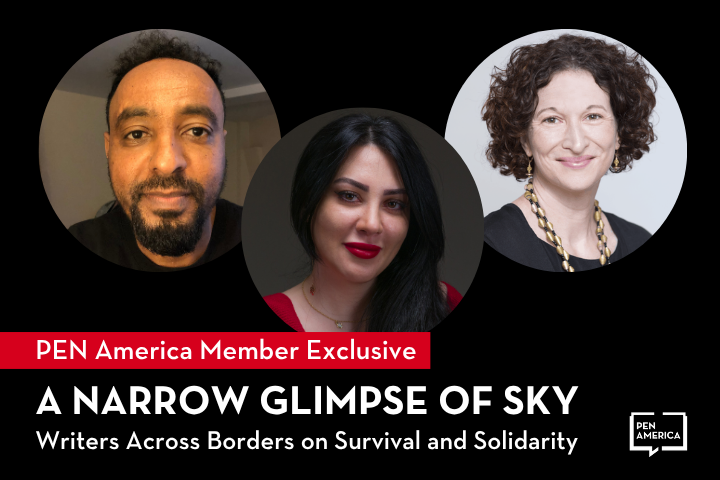
Writers are vessels of public memory: a mirror for the societies they represent, and a portal of understanding for outsiders and generations to come. Around the world and throughout history, governments have seen writers as a threat, interrogating the conveniently-expunged and state-sanctioned versions of “history,” “fact,” and “truth.” That’s precisely why governments around the world are going to extreme lengths to silence and jail writers. Join PEN America for a conversation with two writers, Awet Fissehaye and Behnaz Amani, who know what it’s like to be arrested for words, and why solidarity is the first step to guaranteeing the freedom to write for all.
Awet Fissehaye is a British-Eritrean poet, writer, and lyricist. He started to write poetry at an early age before studying English at the University of Asmara-Eritrea. Awet’s poems and articles have appeared in his native language on different Eritrean media platforms and he was the first recipient of the National Poetry Prize for Students in 2000. In 2007, he was arrested by Eritrean government security forces, tortured and kept in inhumane conditions for 14 months. In 2014, Awet left Eritrea for Sudan before continuing toward Europe through the Sahara Deseret and the Mediterranean Sea. Awet is an Honorary Member of English PEN and in 2022 he became Executive Director of PEN Eritrea in Exile. He has lived in exile in the United Kingdom since 2016.
Dr. Behnaz Amani is an Iranian writer, scholar, university lecturer, and human rights advocate. She holds a PhD in English Literature and is currently a PEN Germany Writers-in-Exile Fellow. Amani was arrested and imprisoned in Iran during the Woman, Life, Freedom movement after publicly supporting detained students and speaking out against state repression. Following her release, she was dismissed from her university position and prevented from continuing her academic career in Iran. Since relocating to Germany, she has continued her work as a writer, public speaker, and advocate for freedom of expression, academic freedom, and women’s rights. Her work focuses on the intersections of power, citizenship, authoritarianism, and human dignity.