Conversations on the Quad | Kaden Ouimet, Frontline for Freedom
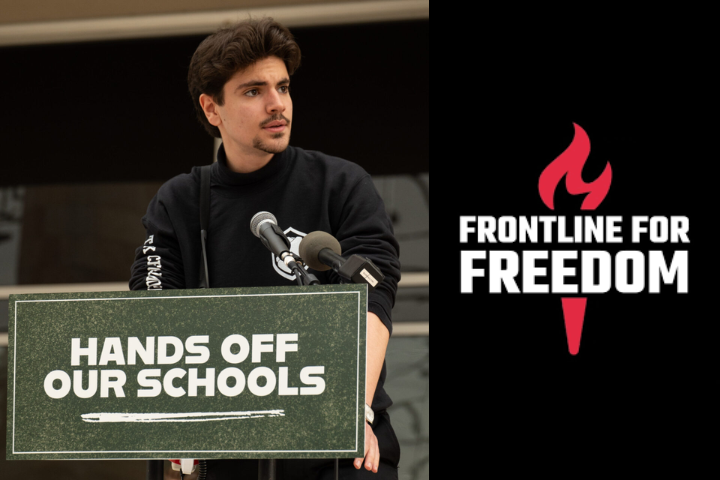
Students often bear the brunt of the attacks on campus free expression coming from states and the federal government. From crackdowns on protests and recent attempts to control research to physical threats to student safety, especially international students’ safety, student organizers are fighting an uphill battle. But for Kaden Ouimet, a student organizer on a gap year from American University, the fight to defend students’ rights on campus is just getting started.
“Students are uniquely poised to respond and to organize in times of repression,” Ouimet explained. By organizing students at both the high school and college level, he and his colleagues are building a nationwide movement to push back against what they see as authoritarian threats to democracy and students’ rights.
Ouimet wears many hats, as an organizer with Public Citizen and cofounder of the Task Force for Democracy, which launched in 2021. He is also one of the founding members of the student network Frontline for Freedom, which was started last year in response to targeted federal attacks on universities. As the Trump Administration sought to coerce colleges and universities to comply with ideological diktats – a topic we explore in PEN America’s 2025 report on higher education censorship – students with Frontline for Freedom were taking notice.
“We realized we had to train, mobilize, and organize to resist these attacks on our rights on our campuses and in our communities,” Ouimet explained. Last summer, Ouimet and his colleagues concluded that they needed a “unified student response to these attacks” and so began, along with organizational partners, to organize for May Day 2026. The goal was to test their organizing structure in preparation for future action on May Day 2028. Students Rise Up was born out of this coalition, to link together efforts across student and faculty organizing.
As the coalition planned for May Day, Trump released the Compact for Academic Excellence in Higher Education, a coercive move to pressure nine universities to support the president’s key priorities in exchange for access to federal benefits (such as funding). Frontline for Freedom and Students Rise Up jumped into action, organizing with campus partners to urge the initial nine universities to reject what the AAUP called a “loyalty oath.”
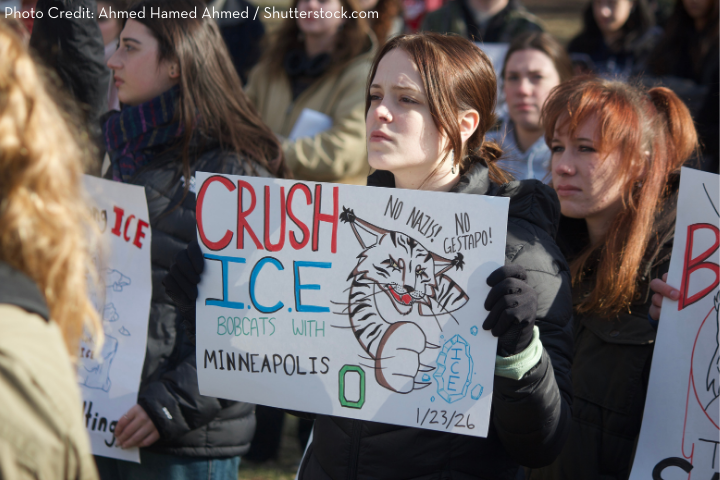
Partly in response to their organizing and a broad public outcry, seven universities did reject the Compact in the first two weeks after it was sent. In November, Frontline for Freedom and Students Rise Up organized a national day of action that included over 115 teach-ins, rallies, marches and other protests to make opposition to the Compact more visible. By late November, other colleges, such as UNC Chapel Hill and the University of Kansas, announced that they, too, would not sign the Compact. Finally, May Day 2026 saw tens of thousands of students participate in protests against federal attacks on higher education and to end ICE presence on campuses.
“Over 100,000 students rose up or walked out,” Ouimet told me.
Recent attacks on free expression and academic freedom on campuses have taken a toll on student activists, and it can be easy to lose hope. “We are [also] facing a much greater level of fear and surveillance than I think previous generations of students have faced on campus,” Ouimet explained.
For example, after the Trump administration set its sights on Columbia University in early 2025, some of the school’s top organizers and student leaders were “expelled, detained or deported by ICE, suspended, arrested, or had their degrees revoked.” That served as a warning shot for student leaders on other campuses. When the free expression of student advocates is squelched, you should expect to see less action on front pages.
But, Ouimet emphasizes, organizing is still humming along. If student organizers are driven off-campus, they may be regrouping at nearby churches, synagogues, mosques, “where those places of worship are giving sanctuary to the students.” And despite these unrelenting attacks on free expression and organizing, Ouimet points to the days of action on May Day and last November, as proof that students are still showing up “in record numbers.”
When asked what advice he would give young student organizers, Ouimet had poignant words of encouragement, explaining that “you are a part of a story, a chapter in a story of students who have had the power to take on systemic barriers and win.”
“Organize to win the future you deserve.”
For students in and around DC, Frontline for Freedom is organizing advocacy events this summer, including an organizing bootcamp on July 11. If you are not in DC, they are continuing to organize virtual events to continue to build a nationwide movement. For more information, get connected at the Frontline for Freedom webpage.