The day after the 2016 presidential election, Wade Hudson learned that his grandniece was so devastated by the news that she wouldn’t leave her room. “She was afraid of the future,” Wade said. “I started thinking, ‘I’m sure there’s a lot of other youngsters who are thinking that way too. What could we do to reach them and to let them know that they aren’t alone?’”
Wade and his wife Cheryl Hudson, both writers as well as the co-founders of the Black-interest publishing company Just Us Books, soon came up with an answer: They would compile an anthology featuring answers to the question “In this divisive world, what shall we tell our children?” Authors and illustrators of children’s literature were more than eager to participate, so much so that Cheryl and Wade had to begin turning down creators after reaching 50 submissions.
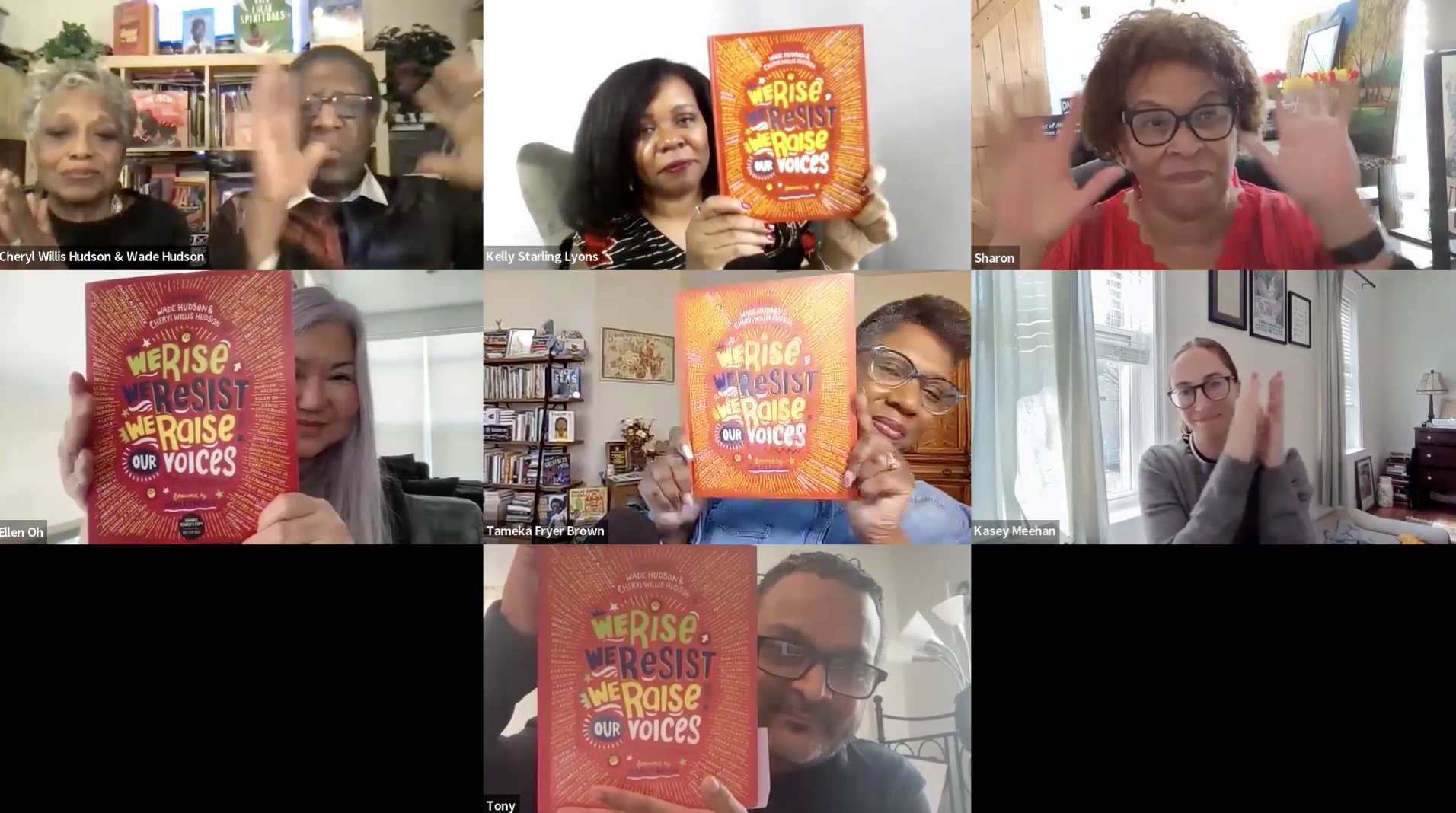
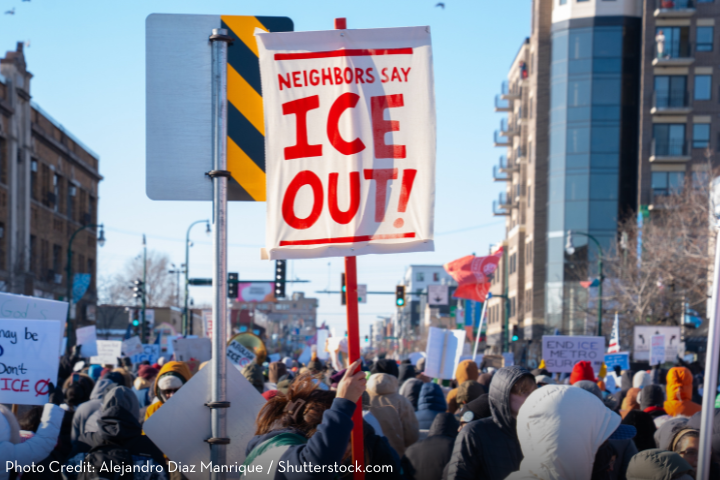
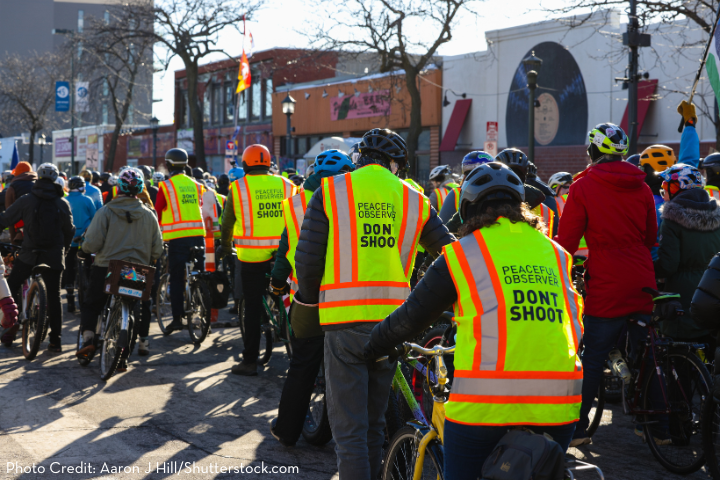
Now, eight years after the publication of We Rise, We Resist, We Raise Our Voices, in the wake of ICE raids and the protests that have followed, its messages still ring true. PEN America gathered the Hudsons and eight anthology contributors — Ellen Oh, Jacqueline Woodson, Kelly Starling Lyons, Tony Medina, Tameka Fryer Brown, Sharon G. Flake, Sharon Draper, and Rita Williams-Garcia — for a virtual event in which they took turns reading to and lifting up the spirits of students in Minneapolis and Saint Paul.
Ahead of the event, the Saint Paul bookstore Red Balloon and the educational nonprofit AMAZEworks distributed more than 600 copies of We Rise, We Resist, We Raise Our Voices, donated by Penguin Random House, to students and libraries in the Twin Cities.
“The goal here is to offer messages of hope and resilience when we find ourselves yet again in some challenging and troubling times,” said Kasey Meehan, director of Freedom to Read at PEN America, who moderated the event alongside the Hudsons. “We hope that we all can walk away from here feeling a little bit more uplifted and inspired and connected.”
Wade began by reading aloud his poem, What Shall We Tell You?, the first piece written for the anthology: “What shall we tell you when our world sometimes seems dark and uninviting? What shall we tell you when hateful words that wound and bully are thrown like bricks against a wall, shattering into debris? … We shall tell you that because we will be there for you, always be there for you, it will be all right.”
Cheryl said that adults should always respond to the question “What shall we tell you?” with the answer “Our stories.” But stories can of course be conveyed in any number of ways, she added, and on the day of the readings she felt drawn to a song: the traditional spiritual Get on Board Little Children. “The gospel train is a-coming,” Cheryl sang. “The fare is cheap, and all can go. The rich and poor are there. No second class aboard this train, no difference in the fare. Get on board, little children, get on board.”
Following the Hudsons’ recitations, Lyons spoke to the students, telling them that she and the other authors understood their heavy feelings and were in their corner. She then read from her poem Drumbeat for Change: “What do we do with the worry, the hurt, the rage? We turn it into something bigger than us. We turn it into change. … The drumbeat of hope will always drown out howls of hate. Can you hear it? Can you feel it?”
After her reading, Lyons asked students to repeat the phrase “I matter” along with her, asking that they say it from their hearts. “I am in awe of all you are and will be,” she told them. “When you feel angry or afraid, remember what you hold inside: kindness, courage, compassion, the power of people who made a way out of no way.”
Woodson later read from her National Book Award-winning memoir, Brown Girl Dreaming, which chronicles her journey of finding her voice as a writer. She recited the first poem, February 12, 1963, which is about the day of her birth: “I am born on a Tuesday at University Hospital, Columbus, Ohio, U.S.A., a country caught between Black and white. … The people who look like me keep fighting and marching and getting killed, so that today, February 12, 1963, and every day from this moment on, brown children like me can grow up free and grow up learning and voting and walking and riding wherever we want.”
The resistance described in her poem is once again necessary today, Woodson said, especially as book bans continue to soar. “They’re trying to get our stories out of your classrooms, out of your libraries, out of your home. And the resistance, of course, is to keep telling our stories.”
Flake then shared a story from a time when she had returned to her hometown, Philadelphia, and noticed that some of the kids in her neighborhood were wandering the block, seemingly bored, and growing progressively louder. Flake distributed books to them, and they all scattered.
“The next day, I had parents coming from everywhere: when I went to the corner store, when I went around the block to walk. And they were saying, ‘Are you that lady that gave our kids those books? My son can’t put them down. My daughter’s been reading all night,’” she said. “I know that books can change lives, but I also wanted them to know that I was thinking about them. I wasn’t just trying to occupy their time. I wanted them to know that they’re on the minds of adults.”
She read excerpts from her piece When I Think of You, inspired by that same message: “How are you, my love? … I see you draped in confidence, walking like you own the world, looking fine, skateboarding, protesting injustice, helping your friends. My heart sings at the thought of what is possible here on earth simply because you exist.”
To close out the event, Cheryl and Wade joined together in a chant: “And remember: We rise, we resist, and we raise our voices. Like the people of Minnesota, we all can make a difference.”