Just in time for the nation’s 250th birthday, its history is being erased.
National Parks workers in late January removed a series of informational displays from The President’s House on Independence Mall, next to the Liberty Bell Center in Philadelphia. But this wasn’t just any update to the location commemorating where George Washington and John Adams lived during their terms in the early days of the republic.
The panels taken down detailed the lives of the nine enslaved Africans who resided in the household while Washington was president, including two who escaped. They detailed the archeological history of the site and included panels that described “The House and the People Who Worked and Lived in It,” “Systems and Methods of Slavery,” “Life Under Slavery,” and “The Dirty Business of Slavery,” along with details on how some enslaved people became free.
The Trump administration determined the history lesson was “disparaging” to the republic.
The exhibit opened in December 2010, after years of development by the City of Philadelphia, community activists, and the National Park Service. In response to the panel removals, Philadelphia filed suit against the Interior Department and the National Park Service on Jan. 23, maintaining that its role in creating the site included a voice in removing any materials, which it was not offered before the displays were taken down. A federal judge ruled that the panels should be immediately restored, but only some of the 34 panels were put back up before the Trump administration won a stay from another judge after appealing the ruling.
The legal fight in the Philadelphia case continues. But the removals were just a part of President Donald Trump’s campaign to purge materials from cultural institutions nationwide that conflict with his vision of the country. The action follows an Orwellian executive order issued in March 2025 with the title, “Restoring Truth and Sanity to American History,” which claims that recognizing the darker side of history replaces “objective facts” with “a distorted narrative driven by ideology rather than truth.”
At the time, the executive order mostly got attention for its attack on the Smithsonian Institution, but it also called for the Interior Department to take action “to ensure that all public monuments, memorials, statues, markers, or similar properties within the Department of the Interior’s jurisdiction do not contain descriptions, depictions, or other content that inappropriately disparage Americans past or living.”
Trump took direct aim at Independence National Historical Park in that executive order, ironically criticizing diversity training done at the site “where our National declared that all men are created equal.”
Now, the true stories of the nine enslaved people who lived with Washington in Philadelphia while he was in office are held in suspension while the legal system decides their fate..
“This blatant erasure of history and educational materials from a national historic site is an attack on our freedoms to read and learn,” said Kasey Meehan, director, Freedom to Read program at PEN America. “With this censorship, the Trump Administration is dictating an alarmingly narrow view of America’s history and identity. Much like public schools and public libraries, public parks ensure open access to information that is critical to a well-informed citizenry. This administration keeps showing their cards in its ongoing assault against the telling of history or celebration of diversity within schools, universities, press, and now, parks.”
The Philadelphia purge is among the most notable moves by the Trump administration to erase facts that the president doesn’t like, but it is not the sole effort.
In Virgin Islands National Park, displays at the ruins of the Annaburg sugar plantation that operated during the 18th and 19th centuries, when the Danish ruled the island of St. John, were similarly removed in early February. The signs, placed in 2023, included one that depicted the story of Carl Francis, who was born into slavery at Annaburg in 1800 and would go on to own both that plantation and another on the island. The removed signs also included artwork from local artists depicting the brutal life slaves in the Caribbean endured, and the story of a 1733 slave revolt on the island.
And at the Medgar & Myrlie Evers Home National Monument in Mississippi, visitor brochures removed reference to Byron De La Beckwith – the KKK member who shot Medgar Evers in the back in his driveway – being a “racist,” and eliminated reference to the civil rights activist lying in a pool of blood after the shooting.
Another target of the administration is Stonewall National Monument in New York City, the birthplace of the LGBTQ+ rights movement. Last February, the park service removed the “T” and “Q” from LBGTQ+ and deleted pages from the monument’s website describing Marsha P. Johnson and Sylvia Rivera, two transgender women who were pivotal figures in the Stonewall uprising.
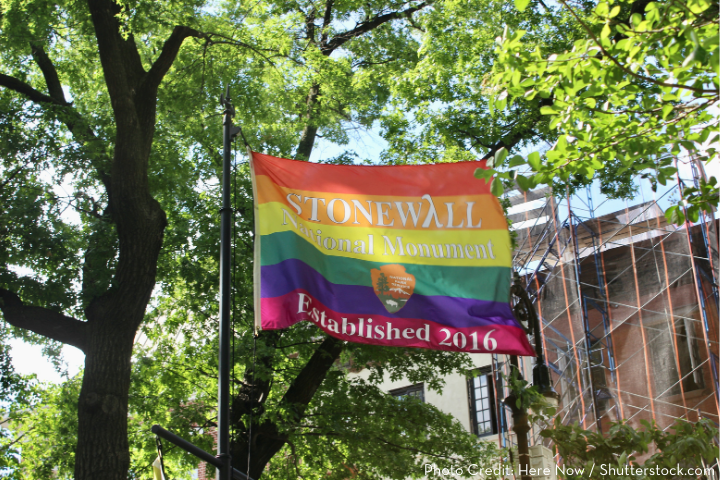
That apparently wasn’t enough for the administration. Responding to guidance from the Interior Department issued January 21, that bans the display of “non-agency flags and pennants,” in the National Park System, the Pride flag that had flown at the Stonewall monument since it opened in 2016 was taken down in early February. Local officials raised the flag again on Feb. 12, and Lambda Legal announced a lawsuit against the Trump administration.
National Parks workers, a depleted force after Trump’s widescale firings of federal workers last year, were also ordered during the summer to survey all signage and other interpretive materials at the nation’s 400+ parks and monuments, scouring the sites for information “negative about either past or living Americans.” The effort included a call for visitors to point out such offenses, though most of the responses praised the parks.
The surveys also involved flagging aspects of exhibits that run counter to Trump’s stated positions, whether pertaining to climate change, civil rights, Indigenous history or women’s rights.
It’s not clear how much of this educational information has already been removed from parks across the country, but reports are suggesting the actions are widespread.
At Fort Sumter in South Carolina, where the first shots of the Civil War were fired, a sign that detailed the risks the island fortress faces from climate change was removed. Signs that referred to climate change were also taken down at Acadia National Park in Maine, while an iconic photo of a formerly enslaved man’s scarred back was removed from Fort Pulaski National Monument in Georgia.
At Muir Woods in California, notes that added information about the role of Indigenous people and women to the story of saving the redwood grove were removed in July. And a display that referred to historical events like slavery, Japanese internment camps and conflicts with Native Americans in describing the park system was removed from Jamaica Bay Wildlife Refuge in New York City.
Fearing exactly what’s happened at the President’s House and elsewhere, academics and activists have responded to Trump’s orders with an attempt to save the history that appears to be on the chopping block. Librarians, historians and spatial data experts at The University of Minnesota launched an effort called Save Our Signs, which is dubbed “the People’s archive of National Park Signs.”
The ongoing project has so far crowdsourced photos of more than 11,000 signs from more than 300 parks, snapped mostly by ordinary citizens, and is still accepting submissions, even as the purge continues.