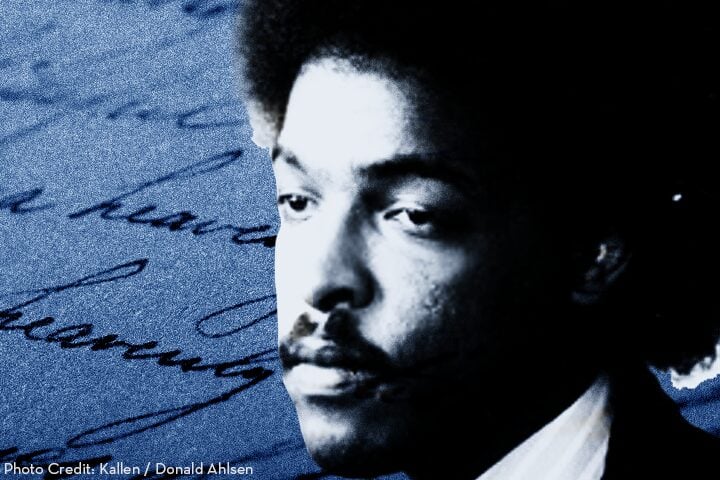
We, the undersigned writers, scholars, journalists, artists, activists, and other allies, are writing to urge the immediate release of poet and translator Ali Asadollahi. He is one of multiple writers and individuals jailed for their peaceful expression and dissent throughout Iran.
Asadollahi’s arrest occurred in the context of a mass protest movement that began on December 28, 2025, leading to a bloody crackdown by the Iranian government that dramatically escalated on January 8, during which thousands were killed and more than 50,000 people have been arrested. The violence was enabled by a pre-planned and almost complete internet blackout, and the continuing communications shutdown has made documentation and information-sharing about the scale of the massacre extremely difficult. In this overall environment of extreme and ongoing repression, Iran’s creative and literary community continues to be singled out as a particular target for reprisal. Both recent and long-standing detainees in Iran—including writers, artists, activists, and journalists—face acute risk.
Ali Asadollahi was detained violently in the middle of the night on January 24. Security forces confiscated his devices and papers, and he was taken to an undisclosed location. He had received anonymous threats in early January warning of his imminent arrest, indicating that he was being targeted. Allowed just several brief phone calls from detention and denied access to a lawyer, Asadollahi is being held in Evin prison, where he has faced multiple lengthy interrogation sessions and been subjected to physical abuse and pressure to make a forced confession. To date, there is no clear basis for his arrest, and no potential charges have been disclosed. Asadollahi suffers from health concerns, and was recently hospitalized for a lung infection, thus placing him at greater risk.
Asadollahi is a member and former secretary of the Iranian Writers’ Association (IWA). He is a leading poet of his generation, with six widely read poetry collections, and his literary output sparks with innovative poetic forms and a deep sense of political consciousness. His work has been translated into English, Italian, and French, and has been published in a number of prestigious journals including Roanoke Review, Alchemy, Palaver, and The Persian Literature Review. Asadollahi has a history of persecution by Iranian authorities. He was previously arrested in November 2022 during the Mahsa (Zhina) Amini uprising, and was detained for several months, before international pressure contributed to his release in February 2023.
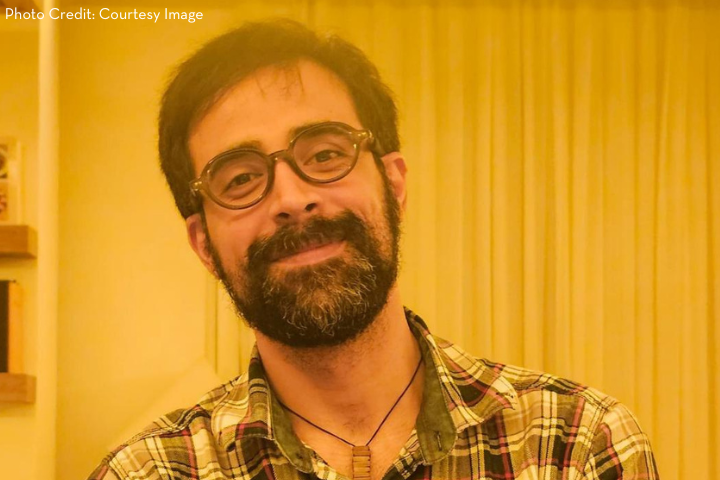
Asadollahi’s arrest is not an isolated example of the current crackdown on writers. On January 8, writer and IWA board member Yousef Ansari and another participant were arrested after reading a statement and poetry at a memorial ceremony for Baktash Abtin, a poet, filmmaker, and IWA board member who died in custody four years ago after delays in receiving medical treatment in prison. Ansari remains in detention despite being issued bail. A recent IWA report notes the arrests of writer and theater director Hamidreza Akhundnasiri in Kashan; writer, researcher, and teacher Boroumand Azamipour in Kermanshah; writer and assistant theater director Malika Malek Mohammadi; and Ghorban Behzadian-Nejad, a researcher, translator, and signatory of the “Statement of the 17.”
Reports in recent weeks suggest that Maryam Moghaddam and Behtash Sanaeeha, a screenwriter and director, have been threatened by security forces with imprisonment and the confiscation of their property, and Masoud Yousef Hasarchin, a translator, was arrested without any clear charges. Davoud Mohammad-Nia, a Bakhtiari poet and writer who incorporated political themes in his writing, was arrested and jailed in Isfahan in early January, and remains in detention in poor conditions. Numerous writers and artists have been killed in the protests; due to the communications blackout and risks involved, the true scope of detentions and deaths of writers remains impossible to verify accurately.
According to PEN America’s 2024 Freedom to Write Index, Iran is the second-worst jailer of writers globally, and since the June military conflict between Iran and Israel, an increasing number of writers, scholars, poets, and translators have been detained or received summonses, while others have faced extrajudicial threats or additional charges. Past patterns in Iran demonstrate that periods of widespread unrest are accompanied by heightened abuses inside detention facilities, where known dissidents are at increased risk of torture, extrajudicial killings, enforced disappearances, and other forms of ill-treatment. Those held in solitary confinement and denied contact with the outside world are particularly vulnerable.
We join together to strongly condemn Ali Asadollahi’s arrest and stand in solidarity with him and with other writers, alongside all of the courageous Iranians who have been arrested or killed for expressing dissent. We call for his immediate release, as well as the release of other writers, journalists, human rights defenders, and others who have been jailed for their peaceful expression and activism. And we urge an immediate end to state violence and the persecution of writers and intellectuals, which is undertaken purposefully and preemptively in order to silence voices of dissent and to crush cultural and intellectual resistance.
Organizational Signatories:
PEN America
PEN Sydney
Bellingham Review
Hypertext Magazine
Sky Island Journal
Individual Signatories:
Aatish Taseer
Abbas Milani
Adam Shatz
Ahmed Naji
Amir Ahmadi Arian
Amir Soltani
Amy Reading
Amy Tan
Ann Tyler
Aparna Halpé
Arash Azizi
Ariel Dorfman
Art Spiegelman
Ava Homa
Ayad Akhtar
Ayelet Waldman
Azar Nafisi
Azareen VanderVliet Oloomi
Bänoo Zan
Behrouz Boochani
Charles Yu
Chowra Makaremi
Claire Luchette
Claire Messud
Colm Tóibín
Colum McCann
Cy Strom
Daniel James Sharp
Daniela Sepehri
David Henry Hwang
David J. Remnick
Diane Woodcock
Dina Nayeri
Elif Shafak
Fatemeh Ekhtesari
Fatemeh Shams
Fereshteh Molavi
Francine Prose
Gary Shteyngart
Geoffrey Young
George Saunders
Ghazaleh Zarrinzadeh
Howard A. Rodman
J.M. Coetzee
James Hannaham
James Lasdun
Janet Afary
Jay McInerney
Jeffrey Eugenides
Jennifer Finney Boylan
Jessica Hagedorn
Jhumpa Lahiri
John Green
Jonathan Franzen
Jonathan Lethem
Jorie Graham
Judith Butler
Judyth Hill
Julie Rak
Kate Marshall Flaherty
Katerina Vaughan Fretwell
Katharine Wallerstein
Khaled Hosseini
Kourosh Ziabari
Krystyna Poray Goddu
Kwame Anthony Appiah
Kylie Moore Gilbert
Lev Grossman
Louise Erdrich
Lydia Davis
Ma Thida
Mansour Noorbakhsh
Margaret Atwood
Marie Arana
Mary Karr
Mehdi Mousavi
Melissa Chan
Michael Wolfe
Molly Crabapple
Molly Ringwald
Nayereh Tohidi
Nicole Krauss
Parvin Ardalan
Patty Paine
Peter Sacks
Peyman Jafari
Philip Gourevitch
Phil Klay
Rana Ayyub
Rita Dove
Robert Pinsky
Roya Hakakian
Salil Tripathi
Sandra Cisneros
Sandra Phillips
Shih Yen Chang
Sholeh Wolpé
Siavash Saadlou
Siri Hustvedt
Sonja Greckol
Stacy Schiff
Stella Nyanzi
Summer Brenner
Susan Choi
Susan Nguyen
Tara Westover
Tina Chang
Tobias Wolff
Tom Healy
Victoria Redel
Vincent Katz
Wajahat Ali