
Expanding the Web of Control
America’s Censored Campuses 2025
Key Findings:
Government censorship of free speech and academic freedom has reached unprecedented heights on U.S. campuses as lawmakers extend a web of political and ideological control over the sector.
More than half of U.S. college and university students now study in a state with at least one law or policy restricting what can be taught or how campuses can operate.
The Trump administration has weaponized multiple levers of state power to coerce colleges and universities into compliance with its ideological diktats.
PEN America Experts:

Program Director, Freedom to Learn
Sy Syms Managing Director, U.S. Free Expression Programs

Senior Manager, State Policy and Government Affairs
Senior Analyst, PEN America
Introduction
There is no use in sugarcoating things. For higher education in America, 2025 was a year of catastrophe.
Across nearly every conceivable front – from state capitals to Capitol Hill and even on social media – America’s politicians have been waging a full-scale campaign against colleges and universities, with a concerted focus on speech. The toll is immense. Fear among faculty, students, and administrators is widespread. Self-censorship in teaching and research is rampant. Every week seems to bring a new law or directive that further threatens academic freedom and educational quality. Many professors are grappling with online hate and doxxing, at times instigated by elected officials. International students have been detained for their speech and threatened with expulsion from the country. Angry legislators are targeting any office or program even tangentially related to diversity, equity, and inclusion (DEI). And campus leaders, buckling under the assault, have fired, suspended, or sanctioned scores of professors and staff, many for constitutionally protected speech. Some university presidents have been forced out or driven to resign. Many campus leaders feel they have no choice but to comply and try to strike deals with the federal government, even as they face mounting threats at the state level.
America’s Censored Campuses 2025: Expanding the Web of Control is a chronicle of this crisis. We build on PEN America’s past reports on this subject, but focus on higher education, rather than addressing both post-secondary and K-12 together, and examine the immense scope of both state and federal attacks on the sector. We describe direct forms of censorship – educational gag order laws that directly restrict teaching about such topics as race, gender, American history, and LGBTQ+ identities – as well as indirect forms of censorship – meaning, the state laws and policies that attack the practices and institutions that enable academic freedom to thrive, thereby indirectly chilling the climate for free speech. We see this in efforts to undermine shared governance and student activism, as well as in how legislators, under the guise of promoting viewpoint diversity, are trying to impose a new orthodoxy on college leaders and educators.
Numbers and taxonomy alone cannot capture the scale of what is taking place. The vast assemblage of legislation, policies, investigations, and threats, from state and federal governments, as well as various elected officials, has cast a web of control over campuses. Taken as a whole, they constitute a widening playbook for censorship that adds up to something more than the sum of its parts. Some states, notably Florida and Texas, have integrated mechanisms of censorship into virtually every dimension of their college and university systems, from how administrative leaders get selected to how faculty are promoted, from the way courses are approved to the specifics of course assignments. Other states – including Oklahoma, South Carolina, Indiana, and Ohio – are not far behind. Meanwhile, the federal government has leveraged its control over federal research dollars, Title VI investigations, and congressional hearings to bring some of the country’s wealthiest and most influential universities to their knees.
It must be noted that long before 2025, the federal government had taken actions that raised concerns for academic freedom and campus free speech. But in both quantity and quality, the second Trump administration’s assault on higher education is without precedent in modern American history. Private institutions have not been spared, nor those in liberal states. This is impacting the entire sector, from community colleges to the national accreditation system, from federal funding for research and student loan programs to efforts to advance student success, address antisemitism, and enable universities to recruit and retain international students and faculty.
When it comes to the expanding web of political and ideological control that has defined the past twelve months, virtually no institution of higher learning is safe.
While the current crisis has been greatly exacerbated by the actions of the second Trump administration, the seeds of these conflicts were sown years ago. Demographic changes on campuses, efforts to make higher education more inclusive, and an increase in knowledge production relating to the study of race and gender have long provoked rightwing criticism. On campuses, tensions manifested particularly at the intersection of free speech and new inclusion efforts, some tied to the growth of DEI offices. In turn, this spurred a growing national debate by the mid-2010s about the limits of speech on campus and the true civic purpose of higher education. In the political realm, some voices on the Right tended to frame the state of America’s college campuses in apocalyptic terms, ignoring reasonable concerns about student inclusion, the effects of targeted hate, and the need to redress legacies of discrimination and inequality. Meanwhile, some voices on the Left tended to downplay the real obstacles to dialogue and open exchange on campuses, particularly the feelings of isolation and silencing shared among conservative professors and students.
In a pluralistic democracy, for free speech and academic freedom to be upheld effectively, they must be upheld for all. But in recent years, campuses have often fallen short on these matters, feeding a perception that college and university leaders were either unwilling or unable to address growing free expression concerns. Rather than engaging with campus leaders, by 2021, Republican officials in a growing number of states turned decisively toward legislative solutions, seeking to impose new ideological restrictions on the professoriate, as if top-down, government-imposed directives, enforced by the fear of punishment, would make campuses better for conservative faculty and students, and for free speech, generally. There’s little reason to believe they have. Nonetheless, those efforts spread incrementally for four years. Then, with tensions on many campuses magnified by protests and encampments related to the war in Gaza, and increasing public scrutiny, the stage was set. With the second election of Donald Trump, the country was poised for the full-blown ideological campaign against the higher education sector we face today.
At their best, colleges and universities are vital engines of liberal democracy. Their faculty should inform and inspire the next generation of citizens and leaders, and their research should ignite innovation and discovery across fields. American higher education institutions have a particularly hallowed reputation worldwide for their traditions of open inquiry, academic freedom, and civic debate. And they have long powered local, state and national economies, all while attracting talent to American shores.
These traits that have made American post-secondary institutions unique and successful are all unquestionably in jeopardy at the start of 2026. This is not to say that they have not faced significant challenges in their evolution, but the current crisis seems less about forward-looking reform than about cudgeling the higher education sector into compliance with certain ideological orthodoxies. For years, campus leaders have struggled to sufficiently address their critics; now, they face a wholly different test of their core principles. Their autonomy and political independence, and the future of academic freedom and free speech on campus, hang in the balance.
The backbone of our research is compiled in our regularly updated Index of Educational Gag Orders, which we encourage you to consult. This comprehensive dataset tracks state-level legislation and policies since January 1, 2021. Using multiple tabs to organize measures by category, the Index includes educational gag orders affecting classroom instruction in K-12 schools and higher education institutions, as well as indirect censorship bills targeting higher education institutions. Bills may be included in more than one tab. Readers can organize and filter the data in each tab by various attributes including year, state, bill status, and type of indirect censorship, as applicable.
The report itself consists of six sections.
Section I offers a summary of the national landscape, highlighting topline numbers for the state bills, laws, and policies affecting higher education, and the chief threats against the sector in 2025 from the federal government.
Section II steps back from the current moment to consider the broader context for the growing crisis on campuses at the start of 2025, when President Trump returned to office. It situates recent events in the context of the long-running conservative critique of higher education, the increasing reliance of colleges and universities on federal funding, and the challenges related to free speech on campus that have worsened over the past decade. As we discuss, the reverberations on American campuses of the Israel-Hamas war in Gaza further weakened free speech and academic freedom norms, making the sector more susceptible to new political threats.
Section III explores the role that model bills developed by conservative think tanks have played in driving the current campaign against higher education. This section also describes the dangerous and even absurd consequences of the recklessness and speed with which new laws and policies have been enacted.
Section IV focuses on the principle of shared governance, which is, we argue, central to upholding academic freedom and free speech on campus. We chronicle the growing attempts by lawmakers to end or weaken it.
Section V analyzes the push by state and federal lawmakers to impose so-called “viewpoint diversity” on colleges and universities. In many instances, this seemingly anodyne term has become, in essence, a wolf in sheep’s clothing, disguising a concentrated effort to directly censor some viewpoints and amplify others, with little actual commitment to upholding diversity of thought on campuses.
Section VI highlights the worsening practice of jawboning, and how responses to a single horrific event – the murder of conservative activist Charlie Kirk – reflect the vulnerability of colleges and universities to pressure from individual lawmakers and government writ large.
Finally, our Conclusion looks forward to the 2026 legislative session, with our predictions for how both state- and federal-level efforts to expand the web of political and ideological control over higher education will unfold in the months ahead.
This report includes two appendices: a Typology of Educational Censorship, where we lay out the categories we use to track legislation impacting colleges and universities; and a comprehensive list of New Higher Educational Censorship Bills and Policies in 2025.
You’ll also find links in this report to a new blog series we’ve launched, Snapshots of Censorship, where faculty share their firsthand accounts of government censorship.
Section I: Higher Education Censorship by the Numbers
2025 was a banner year for higher education censorship, and that is bad news for America’s students. This is the result of a relentless, years-old campaign to exert ideological control over college and university campuses – impacting academic research, teaching, and curriculum, as well as institutional policy and shared governance. The onslaught of legislation, policy, and jawboning targeting higher education has become the new normal for a growing number of state legislatures, as well as for the federal government under President Trump.
Map of Higher Education Restrictions, 2021-2025

State Legislation
Topline Numbers for State-Level Higher Education Censorship
- In 2025, state legislators introduced 93 bills across 32 states that would censor higher education.
- This includes 15 bills with educational gag orders, 56 with indirect censorship provisions, and 22 bills that include both.
- Of the 93 proposed bills, 21 bills – or 23% – became law in 15 states.
- 5 additional states policies restricting classroom teaching were issued or adopted in two of those states.
- State legislatures set 3 new records in 2025: the highest number of new laws censoring higher education enacted in a single year (21), the highest number of states enacting them (15), and the highest number of states enacting their first higher education censorship law (8).
- 23 states have now enacted laws or policies censoring higher education since 2021, and over 50% of university and college students in the U.S. are enrolled in a state that has enacted at least one law or policy censoring higher education.
When PEN America started tracking educational censorship in 2021, we highlighted bills aimed at both K-12 and higher education, since legislators often lumped the two sectors together. The most common approach was what we termed educational gag orders, laws that directly censor topics in classroom teaching and educational materials. State bills of this type have continued to be proposed in each of the past five years, but as we noted in our 2024 report, America’s Censored Classrooms, legislators also began experimenting with a wider range of strategies and, as we put it then, “refining the art of censorship.” This meant looking beyond explicit gag orders, which directly censor classroom speech, and increasingly using indirect means to achieve their censorial goals.
In 2025, we saw this trend continue. As we detailed in a roundup of the 2025 state legislative sessions in July, new records were set last year for both direct and indirect forms of state censorship of higher education. After our final review of 2025 legislation, we can now say that 93 bills that would censor higher education were introduced across 32 states, including 15 with educational gag orders, 56 with indirect censorship provisions, and 22 bills that include both. Of these introduced bills, 21 became law, alongside 5 additional policies, raising the total number of states with new censorial laws and policies last year to 15. While some states are frequent offenders (e.g., Florida, Texas), 8 that passed bills or policies censoring higher education in 2025 did so for the first time (Arkansas, Kansas, Kentucky, Missouri, New Hampshire, Ohio, West Virginia, and Wyoming).
All told, over the past five years, bills or policies censoring higher education have been enacted in 23 different states. Now, over 50 percent of university and college students in the U.S. are enrolled in a state that has at least one law or policy censoring higher education. This is a staggering figure that should give us all pause.
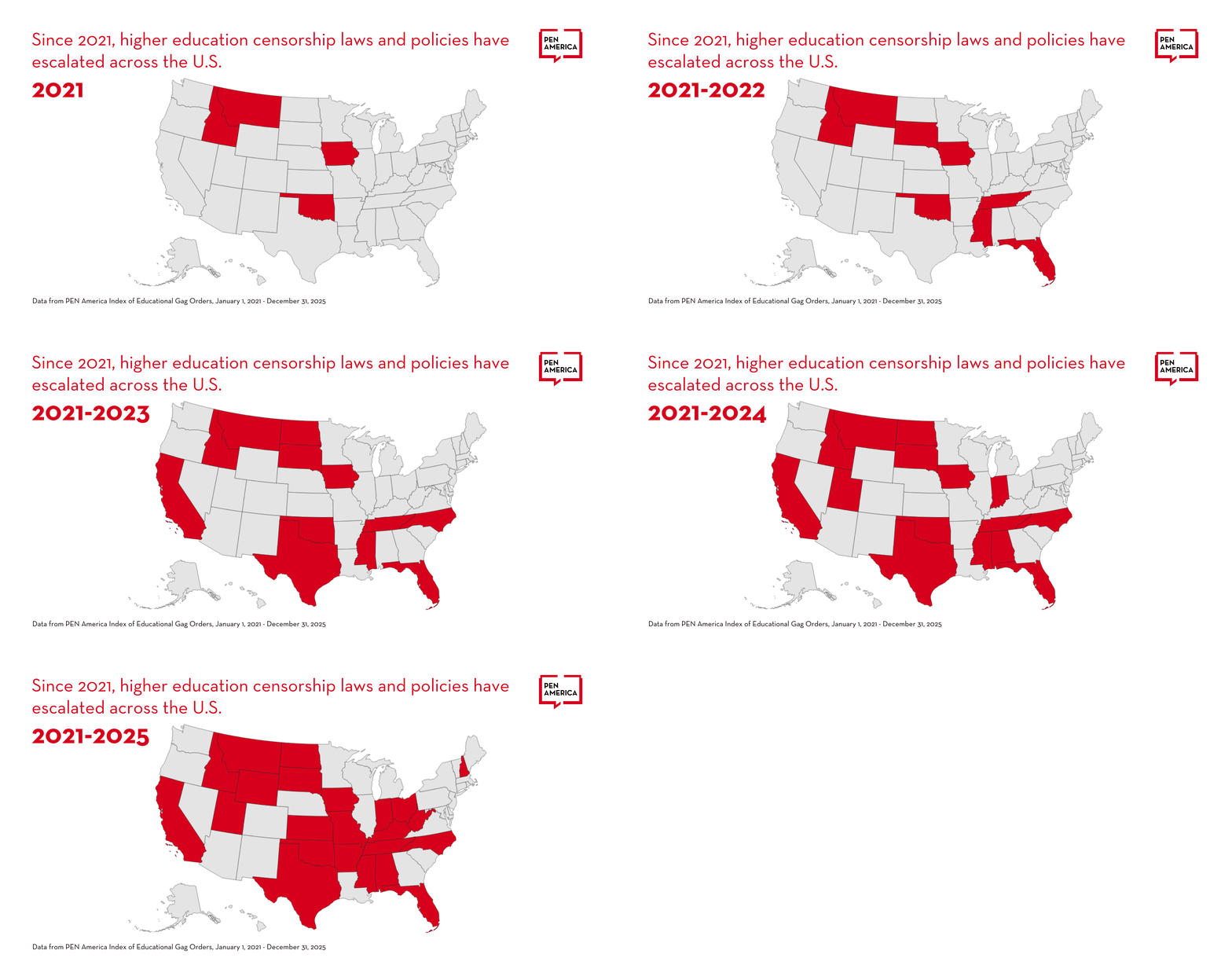
States that Enacted a Higher Education Censorship Law or Policy by Year
| Year | 2021 | 2022 | 2023 | 2024 | 2025 |
|---|---|---|---|---|---|
| States | Idaho*, Iowa*, Montana*, Oklahoma* | Florida*, Mississippi*, South Dakota*, Tennessee* | California*, Florida, North Carolina*, North Dakota*, Texas* | Alabama*, Florida, Indiana*, Iowa, Tennessee, Texas, Utah* | Arkansas*, Idaho, Indiana, Iowa, Kansas*, Kentucky*, Mississippi, Missouri*, New Hampshire*, North Dakota, Ohio*, Texas, Utah, West Virginia*, Wyoming* |
| Number of states that enacted a law or policy | 4 | 4 | 6 | 7 | 15 |
Cumulative number of states with enacted laws or policies | 4 | 8 | 12 | 15 | 23 |
Direct Censorship: Educational Gag Orders
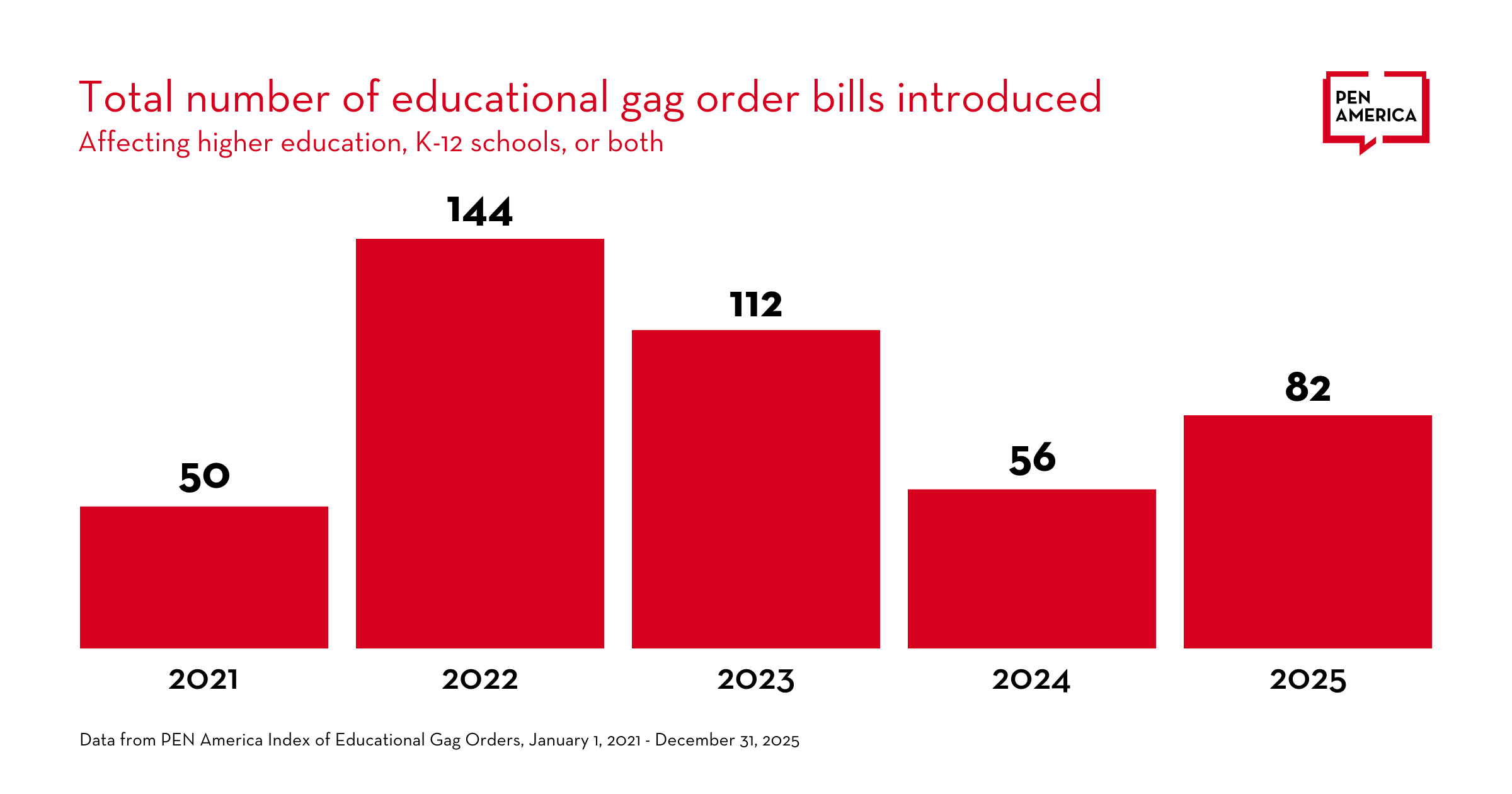
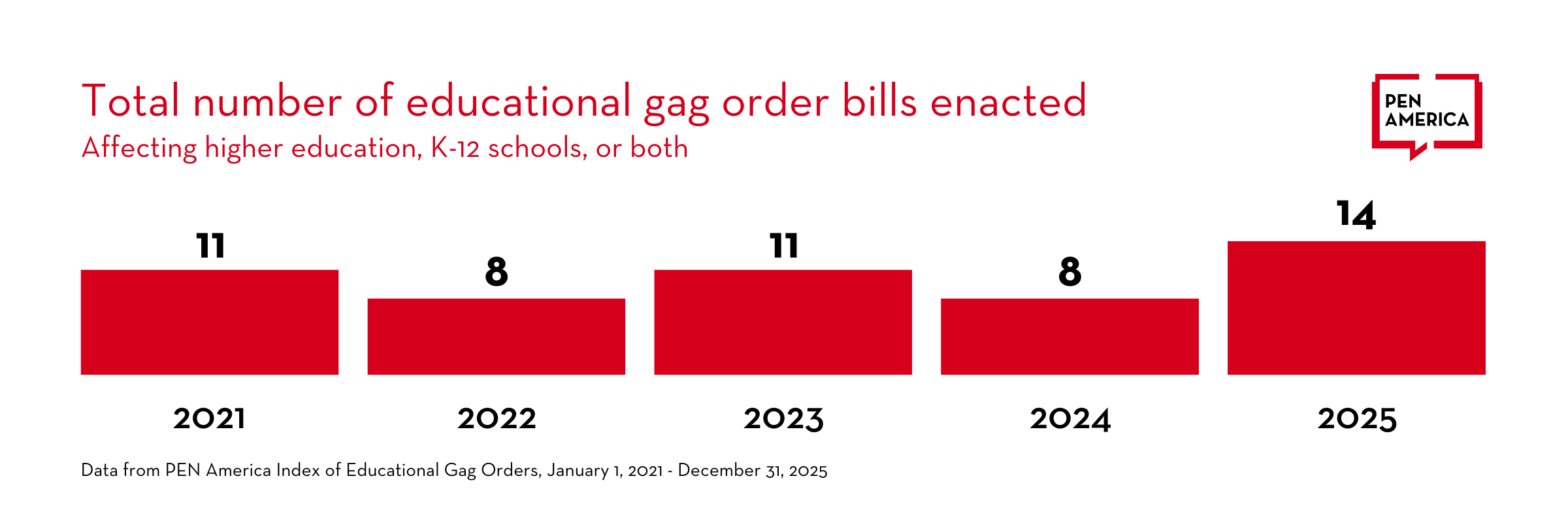
While state-level educational censorship has been ongoing for years, 2025 set a new record for the number of educational gag orders passed, whether targeting K-12 schools, higher education, or both. There were 82 educational gag order bills introduced in 2025, a significant reduction compared to the high-water mark set in 2022, which saw 144 such bills introduced. Despite the decline in absolute numbers of introduced bills, their rate of passage has steadily increased over the past four years. In 2025, 14 educational gag order bills passed into law, including 7 impacting higher education. In addition to bills passed by state legislatures, 5 educational gag orders were issued as state or university system policies. State lawmakers haven’t given up on these kinds of laws; they have become more efficient.
As the scale and scope of educational gag order laws have grown more brazen, legislatures have also increasingly disguised censorship or the true extent of the topics targeted. The same bill may even combine obvious censorship provisions alongside more covert but insidious restrictions. Ohio’s SB 1, for example, a sprawling 42-page anti-higher education broadside, includes mandates that every course demonstrate intellectual diversity, while also forbidding even voluntary diversity, equity, and inclusion trainings. This raises significant concerns for academic freedom, even though the law was passed under the guise of championing it.
Another example is Mississippi’s HB 1193, now subject to a partial preliminary injunction, which cloaks a sweeping gag order on any education that “increases awareness” of race, sex, color, gender identity, sexual orientation, or national origin by defining all such education as “diversity training.” Elsewhere in the now-enacted bill, the legislature directly lists a set of concepts related to gender and sex that cannot be promoted or endorsed – in other words, taught – in academic courses or elsewhere on campus.
In Texas, meanwhile, two major public university systems are implementing sweeping educational gag order policies that are quite explicit about their censorial aims. Faculty members and academic departments are now restricted in how they can discuss race or “race ideology,” gender identity, and sexual orientation without special permission from university leaders. These sorts of policies don’t carry the imprimatur of law, but they can cut off access to speech for tens of thousands of faculty and students. Indeed, the fact that in Texas thousands of course syllabi are now under administrative review confirms that they already have.
These educational gag orders are, however, just one part of the larger story of censorship that played out in 2025. Much of the action on the legislative front last year came in the form of indirect censorship: laws that undermine academic freedom and free expression rather than directly restricting classroom instruction.
Indirect Censorship: Legislation that Undermines Institutional Autonomy
As first identified in our 2023 America’s Censored Classrooms report, indirect censorship bills restrict the mechanisms that protect academic freedom and erode long-standing norms of autonomy and self-governance in higher education. They undermine the ability of colleges and universities to fulfill their missions free from political interference, and instead seek to exert or facilitate ideological control over academic and programming decisions. For 2025, PEN America tracked state-level indirect censorship measures in six categories: curricular control, tenure restrictions, institutional neutrality mandates, accreditation restrictions, diversity, equity, and inclusion bans, and governance restrictions (see the Typology at the end of this report for more information). Many bills and policies contain more than one type of indirect censorship and may also include educational gag order provisions.
While governing boards and other decisionmaking bodies have an accepted role in crafting university and college policies, lawmakers, at best, lack the contextual knowledge to craft good policies on intricate institutional matters and, at worst, can be motivated to constrict academic freedom for one reason or another. Compounding these issues, the legal and political power that state policymakers inherently wield when they intervene by law or by threat routinely generates such high levels of fear and anxiety that faculty, administrators, and even students overcomply in ways that trample academic freedom.
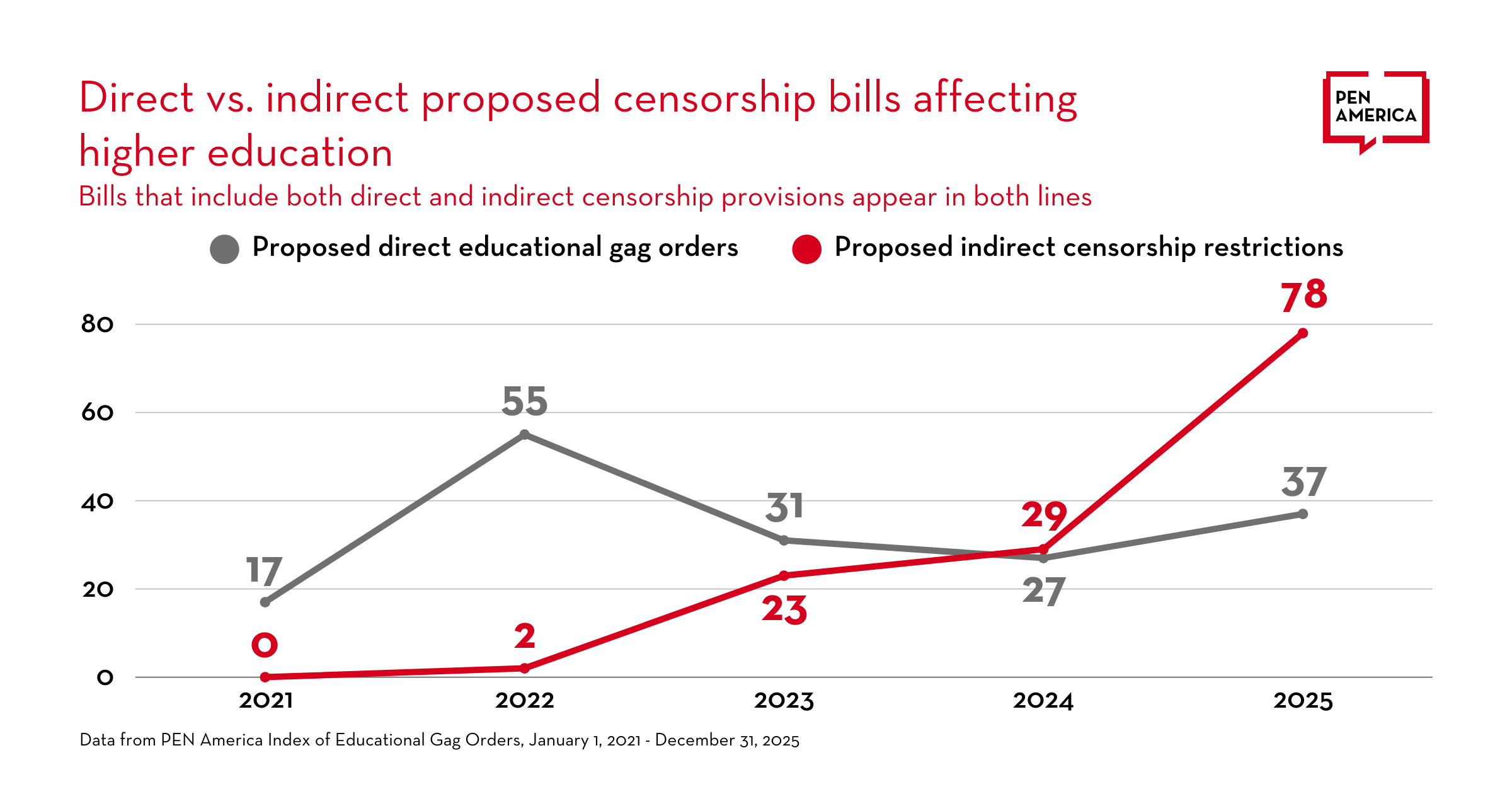
Our research shows that legislators are more frequently adopting indirect means to achieve their end goal of censoring higher education, effectively expanding their web of control over the sector in numerous directions. While the number of indirect censorship bills proposed in state legislatures first surpassed the number of proposed educational gag orders in 2024, this difference magnified in 2025. Indirect censorship measures exploded in popularity, with state legislators introducing more than twice as many of them as they did educational gag orders (78 vs 37).
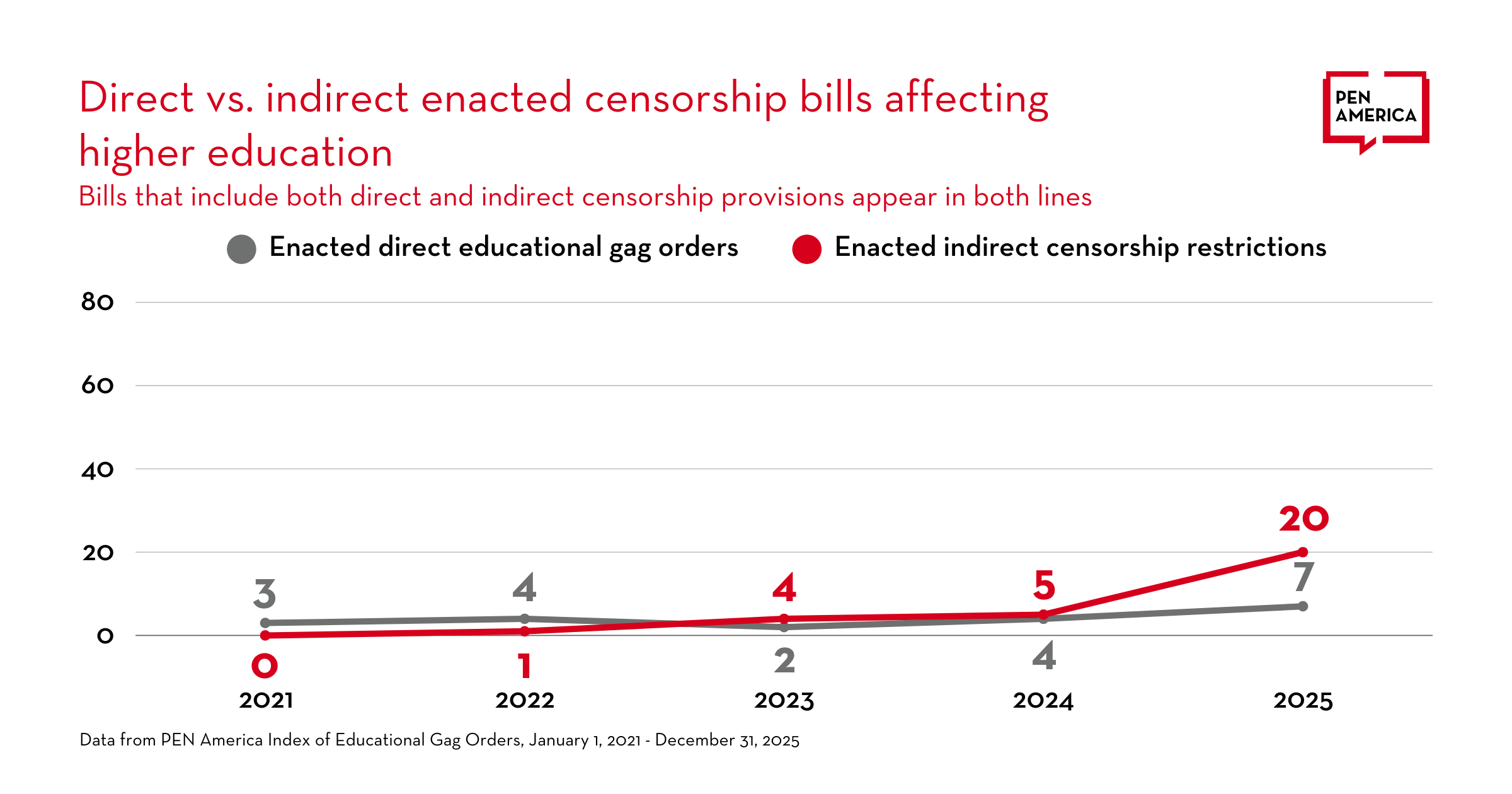
In total, 20 of these indirect censorship bills were enacted into law, impacting a range of college and university operations. The enacted laws include Indiana’s HB 1001, which relegates faculty senates in the state’s public universities to an “advisory” role only in academic affairs, as well as Idaho’s SB 1198, which does not exactly prohibit professors from teaching a course on “critical theory,” but does forbid them from making that course a required part of an academic major, minor, or certificate, with minimal exceptions. And it includes Kansas’s SB 78, which allows universities to sue a higher education accreditor if they are punished by the accreditor for adhering to a state law, a handy weapon for Kansas universities, given how many of the state’s laws violate accreditors’ standards on academic freedom.
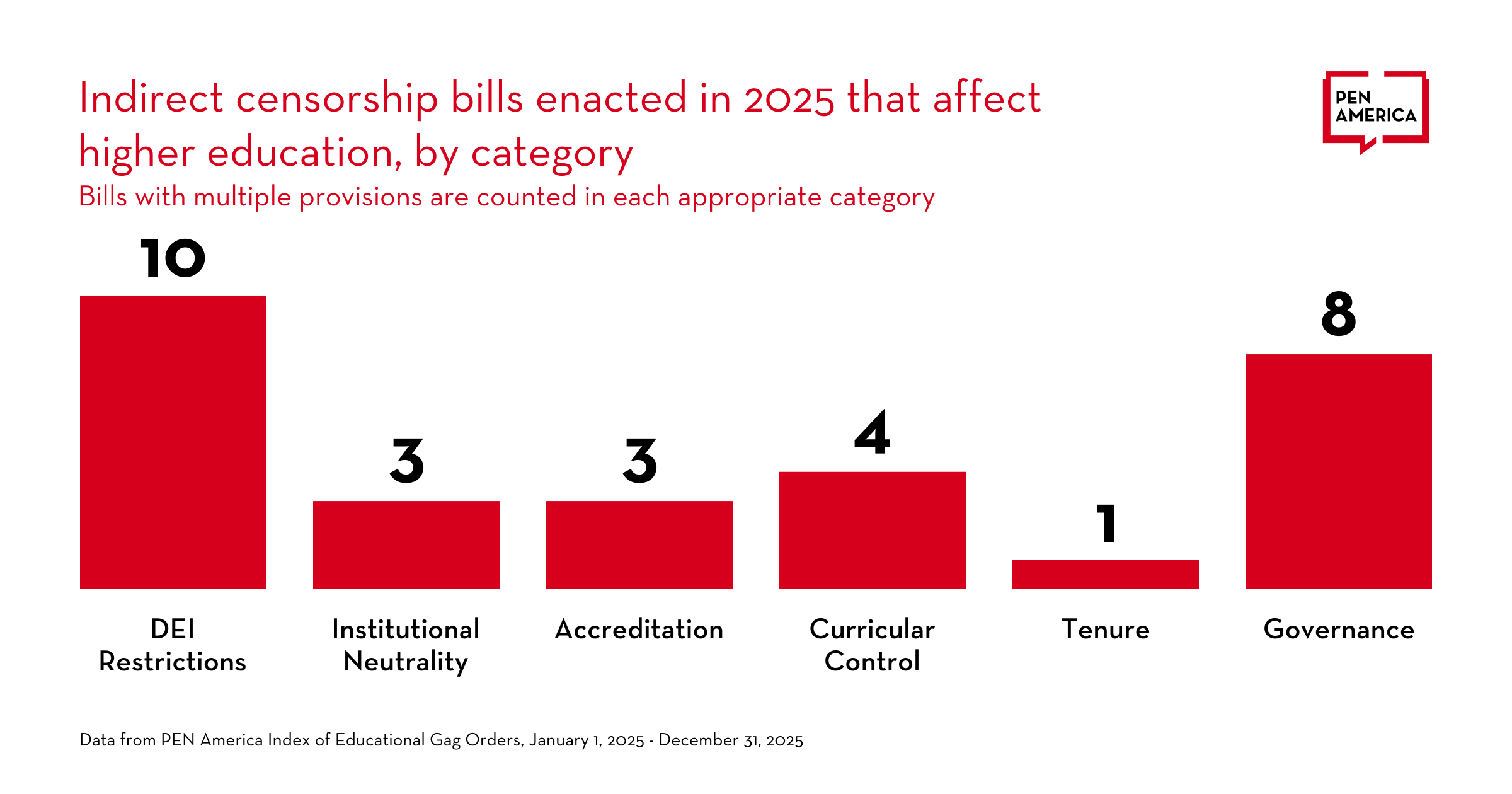
The fact that 20 of 78 indirect censorship bills introduced in 2025 passed into law is a remarkably strong rate of passage (26%), suggesting just how popular this type of legislation has become with lawmakers in states with Republican legislative control. And it is easy to see why. Once you strip away every sort of protection a professor has, there is no need to directly restrict their speech. A vague threat will be more than sufficient. This dynamic, which is discussed at length in Section VI, was on full display after the killing of conservative activist Charlie Kirk. It also reflects what lawmakers and think tanks interested in advancing ideological control over academic teaching at colleges and universities have apparently learned over the last four years: Given the historic strength of support for academic freedom across the country, they need to go beyond direct gag orders and prohibitions if they want to achieve their ends.
Still, all of this state-level activity does not capture the full scope of threats aimed at colleges and universities last year. That is because in 2025, for the first time since PEN America began tracking the war on campus free expression, the federal government has fully embraced this effort.
Once you strip away every sort of protection a professor has, there is no need to directly restrict their speech. A vague threat will be more than sufficient.
Federal Overreach
In early 2025, just a few weeks before President Trump’s second inauguration, PEN America made four predictions about what the federal government would do next. First, that it would launch an unending series of congressional and Title VI investigations designed to bully university leaders into submission. Second, that it would leverage concerns over campus antisemitism to censor faculty and chill student speech, especially that of international students present in the United States on student visas. Third, that it would use its control over federal research dollars to bring universities to heel. And fourth, that it might weaponize the higher education accreditation process to force educators to teach “pro-American” content.
Of these four predictions, only the last has not (yet) come to pass. The others have proved depressingly accurate, though even we did not anticipate the sheer ferocity of the federal government’s assault. That is in part due to the assumption – a mistaken one, as it turned out – that while the Trump administration might stretch the Constitution, it would not violate it. But that is precisely what happened, as the courts have determined again and again. Whether those courtroom victories will ultimately amount to anything, though, is less clear. Just because a university eventually regains lost federal funds does not mean that it has not borne significant costs, including an erosion of academic freedom and political independence. There is also no guarantee that it will receive the level of funding it expects in the future, or even any funds at all, and no promise that it won’t face a different sort of challenge. Universities are operating in a climate of profound uncertainty.
The Federal Government’s Attack on Higher Education in 2025 by the Numbers
| Title VI investigations into universities launched by the Dept. of Justice and Dept. of Education since January 2025 | 90+ |
| Federal research dollars targeted for cuts from grants previously awarded to institutions | $3.7 billion |
| Estimated annual cost of NIH and NSF funding cuts, in the form of decreased U.S. economic output | $10–16 billion |
| The estimated number of clinical trial participants affected by cuts and funding disruptions by the NIH to 383 clinical trials | 74,000 |
| Universities that have cut a deal and had funding restored or have remained eligible for federal funding | 6* |
| The number of universities (including Harvard and Yale) that the State Department has proposed suspending from a federal research partnership program because they engage in diversity, equity and inclusion (DEI) hiring practices | 38 |
| Total that US universities agreed to pay to the federal government in settlements since January 2025 | $305 million** |
| Fine sought by the federal government from the University of California | $1.2 billion |
| Lawsuits filed challenging Trump administration education policy | 56 |
| Executive orders that directly target or otherwise impact higher education | 19 |
| Number of international student visas revoked by the State Dept. | 8,000+ |
| Percentage of institutions reporting a decrease in new international enrollment | 57% |
| Decrease in the number of new enrollments of international students (first time in college) | 17% |
* Including Brown University, Columbia University, Cornell University, Northwestern University, the University of Pennsylvania, and the University of Virginia.
** Universities that agreed to pay settlements directly to the federal government include Northwestern University, Cornell University, and Columbia University. In addition, Brown University is required under its settlement to pay $50 million to state workforce development organizations, Cornell University is required to devote an additional $30 million to agriculture research programs, and Columbia is required to pay an additional $21 million to the U.S. Equal Employment Opportunity Commission.
Note: Information compiled from the Civil Rights Division of the Department of Justice, the Department of Education’s Office for Civil Rights, and the Federal Register, and from analysis by Education Week, Inside Higher Ed, the Center for American Progress, NAICU (the National Association of Independent Colleges and Universities), Higher Ed Dive, and various media reports.
From executive orders and memos, to investigations, the withholding of funds for research and financial aid, and efforts to detain, deport, or deny visas to international students and academics, the federal administration has weaponized every imaginable lever to bring the higher education sector to its knees. We see this in the destabilization of numerous federal agencies whose interactions with scholars, universities, and academia were previously routine; the fear that the use of certain words in scientific research proposals could lead to lost funding; the way that the Trump administration’s shifting interpretations of civil rights and anti-discrimination laws sow confusion; the cancellation of funds for foreign language training, area studies centers, and international exchange programs; orders from the Center for Disease Control and other agencies to suspend external publications to comply with the administration’s ideology; and reports of tightening control over civilian professors and curricula at military academies.
Even during the height of McCarthyism, when Cold War paranoia consumed the country’s universities, the federal government’s actions primarily focused on individuals and did not compare in either quality or quantity to the instruments of control, fear, and censorship deployed against the entire higher education sector in 2025. As our on-going research has shown, the groundwork for these federal actions was laid years ago in state capitals across the country – where legislative censorship has also continued to grow. The range of strategies in the federal toolbox and the high level of coordination among different departments will be discussed in greater detail in the ensuing sections of this report. As new attacks roll out weekly, the costs to us all keep rising, whether in the numbers of grants cut, the foreign students who have left or not enrolled, the dollar amounts in penalties being demanded of public and private universities, the weakening of scientific research, or the narrowing of students’ educational opportunities.
Section II: The Growing Crisis on Campus Before 2025
As PEN America’s previous annual reports have shown, the campaign to control what is taught in the U.S. education system is not new; so why, then, has the past year seen such a dramatic erosion of institutional autonomy and a sector willing to bend to political pressure?
The attacks on higher education just in 2025 – whether from state legislators or federal agencies or even the general public – and the sector’s apparent openness to abdicating its agency and principles, come as the result of three distinct trends that have been years in the making. These include the decades-old conservative critique of higher education, which has recently gained new energy and adherents; the increasing financial reliance (and consequent vulnerability) of the sector on the federal government; and the growing challenges to free speech on campuses in the mid-2010s. These three trends eroded the foundation of higher education, weakening public trust in the institution. All that was needed to trigger a collapse was a spark, which came in the fall of 2023 in the form of the war in Gaza. The fissures in campus communities that were brought to the surface were then exploited by political actors eager to weaponize genuine concerns about discrimination, safety, and free speech on campuses, in order to undermine the sector as a whole.
The effects of the Israel-Hamas War and subsequent campus protests reverberated throughout the 2023-24 academic year and into the fall 2024 semester, causing widespread anxiety and fatigue among students and faculty, as well as college and university leaders. Heightened scrutiny from both state and federal governments and the constant threat of high-profile negative press, as well as fear among administrators that their own actions might draw fire, worsened this state of affairs. As a result, the lines that ought to distinguish what speech is permissible or not on campus seemed to become harder to distinguish, perhaps most so to the individuals charged with drawing them.
When President Trump took office in 2025, the higher education sector was already vulnerable, the lines around free speech on campus fraught and weakened by years of censorial state action and growing public skepticism. This climate made the country’s colleges and universities uniquely susceptible to new federal efforts to expand direct government control.
The Conservative Critique of Higher Education
While this report focuses on 2025, the roots of the current catastrophe run deep. America’s colleges and universities have been embattled institutions at numerous points in the last century. During the First World War, critics accused academics of being unpatriotic and purveyors of “foreign” ideologies like Marxism and anarchism. These criticisms diminished somewhat during the 1940s, but resumed with a vengeance during the Second Red Scare of the 1950s. During the McCarthy era, hundreds of professors lost their jobs or had their careers permanently stunted because of their scholarship or refusal to denounce colleagues. Self-censorship among professors was pervasive, often with the knowledge and encouragement of campus administrators. So great was the paranoia, recounts the historian Ellen Schrecker, that some scholars stopped using words like “capitalism” and “revolution” in the classroom.
But even after the end of the McCarthy era, criticism of higher education continued to grow. Public intellectuals like Russell Kirk and William F. Buckley, who otherwise had markedly different opinions about academic freedom, agreed that professors were increasingly un-American, if not downright corrupt. Professors, they argued, had no sense of truth or beauty, having traded eternal truths for passing fashions. As a result, academic freedom had lost its purpose. Of course, even in the 1950s, this critique of colleges was not entirely new. But Kirk and Buckley’s legacy was laying the foundation for a populist critique of higher education, a move that sought to restore to the academy the simple virtues of patriotism, individualism, and love of God. This critique would prove remarkably adaptive, and throughout the 1960s and 1970s was seemingly able to diagnose every prevailing anxiety of the day, whether from civil rights or anti-war activism, feminism, decolonization, or political correctness run amok.
Then there’s the influence of James Burnham, a philosopher frequently cited by those advancing the “burn-it-all-down” nihilism that drives some of the MAGA movement’s more vicious attacks on the higher education sector. Like Kirk and Buckley, Burnham was suspicious of universities, warning that as the economy grew more complex, power would become concentrated in the hands of unelected and unaccountable experts and credentialed elites.
Coupled with rising anti-immigrant and white nationalist sentiment in response to the twentieth century’s civil rights movements and demographic changes on campuses, Burnham’s ideas helped fuel the populist ideologies that undergird much of the conservative critique of higher education today.
The Rise of Federal Power
It was amid these mid-century critiques of academic freedom and the professoriate that, with bi-partisan support, the federal government massively expanded its investment in higher education. The G.I. Bill (1944) first brought the federal government into large-scale funding of college tuition, and this commitment continued into the 1960s, with the passage of the Higher Education Act, and early 1970s, with the expansion of Pell Grants. During the same time, the federal government was investing enormous sums of money in scientific research through the National Defense Education Act (1958) and a Johnson-era executive order, which ensured that money was distributed to small and large institutions alike. Over the following decades, the federal government became a major underwriter of biomedical research, engineering, physical sciences, area studies and foreign language training, energy and agricultural sciences, and many other disciplines deemed critical during the Cold War.
The implications of these developments were vast. With more money and more students came the need to hire more faculty. This market demand blunted significantly the effects of McCarthyism on the academy, since professors persecuted in one university could often find refuge in another. In that respect, the government’s attempts to exert control over the professoriate and expand the education sector were at cross-purposes.
Federal support came with two conditions, however. The first was the statutory requirement that, as a condition of qualifying for Pell Grants, work-study funds, and other federal programs, students must attend an institution recognized by a higher education accrediting body. Otherwise, Congress feared, students might spend their publicly subsidized tuition dollars at, for example, predatory diploma mills or fiscally insolvent institutions. This rule protected students and encouraged colleges and universities to behave responsibly; it also gave those accrediting bodies significant influence over the higher education sector.
The second condition was via federal civil rights laws, which all universities – public and private – must follow in order to receive federal financial assistance. The most pertinent of these laws for campuses are Title VI of the Civil Rights Act of 1964, which prohibits discrimination on the basis of race, color, or national origin in programs or activities receiving federal financial assistance, and Title IX (adopted as part of the Education Amendments of 1972), which prohibits discrimination on the basis of sex in programs or activities receiving federal financial assistance. Universities and colleges found to have discriminated on any of these grounds, or to have knowingly allowed others to discriminate, can lose out on federal funding for research, Pell Grants, work-study programs, or any other earmark.
These increases in federal support and oversight left the sector – and large research universities in particular – dependent on the government’s largesse. Over time, college and university administrators sought out alternative revenue streams and cost-savings measures, but each came at a price. For example, hiking tuition raised revenue, but also angered many Americans for whom access to higher education was considered a public good. And adopting a “student-as-customer” business model helped enrollment, but arguably undermined educational quality. Campuses also tried to rein in expenses by shifting away from hiring full-time, tenure-track faculty and toward a part-time and contingent labor force; between 1987 and 2021, the overall percentage of tenured or tenure-track faculty declined nationwide from 53 percent to just 32 percent. Contingent faculty are far less expensive, but their lack of job security means they’re less able to push back against administrators’ demands, less able to advocate for academic freedom, and less able, as well, to provide students with the mentorship and support they need.
In the process of implementing this carousel of strategies, administrators undermined the principle of shared governance in order to concentrate decision-making power in their own hands. They were accused of inflating their administrative ranks and mimicking strategies from the corporate sector. While these choices may have helped with the financial challenges of the sector, they did enormous damage to the job protections that undergird academic freedom and left the sector more vulnerable to critiques of mismanagement.
Growing Challenges to Free Speech on Campus
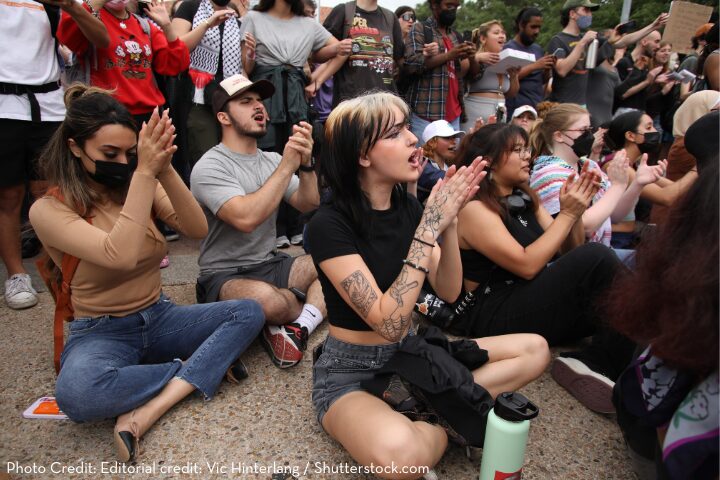
These multiple pressures left the sector ill-prepared for the new challenges that emerged around 2010, when social polarization weakened support for higher education within the Republican Party. A declining number of conservatives in the professoriate, which denied academia some of its most persuasive advocates on the political Right, and dramatic increases in the cost of tuition and student debt, led many to question the value of college degrees. Meanwhile, conservatives developed a potent line of criticism against the sector, accusing it of being an incubator for harmful ideas run by out-of-touch elites more interested in coddling students than educating them.
Then, around 2015, a new national debate over free speech on campus emerged. Many elements contributed to this including a string of high profile attempted deplatformings, ill-advised administrative responses where students and faculty were punished for what should have been protected speech, and intense media scrutiny. Campuses became flashpoints for conflict, with social media feeding the fire and fomenting public pressure on universities to react.
Many of these incidents were driven by liberal students and directed at conservatives, exacerbating the existing impression that conservatives were unwelcome on college campuses. As PEN America summarized in reports published in 2016 and 2019, campuses’ attempts to address discrimination and advance inclusion through concepts like trigger warnings or safe spaces may have been well-intentioned, but nonetheless often had the effect of stifling academic freedom and free speech. The same was true of certain DEI offices or programs, if they enforced a rigid orthodoxy around race, gender, and social justice. At the same time, many campus controversies from this period involved genuinely hateful speech, leaving administrators, faculty, and students unsure of how to respond. Universities cannot teach when speech is censored, and students cannot learn when they feel unsafe or unwanted; as PEN America has long argued, it is a delicate but necessary balance to strike. Unfortunately, a lack of preparation, including inadequate procedures to respond to students’ demands, often resulted in knee-jerk reactions, rather than dialogue and mutual respect from all involved.
By the time that President Trump first took office in 2017, these tensions were worsening. The period saw an increase in hate crimes and intensifying polarization on campuses, including accusations about the politicization of teaching and research, and instances where protestors shut down speakers. One of the most infamous of these deplatformings – when Charles Murray was invited to speak at Middlebury College – turned violent. A student journalist explained the flare of tensions as reflective of the political context, “After Trump was elected, there was really a lot of tension on campus. There was a need for some outlet, for some sort of event, or demonstration that students could rally around.”
The same could be said about the country more generally. The summer of 2020 saw mass Black Lives Matter protests following the murder of George Floyd by Minneapolis police, and the public reckoning with racism led many institutions in various fields to adopt new curricula, training, and commitments to address systemic racism. Along with The New York Times’ 1619 Project, published the year prior, these formal and informal changes in schools, colleges, and workplaces became the focus of pointed ideological disagreement. As colleges and universities committed to combating racism, some conservative activists took up the existing conservative critique of higher education and adapted it, targeting race, ethnic, and gender studies, as well as campus inclusion programs. Ironically, they turned against freedom of speech on campus even while continuing to claim they were defending it.
In September 2020, with the election just weeks away, President Trump issued Executive Order 13950, “Combatting Race and Sex Stereotyping.” It included a list of nine so-called “divisive concepts” that recipients of federal funding were prohibited from promoting. Trump would go on to lose the election and President Biden would rescind the executive order on his first day in office.
But by then, the very same list of divisive concepts was already popping up in state-level bills across the country. These educational gag orders, as PEN America called them, proved popular with Republican policymakers. Between 2021 and 2023, over 300 gag orders were introduced targeting K-12 or higher education, with their focus overwhelmingly on restricting teaching about race, gender, and sexuality. Powering their adoption was a widespread rhetorical campaign against “critical race theory” – a scholarly movement that began in law schools in the late 1970s. As the term entered the political mainstream, it became a catch-all for everything wrong on college campuses, alongside “DEI.” One need not endorse every DEI-related office or program that has existed in higher education to recognize that outright bans, driven by government actors, pose their own threat to the political independence of the academy writ large.
By mid-way through the Biden administration, the chilling of campus speech for one reason or another was following a familiar pattern, generally driven, on the one hand, by cultural pressures on faculty and administrators to avoid topics that might be disfavorable to left-leaning students, and on the other, by a political threat from state legislators who were passing laws to censor and control academic teaching. Around the country, faculty expressed concerns with one or the other of these censorial pressures, sometimes both.
In this climate, students often chose self-censorship, declining to share their views on controversial topics. Some faculty and administrators were also complicit, both by creating new tools for censorship and by actively deploying them against students’ speech. According to a 2024 report by Heterodox Academy, which analyzed data from 2019 to 2022, students across the nation were consistently hesitant to share views on controversial issues, regardless of their geographic location or institution type.
The Israel-Hamas War
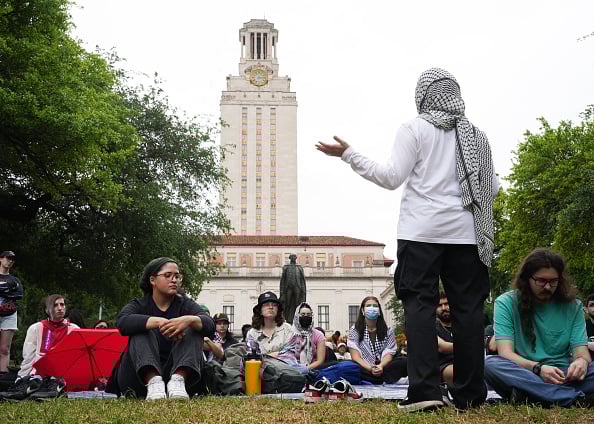
These cultural and political dynamics on campuses changed dramatically following the Hamas-led attack on Israel on October 7, 2023, and Israel’s subsequent air and ground campaign in Gaza. These events triggered an enormous wave of protests, most notably in the form of encampments and building occupations, accompanied by intense criticism of Israel from students, faculty, and others associated with the academy – which generated accusations of antisemitism and demands that universities crack down on these activists.
From coast to coast, these tensions became a daily reality on many campuses, with instances of antisemitic, anti-Arab, and anti-Muslim hate and violence, as well as clear censorship of both pro-Palestinian and pro-Israeli views. The combined horror of the Hamas-led attacks on October 7, the taking and subsequent treatment of hostages, the massive Israeli military response and its devastating toll on civilians, infrastructure, and culture in Gaza, and the failure of the international community to put a stop to the violence increased tensions on U.S. campuses. These concerns were made more urgent by a series of much-discussed reports from major international human rights groups, including in Israel, which argued the Israeli government had committed war crimes and other atrocities, including genocide. Student protestors often pointed out the complicity of the US government in these atrocities.
Almost immediately after the attacks of October 7, the very real issue of rising antisemitism was seized on by numerous politicians to advance critiques of campus free expression. As PEN America discussed in a previous report, some state lawmakers quickly introduced legislative proposals to censor speech deemed antisemitic. At the federal level, over the ensuing year, multiple college and university leaders were hauled before the House Committee on Education and the Workforce, forced to answer antagonistic questions and respond to lawmakers’ grandstanding while testifying under oath. Some were pressured to denounce their own faculty. Others were chastised for defending free speech or negotiating with student protesters. At least two high profile university leaders, Harvard’s Claudine Gay and the University of Pennsylvania’s Liz Magill, resigned shortly thereafter. And it seems likely that there was a link between the disastrous testimony of Columbia’s Minouche Shafik before the Committee on April 17, 2024, and her decision to end negotiations with student protesters one week later. It was also around this time that Rep. Mike Johnson, the Speaker of the House of Representatives, visited Columbia’s campus to demand that Shafik resign. Later that summer, he would get his wish.
Regardless of the political motivations that propelled these congressional hearings, there were unquestionably a troubling number of instances of antisemitic and anti-Israel discrimination on college campuses. In one especially egregious example, the University of California, Berkeley is alleged to have refused to hire a dance professor because she was from Israel. Internal messages, made public as part of the professor’s lawsuit, show the department chair seemingly caving to student anger at the prospect of an Israeli faculty member on campus: “My dept cannot host you for a class next fall… Things are very hot here right now and many of our grad students are angry. I would be putting the dept and you in a terrible position if you taught here.” The professor alleged discrimination and an internal investigation by UC Berkeley agreed with her. In December 2025, UC Berkeley agreed to pay the professor $60,000 in a settlement. The chancellor issued her an apology and invited her back to teach.
In another case, a Cornell student threatened to murder his Jewish classmates. At the University of California, Los Angeles (UCLA), student protesters occupying a portion of the quad barred any student who declined to disavow Israel from access to certain ordinarily available campus areas and programs; a federal judge subsequently found UCLA liable for violating the Jewish student plaintiffs’ First Amendment rights under the free exercise of religion clause when the university failed to ensure that either all students or, in the alternative, no students were granted access, regardless of religion. A University of Delaware student attacked a campus Holocaust memorial while shouting “Fuck Jews” and “The Holocaust should have happened.” At Stanford, an instructor asked the Jewish and Israeli students in his class to stand up and move to a separate area of the classroom. He then said “This is what Israel does to the Palestinians.” He went on, “How many people died in the Holocaust?” When a student answered, “Six million,” the instructor said, “Colonizers killed more than six million. Israel is a colonizer.” In this period, thousands of Jewish sites on campus, including synagogues, Hillel centers, and fraternities, were also protested and/or vandalized.
Alarming as these incidents were, there are ways that colleges and universities could have responded to them that are consistent with academic freedom and the principles of free speech. Too often, any criticism of Israel was conflated with antisemitism, which seemed to spur overly-aggressive responses to protests that were otherwise peaceful in nature. Between October 2023 and January 2025, repression of students and free expression on campuses reached levels unseen in recent decades. Some pro-Palestinian students were punished for expressive activities, and some student journalists were even sanctioned for covering protests. Other students were subject to grueling investigations, lost their meal plans and access to campus housing, or endured withering public criticism, leading to doxing and rescinding of employment opportunities. In some instances, university leaders rewrote the student disciplinary process on the fly in order to smooth the path to punishment. In other cases, decades old debates about “institutional neutrality” were reignited as some university leaders got nervous about their own speech, or faced external pressure to exert control over what their faculty and academic departments might express about the war. Campus leaders were met with public and private scrutiny from their boards, alumni, and at times, elected officials. It seemed no matter which path presidents took in responding to these campus conflicts, criticism abounded.
Individual faculty were not spared either. In one case, Jodi Dean, a political theorist at Hobart and William Smith Colleges, was temporarily barred from campus because of a pro-Palestine blog post. Raz Segal, an Israeli academic and leading expert on the Holocaust, lost a job offer at the University of Minnesota because he accused Israel of genocide. After criticizing Israel during an interview with the news program Democracy Now!, Columbia professor Katherine Franke was investigated by the university’s Office of Equal Opportunity and Affirmative Action. The toll of the investigation was so heavy, Franke would later say, that she stepped down from her position in early 2025, arguing that it was not really her choice to retire, but “a termination dressed up in more palatable terms.” Kareem Tannous, a business professor at Cabrini University, lost his job over anti-Israel comments he made on his personal social media account. So did Maura Finkelstein, who had been a tenured professor of anthropology at Muhlenberg College in Pennsylvania.
The Challenge of Adjudicating Antisemitism on Campus
Antisemitism from across the political spectrum has significantly increased in recent years, and complaints of antisemitism have surged on college and university campuses in particular since October 2023. Administrators have faced significant challenges adjudicating these cases in part because of disagreement as to how to define antisemitism. Speech critical of Israel and/or Zionism is not inherently antisemitic. Even though some such speech can cross the line into antisemitism, there has long been a dangerous tendency to conflate anti-Israel expression with anti-Jewish bias. The result of this conflation has been that core political speech critical of Israel is being chilled.
This question is especially consequential for how colleges and universities respond to complaints alleging violations of Title VI of the Civil Rights Act of 1964, which bars discrimination based on race, color, and nationality. Although Title VI does not expressly mention religion, the statute has been interpreted to forbid discrimination of religious groups where unlawful conduct is based on actual or perceived shared ancestry or ethnic characteristics of that group. Thus, Jews (shared ancestry) potentially can be a protected class under Title VI, as are Israelis (national origin), and both groups are protected under other federal and state laws (and constitutional provisions) that prohibit discrimination based on religion and/or national origin. By contrast, Zionism, defined as a political belief or ideology, would not render its supporters a protected class, unless it could be shown, for example, to serve as a proxy for Israelis, Jews or Judaism. This in turn can inform whether there has been discriminatory intent when investigating alleged violations of civil rights laws or anti-discrimination policies.
Distinguishing between antisemitism and political and ideological criticism of Israel has also been complicated by an effort to codify a specific and controversial definition of antisemitism — from the International Holocaust Remembrance Alliance (IHRA) — in state and federal law, as well as in campus policies. This is because in addition to its core definition of antisemitism as pertaining to hatred toward Jews, the IHRA definition includes 11 “illustrative” examples of what could be antisemitism, 7 of which involve speech critical of Israel. These include, for example, claiming that the State of Israel is a racist endeavor (which the definition equates with denying Jews the right to self-determination), and “applying double standards by requiring of [Israel] a behavior not expected or demanded of any other democratic nation.” By contrast, other respected definitions of antisemitism expressly reject that a number of the IHRA definitions’ examples are per se antisemitic.
Nonetheless, since 2019, the Department of Education’s Office of Civil Rights (OCR) has required that the IHRA definition, including its examples of anti-Israel expression, be considered in determining the existence of antisemitic discriminatory intent when enforcing Title VI. And although the definition does not insist that its illustrative examples always constitute antisemitism, they are worded in a broad and vague way that makes them vulnerable to the vagaries of interpretation. In other words, incorporating this definition into laws and policies that carry disciplinary and legal sanctions opens the door to enforcement that curtails speech critical of Israel’s government, its military, or its actions, laws, or policies. Indeed, the institutionalization of the IHRA definition to adjudicate campus discrimination has been opposed by numerous free speech groups, including FIRE, the AAUP, and the ACLU, and even its original lead drafter, Kenneth Stern, because of its clear chilling effect on speech about Israel.
None of this is to say that there have not been serious challenges with surging antisemitism on campuses that demand addressing by campus leaders. It is also important to recognize that there are significant numbers of Jews for whom Zionism – meaning, for example, support for a Jewish homeland which includes modern-day Israel – is an integral part of their genuinely held religious beliefs. Many Jewish students who hold those beliefs have felt targeted based on their religion on campuses, particularly by efforts to exclude “Zionists” from events or spaces, and some courts have found that these students have legitimate claims.
However, as PEN America has repeatedly said, the ongoing institutionalization of the IHRA definition is the wrong answer to the serious problem of surging antisemitism across the political spectrum. This definition was originally developed as a “non-legally-binding working definition of antisemitism.” But more and more it has become the single arbiter of antisemitism, and what is or is not permissible expression about Israel, in situations that can result in disciplinary or other punitive actions, including legal sanctions. The danger of this codification is even more heightened given the Trump administration’s unprecedented use of concerns about the very real threat of antisemitism as a cudgel to advance a political and ideological agenda against speech and speakers it disfavors and the autonomy of the higher education sector broadly.
There are many more cases like these. Indeed, since the outbreak of the war, Title VI complaints and investigations have become increasingly routine. According to a November 2025 report by the American Association of University Professors (AAUP) and the Middle East Studies Association, under the Biden administration, at least 65 Title VI investigations into alleged campus antisemitism were launched between October 2023 and January 2025. In that climate of escalating civil rights investigations, anxiety around free speech on campuses grew, as university leaders tried to balance protections for anti-war protesters, concerns with antisemitism, and the chorus of critics scrutinizing their every move.
Whatever tensions were present on campuses before the war, there is little question that these events exacerbated them. In 2025, FIRE reported that nearly 9 in 10 university students who responded to their open-ended survey expressed concerns about censorship, specifically when discussing Israel, Palestine, and/or Gaza. All the while, concerns about students’ understanding of free speech haven’t gone away, either.
American Higher Education at the Start of 2025
This is how America’s colleges and universities entered into 2025: internally divided, financially unstable, politically vulnerable, and increasingly distrusted by large portions of the country. Amid the rising number of Title VI investigations and debates about their own institutional speech, college and university leaders had grown anxious about free speech and about their own policies, with many uncertain of how best to tamp down tensions in their communities, or address concerns about antisemitism.
When Trump was sworn in as the 47th president, the higher education sector was largely unprepared for what was about to happen. Drawing on a set of playbooks developed by conservative activists months or years in advance, the administration moved fast. In his first two weeks in office, Trump signed over 50 executive orders, an immediate demonstration of his theory of the expanded powers of the executive. These were soon followed by a blizzard of new guidance, Dear Colleague letters, legal and regulatory interpretations, and additional executive orders designed to bring the nation’s colleges and universities to heel.
It is in this context – a backdrop of fear, uncertainty, and censorship – that everything else in 2025 played out.
Section III: Model Bills, Reckless Laws, and Internal Contradictions
As noted in Section I, 2025 was a record-breaking year in terms of both the number and the scope of state bills aimed at censoring higher education. Together, these bills cast a web of political and ideological control over higher education, attacking the foundations of free expression from multiple angles. The proliferation of model bills produced by conservative legal activists and think tanks, and designed for easy use by lawmakers in any context or political situation, has enabled this boom. Federal executive orders have also played a part, giving state lawmakers language to incorporate into their legislation, as we will soon discuss. Trump’s list of “divisive concepts” from the tail end of his first administration in 2020 is perhaps the most famous example.
Of course, model bills are not objectionable in and of themselves. Many political causes from across the ideological spectrum offer legislative templates for lawmakers to consider. But when the models pose chronic threats to free expression on campus, and are mixed and matched rapidly, the probability of ending up with laws that are confusing or contradictory, and which create new threats to free speech and academic freedom, is high. Such has been the case with the flurry of state-level bills introduced and passed in 2025. (For more information, see PEN America’s Index of Educational Gag Orders.)
Campus Free Speech Bills
Model state bills targeting campus free speech are not especially new. As PEN America previously discussed in Chasm in the Classroom (2019), a small cottage industry emerged in the 2010s to produce and disseminate bills in response to growing concerns about free speech on campus. This included FIRE’s Campus Free Expression Act, the Campus Free Speech Act from the Goldwater Institute, and the Forming Open and Robust University Minds (FORUM) Act, from the American Legislative Exchange Council (ALEC). Together, these bills claim to offer general prescriptions for free expression on campus, including by mandating free speech education, affirming a commitment to free speech, and abolishing the practice of establishing “free speech zones.” While PEN America supports certain of the provisions in these bills, overall we view them with reservation, particularly because of how some prescribe significant student discipline for vaguely defined infractions, or mandate reporting and legislative oversight in ways that might undermine colleges’ and universities’ autonomy from political interference.
The list of so-called “divisive concepts” originated in this milieu, too, appearing first in the executive order “Combatting Race and Sex Stereotyping” that President Trump introduced in September 2020. Language from that order has since been incorporated into dozens of state bills. More recently, the Heritage Foundation’s Project 2025 has received attention as providing the overall blueprint for President Trump’s second-term agenda. But the Heritage Foundation is far from the only influential think tank on these matters. The “Freedom from Indoctrination Act,” from the Goldwater Institute and Speech First, formed the basis for at least one law, as well as two other bills that would have been enacted but for last-minute gubernatorial vetoes. The Civics Alliance, launched by the National Association of Scholars in 2021, maintains a “Model Higher Education Code” that includes 24 model bills, laying out a path for everything from how to control accreditation bodies or impose “intellectual diversity” in the classroom to banning donations from the Chinese government. In 2025, Ohio’s SB 1 drew heavily on multiple Civics Alliance bills, as did Iowa lawmakers in at least nine different bills. Meanwhile, visitors to the website of the James G. Martin Center for Academic Renewal in North Carolina will find eight model bills for overhauling higher education. One of them is the End Political Litmus Tests in Education Act, which it co-developed with the Goldwater Institute and is not, as written, a measure PEN America categorizes as educational censorship. But its influence is undeniable: it has found its way, in bits and pieces, into multiple state bills and (virtually in its entirety) into one federal bill introduced last year.
The Spread of Model Bills in 2025
| Model bill | Origin | Number of bills influenced by model legislation | Number of laws enacted influenced by model legislation |
|---|---|---|---|
| EO on Combatting Race and Sex Stereotyping | First Trump Administration, 2020 | 14 bills (proposed in 11 states) | 4 laws (enacted in 4 states) |
Freedom from Indoctrination Act | Goldwater Institute and Speech First, 2023 | 9 bills (proposed in 7 states) | 1 law (enacted in 1 state) |
Abolish DEI Bureaucracies Act | Goldwater Institute and Manhattan Institute, 2023 | 25 bills (proposed in 16 states) | 5 laws (enacted in 5 states) |
Accreditation Autonomy Act | Civics Alliance | 2 bills (proposed in 2 states) | 2 laws (enacted in 2 states) |
Campus Intellectual Diversity Act | National Association of Scholars, Civics Alliance | 1 bill (proposed in 1 state) | 1 laws (enacted in 1 state) |
School of Intellectual Freedom Act | Civics Alliance | 2 bills (proposed in 2 states) | 2 laws (enacted in 2 states) |
Note: This table reflects the influence that a selection of model bills had on 2025 higher education censorship bills tracked in PEN America’s Index of Educational Gag Orders. A bill was considered influenced by model legislation if at least one provision was either directly or substantially copied from the model bill. This may include lists of restricted concepts or activities, even if the proposed bills differ in their mechanisms of censorship. Bills and laws influenced by more than one model bill are reflected in each appropriate entry.
What stands out most about state legislation in 2025 is the dizzying variety of model bills available to state lawmakers interested in regulating higher education, as well as the rapid pace at which these bills continue to be introduced and, in some cases, passed, without due consideration of their consequences. The result is not just bad legislation, but a reckless approach to lawmaking that is chilling the climate for free expression on campus.
Coming Your Way in 2026: A New Model Bill with a Misleading Title
In early December 2025, the Goldwater Institute debuted its latest model bill, “The American Higher Education Restoration Act.” According to its authors, the academic research process is broken. At best, faculty research is trivial; at worst, it is downright un-American. And high-profile journals, which ought to prioritize the pursuit of truth, are making publication decisions on the basis of identity politics and political activism.
To solve this supposed problem, the model bill would have public universities and colleges divide their faculty into three camps. The first would contain all STEM faculty, and the second any faculty members who teach an “Americanism and Western Civilization” course. Both would have fewer teaching responsibilities, and those in the second would also have an expedited path to tenure. The third camp would contain everyone else – generally, faculty appointed to departments in the social sciences, humanities, professional studies, and fine and performing arts. This group would have a heavier teaching load. Should a university seek to hire new faculty in the third group – but not in a STEM field or in a unit teaching Western Civilization – it would first have to seek permission from the governing board, which would scrutinize each posting on an individual basis.
The bill creates additional hurdles for faculty in the third group who seek to use contract time or state resources for their research. Any requests for a reduced teaching load would need approval from a special committee, dominated by politicians and political appointees, to oversee a fund for state-sponsored research of “public value.” Were a university to assign a reduced teaching load to a faculty member in the third group or allocate state funds to support their research without going through that approval process, the state attorney general or any other taxpayer could file for an injunction in court.
One of the stranger provisions of this section is that it would give preference to faculty publishing research in “open-access venues,” thereby discounting many peer-reviewed journals, which are the standard for academic publication.
The goal of it all, according to the Goldwater Institute, is to stop wasting taxpayers’ money on “corrupt academic research.” In reality, it would furnish politicians with one more tool to decide what gets taught, who gets hired, which topics are researched, and who gets tenure. In other words, it is about political and ideological control.
States of Contradiction
As PEN America has documented previously, the rapid spread of these bills has resulted in logical and typographic errors, as well as impossibly vague legislative language. All of this has sown confusion and no small degree of fear among educators, something that 2025’s crop of laws and policies seems destined to exacerbate. Last April, for example, we raised the alarm about Idaho’s SB 1198, a familiar sort of DEI ban that was introduced, passed, and signed into law in just 10 days. Nationwide, the combination of borrowed provisions and limited legislative debate has resulted in legislation and policy that is difficult to implement and, in some cases, susceptible to legal challenge.
For further reading:
Wait, What Just Happened in Idaho? A Wake-Up Call for Higher Ed
Mississippi’s HB 1193, passed into law earlier in 2025, is a good example of this alarming trend. This law requires public K-12 and university faculty to teach that there are only two sexes – male and female. But the law also prohibits educators from offering a class that “increas[es] awareness or understanding of issues related to race, sex, color, gender identity, sexual orientation or national origin.” Together, these provisions are irreconcilable. Professors cannot simultaneously teach students about sex and comply with a law that forbids any formal education that might increase students’ understanding of sex. It is an impossible position, one into which every public university in Mississippi has been plunged. But that’s what happens when lawmakers are more focused on ideological censorship than debating what the various provisions of a bill mean altogether. Mercifully, this provision of the law has been preliminarily enjoined by a federal judge.
Other laws contain provisions so sweeping that their impacts contradict their ostensible purpose. For instance, after allegations from the federal government that Arizona universities were coddling antisemites, lawmakers passed a law banning encampments on campus. However, the language they adopted is so sloppy and extreme that it would seem to prohibit Jewish students from celebrating Sukkot, a holiday during which many Jews construct a temporary structure and sleep in it overnight.
And in Texas, although legislators have spent years discussing the importance of unfettered free speech on campus (and passing a law ostensibly to support it), in 2025 they passed a law so farcically broad that it bans any expressive activity anywhere on campus by anyone between the hours of 10:00pm and 8:00am. What’s more, the law explicitly defines “expressive activity” as expression protected by the First Amendment. This means no after-hours journalism by the student newspaper, no early-morning prayer circle in the campus chapel, no theater rehearsal the night before the big show. The law also bans the playing of drums or the use of sound amplification at any time of day or night during the final two weeks of the semester, so that probably takes care of concerts, marching band practice, or even convocation ceremonies. The ban is total and inflexible, with no exception made for even university-approved events. Thankfully, it has also been enjoined by a federal judge. “The First Amendment,” Judge David Alan Ezra reminded the state in his ruling, “does not have a bedtime of 10:00 p.m.”
Contradictions at the Federal Level
This barrage of state-level legislation has been amplified by the deluge of executive orders (EOs) and other policies coming from the Trump administration. Starting on day one, January 20, when he signed a stunning 26 EOs, the aim has been to “flood the zone” and overwhelm the opposition. In 2025, Trump signed 225 EOs, a number one might expect over the course of an entire presidential term (in Trump’s own first term, he issued just 220). While a large number of these EO’s have already been challenged in the courts, their impact persists.
According to NAICU (the National Association of Independent Colleges and Universities), 19 of the EOs so far take aim at higher education. Some do so head-on, by undermining DEI programming and accreditation standards, wiping out an established merit-based system of grant making, and banning trans women from participating in the women’s divisions of intercollegiate sports. But there are others that, because of the breadth of their framing and mistaken assumptions about their scope, have also impacted higher education. For example, one of the first EO’s issued on January 20 was Executive Order 14168, “Defending Women from Gender Ideology Extremism and Restoring Biological Truth to the Federal Government.” As that name suggests, the focus of this EO is on the federal government. It does not apply to universities, let alone to classroom teaching. Yet it was precisely this EO that a Texas A&M student cited when she disrupted a class discussion because it referenced gender diversity in literature. That complaint subsequently led to the professor’s dismissal.
Another example of how the federal government is exerting undue authority over higher education can be found in the Dear Colleague letter issued by the Office for Civil Rights on February 14, and the subsequent FAQ sheet issued on February 28. This letter put all colleges and universities on notice that the continuation of DEI programming could jeopardize their federal funding, citing the Supreme Court’s 2023 decision in Students for Fair Admissions v. Harvard (SFFA) as precedent. But as PEN America made clear in our statement condemning this guidance, “This declaration has no basis in law and is an affront to the freedom of speech and ideas in educational settings. It represents yet another twisting of civil rights law in an effort to demand ideological conformity by schools and universities and to do away with critical inquiry about race and identity.” And we were right: in August, a federal court vacated the letter. But in the meantime, many colleges and universities rushed to comply with the federal government’s letter, shutting down programs and killing initiatives not easily resurrected. The damage was done.
Catch-22: Conflicting Rules from the Federal Administration
There is one additional example of the federal administration’s efforts to change the rules for higher education that deserves close consideration, since it illustrates how the torrent of laws, executive orders, and legal threats from state and federal actors can combine and contradict one another in unexpected ways.
In late July, the Department of Justice released a “Guidance for Recipients of Federal Funding Regarding Unlawful Discrimination.” Across nine pages and dozens of examples, it attempts to lay out the sorts of discriminatory practices that can cost schools, universities, and other organizations their access to federal funds. For instance, it asserts that a university may not establish or allocate resources to support a “safe space” for students of a particular religion or national origin, as this would constitute unlawful “segregation,” even if “access is technically open to all.” Nor may universities engage in “preferential hiring or promotion practices,” for instance by trying to recruit students from specific institutions or parts of the country that “correlate with, replicate, or are used as substitutes for” a particular race or ethnicity. So no more sending recruiters to predominately Black high schools in order to channel Black students into the freshman class. The federal government will not tolerate that sort of thing anymore.
Except when it does. In fact, the very next day after issuing its guidance to universities, the Department of Justice announced that it had reached a settlement with Brown University over alleged antisemitism and other discriminatory practices. Among the terms of that settlement: Brown will take actions “to support a thriving Jewish community,” perform “outreach to Jewish day school students to provide information about applying to Brown,” provide “resources for religiously observant Jewish community members,” offer “support for enhanced security at the Brown-RISD Hillel,” and muster university resources to “celebrate 130 years of Jewish life at Brown in the 2025-2026 academic year.”
This directly contradicts the Justice Department’s own orders from the previous day. For instance, the Brown settlement requires the university to provide outreach to students at Jewish day schools, which is precisely the sort of behavior that the guidance document expressly forbids. On the one hand, Brown is required to provide resources for religiously observant Jews and celebrate Jewish life on campus. On the other, the Justice Department has warned all universities that using resources to support a practice or event with an “identity-based focus creates a perception of segregation and may foster a hostile environment.” How do we explain this catch-22? Does one hand even know what the other is doing?
The government’s intent to treat Jewish students differently from other religious, racial, or ethnic groups is not limited to the agreement with Brown. Cornell agreed to survey students about whether the university’s efforts to address antisemitism are effective and improve the campus climate for Jewish students. Columbia University is required to appoint a special “Student Liaison” in order to “further support Jewish life and the well-being of Jewish students on campus.” While we recognize the need to address antisemitism, the double standard – forbidding spaces and services to support any particular racial or national community while also insisting that there be specific supports created for Jewish students – is concerning. Our concerns were amplified when news broke in November that the Equal Employment Opportunity Commission was suing the University of Pennsylvania to force it to turn over the names and contact information of some Jewish faculty and students, just as the Department of Education had pressured UC Berkeley to do in September. While the lawsuit asserts this is part of the EEOC’s efforts to document “potential unlawful employment practices, namely religious, national origin, and race-based harassment,” asking universities to create and turn over to the government the names of Jewish faculty and students will understandably make many feel targeted.
How can these actions be squared with the Trump administration’s demand that universities stop providing special resources for students on the basis of their race or religion?
These contradictions are difficult to explain. One interpretation is that the federal government does want these universities to apply a different standard to some types of students than it does to others. This is the theory offered by Kenneth Marcus, a former assistant secretary of civil rights for the Department of Education during the first Trump administration, in his defense of the government’s settlement with Brown. Marcus notes that sometimes the courts will require a university to give students of a particular group special treatment to ameliorate past discrimination, and that it “may be that the universities are simply being required to extend to Jewish applicants and Jewish students the same sorts of accommodations given to others.”
Another possibility is that officials at all levels of state and federal government, flush with power and eager to wield it, are simply not paying attention to all the details of what they are doing. The Department of Education is currently investigating at least 60 colleges and universities over alleged antisemitic discrimination and harassment. Other federal agencies, including the Department of Health and Human Services, have launched investigations of their own. So far, only two of these (of Columbia and Brown) have been resolved through a formal legal settlement that directs the institution to provide special treatment to Jewish students. That means that everywhere else, the Department of Justice’s guidance prevails, and even if a university other than Brown or Columbia wanted to provide extra support for Jewish students or to prioritize students at Jewish day schools for recruitment, it could not. Not without breaking the law as interpreted by the guidance from the Justice Department.
Bottom line, the Trump administration aims to exert control over how universities conduct their business. Whether these contradictions are intentional or not, they sow confusion on campuses. When administrators and campus leaders are left to navigate conflicting or ambiguous official legal interpretations from the federal government, the result is an ad hoc mess.
This pattern of internal inconsistency from the federal government is repeated in other areas as well. A letter sent to Harvard University in April 2025, signed by officials from the Departments of Education and Health and Human Services, and the General Services Administration, stipulates that Harvard must embrace “merit based” faculty hiring and “abolish all criteria” in its hiring that “function as ideological litmus tests.” Yet in virtually the same breath, the letter instructs the university to hire “a critical mass of new faculty within” every department or academic field in order to achieve “viewpoint diversity.” Again, whatever one thinks about the merits of this letter, those two orders are incompatible. Harvard cannot simultaneously dispense with any ideological litmus test for faculty hiring and then make hiring decisions based on a candidate’s political viewpoints.
For further reading:
What is Trump’s Compact for Higher Education? — FAQ
Internal inconsistency is evident, as well, in President Trump’s proposed Compact for Academic Excellence in Higher Education, released on October 1, 2025. The Compact urges universities to “screen out [international] students who demonstrate hostility to the United States, its allies, or its values” while also insisting that there be no consideration of factors including “national origin” or “political views” in admissions. Similarly, a draft settlement sent by the federal government to UCLA demands that the university develop “policies to protect faculty and students from retaliation for expressing minority opinions or engaging in free expression” and also that it deny admittance to international students deemed “likely to engage in anti-Western, anti-American, or antisemitic disruptions or harassment.” How are these provisions supposed to be reconciled?
The answer, of course, is that they cannot be.
Whether out of anger, contempt, or a kind of reckless exuberance, politicians are acting with incredible force and speed. The result is policy that is chaotic, self-contradictory, and destructive. When faced with such a catch-22, people tend to err on the side of caution, which is likely to lead to self-censorship and a chilling of campus climates for free expression. In the end, as always, it will be students and educators who are left to deal with the consequences.
International Impact of Federal Policies
American higher education’s internationalism has long been a key part of its identity and a source of strength. The openness of our curricula to international perspectives, the support of study abroad experiences, the welcoming of international faculty and students on our campuses – all of this has driven the innovation that has defined the U.S. higher education sector. But now that forward-looking momentum is undeniably in jeopardy. A range of actions by the Trump administration are damaging the climate for cultural and academic exchange, narrowing opportunities for global perspectives in classrooms, and weakening the ability of the sector to attract talent from abroad.
The administration’s unbridled approach to cancelling funding for research and educational programs, discussed elsewhere in this report, also has an international dimension. We’ve seen drastic cuts to educational and cultural affairs programs that operate through colleges and universities, as well as foreign language study fellowships and international and area studies centers. When coupled with the defunding of international research and partnerships in fields like agriculture, public health, and medicine, not to mention the end of USAID, the result is a higher education sector crippled both now and for the future.
American colleges and universities have long been successful in recruiting international students and scholars, in part, because of consistent federal support and a reliable system for issuing visas. In the past year, however, that too has been upended. For currently enrolled international students and visiting faculty, a rising number of visa revocations since the start of Trump’s second term has left many unsure if they will be able to finish their course or even their semester. Increased scrutiny at U.S. borders has also led to fears of being blocked from returning if they travel abroad, even when they hold valid visas. In June and in December, the Trump administration placed a host of countries, primarily in Africa and the Middle East, under complete or partial travel visa bans, effectively foreclosing any opportunity for their citizens to attend American colleges and universities. And a pending rule change submitted by the Trump administration in August that would set a 4-year cap on the length of F-1 visas for students and J-1 visas for faculty or researchers raises the specter that those who do secure visas could lose their status before finishing their degrees.
The administration’s skepticism about international students is clearly reflected in the terms of the “Compact for Excellence in Higher Education” proposed in fall 2025 as well. It would have required institutional signatories to cap international student enrollment to no more than 15% of a university’s undergraduate population, with no more than 5% from any one country; to screen out “students who demonstrate hostility to the United States, its allies, or its values”; and to promise to provide, upon request, information about foreign students, including disciplinary records, to the Departments of Homeland Security and State.
These threats are not just hypothetical. Already, international students and scholars face a heightened threat of viewpoint discrimination from the U.S. government. The administration’s targeting of international students, including Rümeysa Öztürk and Mohsen Mahdawi, has given many others good reason to self-censor online or within their fields of study. Some report that they now avoid protests, publishing, or speaking to the media to avoid government scrutiny. Indeed, Secretary of State Marco Rubio explained to reporters that they were revoking the visas of students “if they’re taking activities that are counter to our foreign – to our national interest, to our foreign policy.”
The cumulative impact of these policy changes is clear: students and scholars worldwide can no longer rely on the U.S. as a haven for free speech and association. Unquestionably, the First Amendment protections that are supposed to apply to all in the U.S. – citizens and foreign nationals alike – are being undermined. Campuses across the country are already reporting significant drops in their enrollment of international students. That’s a major pivot in the direction of American higher education and a blow to the climate for free expression and cultural exchange on our campuses.
Section IV: Shared Governance
“Yippie Ki Yay! Adios! Sayonara! Auf Wiedersehen! Au Revoir! In every language you can possibly think of: Goodbye!”
This is how Dan Patrick, the lieutenant governor of Texas, celebrated the passage of SB 37, a 2025 Texas law that, among other things, effectively put the kibosh on shared governance by eviscerating faculty senates in his state’s public universities.
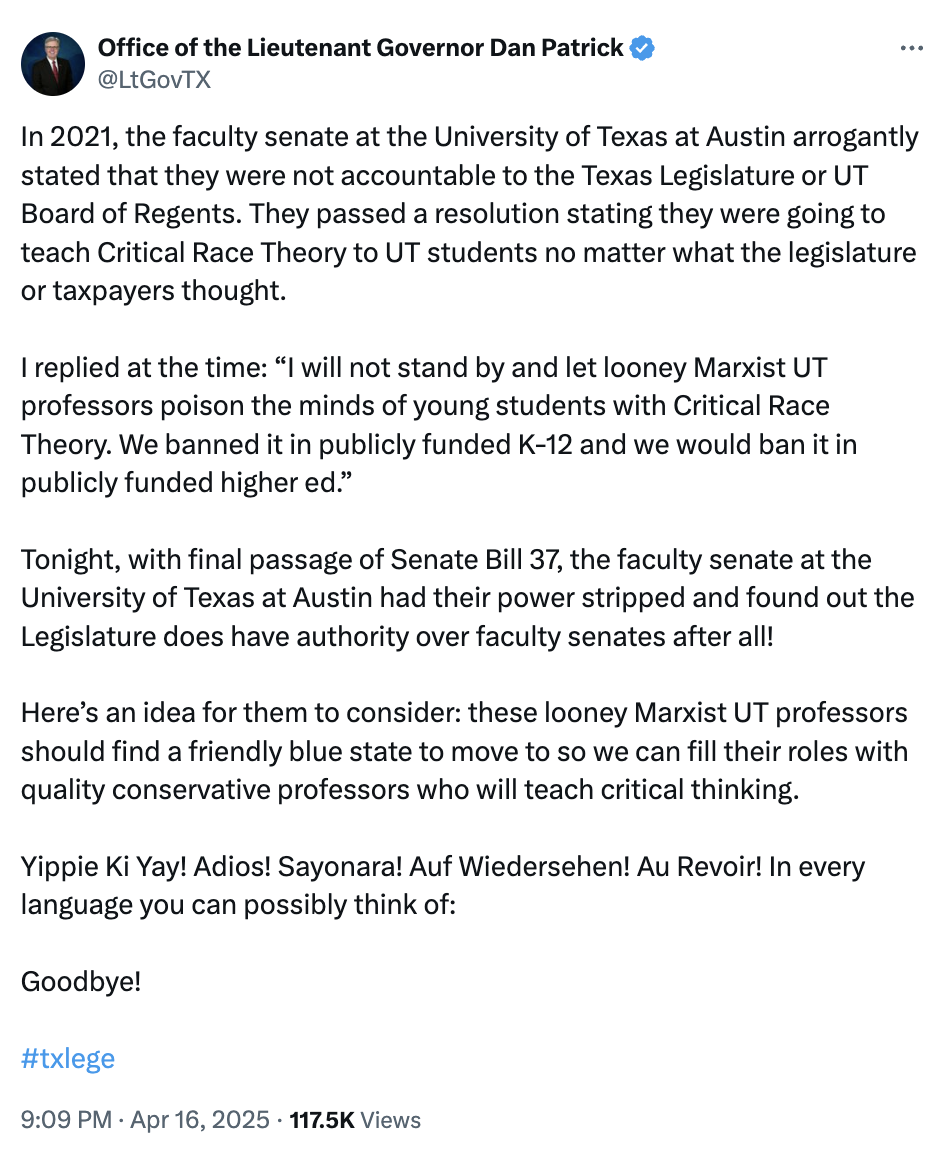
For Patrick, it was personal. Back in 2022, the University of Texas at Austin’s faculty council openly defied him by affirming academic freedom at a time when he and many other Texas lawmakers were trying to ban “critical race theory” in the classroom. It was an insult he could not let pass. “I will not stand by and let looney Marxist UT professors poison the minds of young students with Critical Race Theory,” he vowed. Three years later, he has his revenge.
SB 37– like 13 other bills introduced in 2025 in states from Indiana to Ohio, Utah, and West Virginia – attacks the principle of shared governance. This is the idea that universities are, at their most basic level, a “joint effort.” No one party or faction within the institution can call all the shots or pull every lever. Faculty members develop and manage the curriculum, but they must work within broad educational goals set by administrators. Those administrators allocate funding and resources, but ultimate fiduciary power rests with the governing board. And while governing boards have authority, they respect the local expertise of faculty and administrators. Indeed governing boards themselves are not expected to hold educational expertise and must rely on faculty for both subject area expertise and insight into the inner workings of the classroom. This delicate balancing act plays out on multiple levels across the institution, in issues from faculty hiring to student discipline and standards for admission or graduation. Give any one faction too much authority – for instance, by vesting all hiring and firing power in the governing board – and very quickly the university will face challenges in fulfilling its academic mission.
For further reading:
Is University Shared Governance on the Way Out? How State Legislators Are Shifting Power to Themselves

Texas universities are finding this out the hard way. Under SB 37, sponsored by State Sen. Brandon Creighton, faculty senates and councils in most of the state’s public universities were terminated as of September 1, 2025. Most have since been resurrected by their boards of governors, but in a radically transformed state. First, they are now largely toothless advisory bodies, prohibited under the law from wielding “final decision-making authority on any matter.” Second, they are no longer representative, with up to half of the faculty senates’ members (including their presiding officers) now appointed by university presidents. And to rub salt into the wounds, there is now a statewide ombudsman, appointed by the Texas governor, tasked with investigating whether universities abide by the new limitations on faculty power. Indeed, the law goes so far as to specify that “shared governance structures may not be used to obstruct, delay, or undermine necessary institutional reforms or serve as a mechanism for advancing ideological or political agendas.”
In April, after the Texas State Senate passed his draft of SB 37, Creighton took the opportunity for a victory lap. “For too long, unelected faculty senates have operated behind closed doors, steering curriculum decisions, influencing institutional policy, issuing political statements to divest from Israel, and even organizing votes of ‘no confidence’ that undermine public trust.” With the enactment of SB 37, the era of shared governance comes to a close.
It also brings to a close Creighton’s career as a legislator. Shortly after SB 37 was signed into law, he stepped down as a state senator. His next job? Chancellor of Texas Tech University.
Shared Governance and Academic Freedom
Creighton’s predictions for the impact of Texas SB 37 are quickly becoming facts on the ground. On September 8, just one week after its faculty senate was abolished, Texas A&M fired Melissa McCoul, an English instructor, for discussing gender and sexuality in the classroom – a move that PEN America called “the death of academic freedom in Texas.” Two days after that, Texas State University fired a tenured history professor for discussing the hypothetical overthrow of the U.S. government at an academic conference. Now in his new role at Texas Tech, Creighton is making quick use of the powers he secured for himself by issuing directives that outright prohibit some content from academic instruction and require professors to seek permission to include any content “related to” gender identity and sexual orientation in their courses.
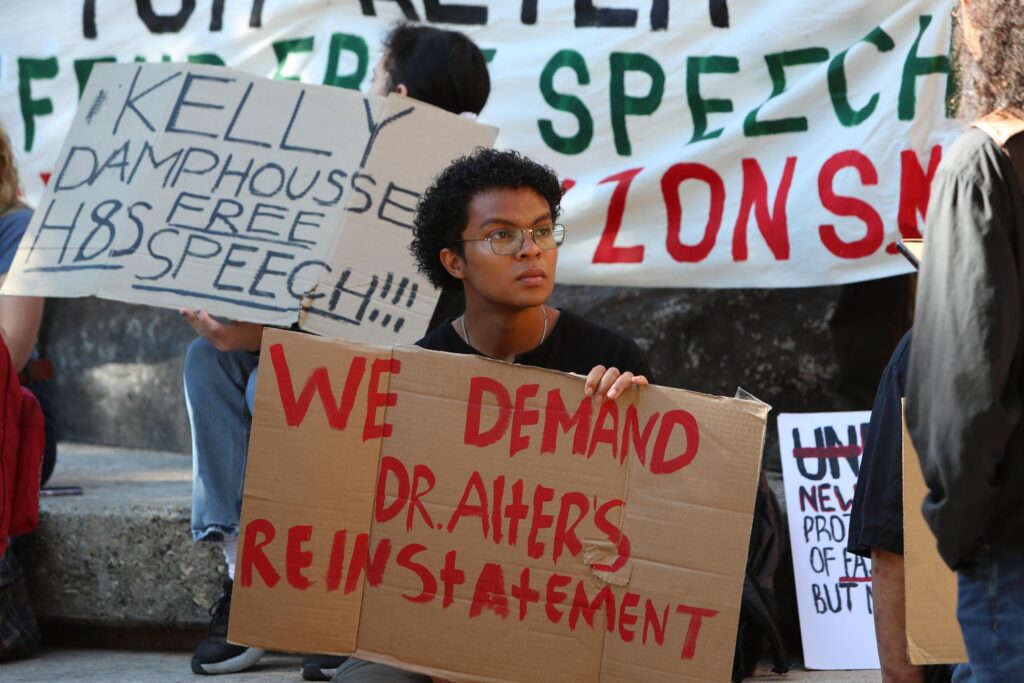
Faculty senates have often been defenders of academic freedom. Supporters of censorship know this, which is why they have spent recent years trying to weaken, constrain, and abolish them. They tried in Arizona in 2024 and came within a hair’s breadth of success. The same thing happened at the University of Kentucky, also in 2024, and at Spartanburg Community College in 2023. Bluefield State University’s faculty senate was eliminated by its president in 2022. When some of the faculty there complained, he threatened to eliminate them, too.
In 2025, these efforts continued to spread. In Indiana, lawmakers snuck last-minute language into the state’s must-pass budget bill to make “faculty governance organizations” at the state’s public universities “advisory only.” Power over curricula, tenure decisions, and other core academic matters will have to shift elsewhere, most likely to each institution’s board of trustees – the members of which, per HB 1001, will now be selected exclusively by the governor. Next door in Ohio, a very similar set of provisions (also inserted into the state budget bill) gives each university’s board of trustees “ultimate authority” over academic programs and curricula. Generously, the board must still grant faculty “the opportunity to provide advice, feedback, and recommendations” on what gets taught in their classrooms – but as the law makes clear, the board retains “final, overriding authority.” And as in Indiana, those trustees are picked entirely by the governor.
While a case can be made that boards should have an oversight role in setting academic programs, PEN America’s concern with these laws is how thoroughly they seek to remove or lessen the role of the faculty in campus governance, particularly when it comes to determining degree requirements or curricula. Such educational matters have long been understood as the purview of faculty, and yet with these bills, faculty expertise is brushed aside.
The argument that it is necessary to reform tenure and abolish shared governance just serves to mask the state actors’ own interests in exerting control over the academy.
Utah, to cite another example, is sidelining faculty involvement in curriculum by setting up a parallel structure where an administrator holds all the cards. Under a law passed last spring, a new Center for Civic Excellence was founded at Utah State University. One of the center’s charges is to develop a mandatory general education curriculum that focuses on texts “predominantly from Western civilization” and on “the founding principles of American government, economics, and history.” These courses will be developed by a faculty curriculum committee, but crucially, the members of that committee will be selected entirely by an administrator. That same administrator will hand pick the faculty who will teach the courses, approve their syllabi, and ensure that their teaching adheres to the center’s “principles, values, and goals.” It is difficult to discern in all of this any role for USU’s faculty senate. The board of trustees insists that this new law actually “preserves” faculty governance, but that is hard to square with the facts.
These efforts to undermine shared governance are also related to tenure restrictions: bills that weaken or eliminate tenure. As noted above (in Section II), the percentage of faculty who are full-time tenured or tenure track has been steadily declining for decades. Some state legislatures have sought to speed up the trend. In 2025, five states introduced bills that aimed to limit tenure protections, including three that sought to end the practice altogether at public universities or colleges (North Dakota’s HB 1437 was amended before passage so that it significantly weakens tenure protections, but no longer outright abolishes tenure). And though mandated post-tenure reviews do not inherently threaten academic freedom, evidence out of Florida illustrates that the implementation of post-tenure review must be watched closely. After the Florida legislature mandated post-tenure reviews, the State University System of Florida implemented a policy that stipulates that faculty can be fired if they receive a low rating on a review. At the flagship University of Florida, 36 faculty members (14% of those reviewed) either were terminated or opted to relinquish their tenure during the first round of the review process. Tenure, like shared governance, is a crucial part of the structure that enables colleges and universities to function. It protects faculty individually and as a body so that they can teach, research, and contribute to the operation of the institution without fear of losing their jobs because someone objects to the content of their work.
Cases like these reveal an all-out push in state after state to undermine the principles of respectful collaboration that allow shared governance to work. This is not about correcting an imbalance or streamlining processes. It is about subjugation. It is the idea that faculty cannot be trusted and that only government-picked administrators or trustees should get to wield power. The argument that it is necessary to reform tenure and abolish shared governance just serves to mask the state actors’ own interests in exerting control over the academy.
Shut Up or Else
All the examples above are drawn from state legislation, but new laws are not the only way of bringing faculty to heel. Over the course of 2025, the federal government has used every tool at its disposal to wear away at shared governance, from lawsuits and investigations to public humiliation. And it is working.
One of the most egregious episodes involves George Mason University. This past July, the U.S. Department of Education launched a pair of investigations into the university’s DEI policies. In response, George Mason’s faculty senate adopted a resolution affirming academic freedom and criticizing the federal government for its interference in university affairs. This must have infuriated someone, because just a few days later, the Department of Justice actually opened an investigation into the senate. Calling the resolution “concerning,” the department demanded that the faculty senate surrender “any proposed drafts of [the] resolution, and all written communications (including emails, texts, voice mails and other forms of electronic communications) between any Faculty Senate members or between Faculty Senate members and [university administrators].” The message to George Mason faculty is clear: Shut up or else.
The shakedown at George Mason is an extreme case and attracted much attention. There are others, however, that are just as troubling but flew below the radar. Academic partnerships are another pressure point. In January 2025, Harvard settled a pair of lawsuits brought by Jewish groups, the terms of which include pursuing an academic relationship with an Israeli university. Brown University agreed to something similar in its settlement with the federal government. As part of its settlement, Barnard College agreed to expand its partnership with the Jewish Theological Seminary. Around the same time, Harvard also suspended its research partnership with Birzeit University in the West Bank, a key demand made by congressional Republicans in a July 2024 letter to Harvard’s president. In each of these cases, it is one thing for faculty and administrators to expand or contract these academic partnerships with other institutions; but it is another for such a measure to be externally imposed, especially as part of a settlement with the federal government. Generally, when a university decides to establish an academic partnership with another institution, it should do so only for academic reasons, and faculty should have a significant, albeit not determinative, say in the matter. Yet in each one of these cases, agreements were made by senior administrative leaders scrambling to placate governmental and legal fury. Questions of an academic nature should be answered through an academic process, but not once in any of these episodes were faculty consulted.
Another area where faculty are being shoved aside involves student discipline processes. In most universities (though not all), reviewing students for misconduct is one of those tasks that gets shared between administrators and faculty. That is now changing. Under enormous pressure from the federal government, both Columbia and Harvard rewrote their student discipline policies in ways that trample shared governance. The obvious trigger was the wave of pro-Palestinian protests in 2024. In Columbia’s case, the university moved authority over student misconduct from the University Judicial Board, on which faculty have a prominent place, to the Office of the Provost. This change was one of the Trump administration’s key demands and a condition of releasing Columbia’s frozen federal grants. It also happened without either the knowledge or the consent of Columbia’s faculty senate, an alarming and potentially illegal attack on shared governance. Harvard has largely followed suit, centralizing student disciplinary processes under the Office of the President, which once again was one of Trump’s conditions for federal funds.
While these policies initially limit faculty oversight, the downstream consequences will inevitably harm student speech. This is not because faculty are somehow the only ones competent to judge students accused of misconduct. Rather, it is simply that faculty are usually less vulnerable than administrators to direct outside pressure and more attuned to the importance of academic freedom and the educational process. That is part of what makes shared governance so necessary, and what makes the growing threats against it so concerning.
Section V: State-Imposed Viewpoint Diversity
A healthy university is one where a wide range of views are present, limited only by the norms of discipline-specific expertise, respect for facts, and such substantive rules as are necessary to ensure that the campus is free from harassment and discrimination. On such a campus, students and faculty of all political stripes feel equally welcomed. Unfortunately, countless surveys suggest this is too often not the case, an impression borne out by the paucity of self-identified conservatives within the ranks of the professoriate.
PEN America supports the idea that universities ought to be intellectually diverse, but believes efforts to achieve this must arise from within and be directed by universities themselves. Only the university possesses the contextual knowledge and academic sensitivities to promote intellectual diversity on its campus while preserving academic freedom and educational excellence. For instance, recent efforts by Tufts University to bring more political balance to its campus provide a model that other colleges and universities ought to consider.
Unfortunately, it has become all too common to see agents external to the university – political figures, government agencies, lobbying groups, business and industry – trying to impose intellectual diversity on the university, often through heavy-handed interference. Such efforts invariably wreak havoc on academic freedom. Whether policies aim for an arbitrary notion of “balance” or target reforms at specific disciplines, they effectively punish some forms of speech and reward others. Worse still, they tend to lock faculty into a rigid matrix of underrepresented-versus-overrepresented viewpoints, assuming faculty will stick to an assigned script, and opening the door to the use of other facets of identity (e.g., race, religion, ethnicity) as proxies to assess the faculty’s political diversity (or lack thereof).
Indeed, whether coming from the left or the right, state power is far too blunt a tool for this delicate task, which is why PEN America has opposed not only Republicans’ proposals of this nature, but also California’s DEI mandate in 2023. State guidance to California’s community colleges instructed faculty that they must adopt or affirm very specific practices and ideologies in their work, including that they “demonstrate an ongoing awareness and recognition of racial, social, and cultural identities with fluency regarding their relevance in creating structures of oppression and marginalization.” Faculty were told that this guidance was a “baseline” for employment, tenure, and promotion – guidance that goes far beyond DEI policies at other colleges and universities nationwide and seeks to compel certain speech. When lawmakers try to legislate a particular mix of viewpoints, the natural curiosity and growth that education is meant to engender will suffer.
In 2025, initiatives to impose “viewpoint diversity” on America’s campuses came from multiple sources at both the state and federal levels, including specific legislative proposals, executive orders, policies, and other directives. In terms of state laws, there were at least 23 bills introduced in 2025 that reference the notion of “viewpoint” or “intellectual” diversity, plus one resolution (HR 947) introduced in the U.S. House of Representatives. The obvious and bitter irony is that these bills requiring viewpoint diversity have come amid a sustained state and federal level campaign to prohibit “diversity, equity, and inclusion.” As a result, what’s been advanced in the past year is hardly a value-neutral proposition about increasing the diversity of thought on campus. Regardless of how one views the current political leanings of the professoriate, the “viewpoint diversity” pushed by many Republican lawmakers has become little more than a coded phrase used to censor certain progressive ideas while promoting certain conservative ones.
State Intellectual Diversity Legislation in 2025
The idea of legislating “intellectual diversity” as a requirement of higher education is not new. In South Dakota, lawmakers passed such a bill in 2019, HB 1087, leaving administrators to determine how best to “promote and ensure intellectual diversity” on the state’s campuses. Similarly, in Kansas in 2021 and Missouri in 2024, lawmakers considered (but ultimately rejected) bills requiring public universities to stage debates between “speakers who represent widely held views on opposing sides of the most widely discussed public policy issues of the day.” The bills were based nearly word for word on a piece of model legislation developed by the Ethics and Public Policy Center called the “Campus Intellectual Diversity Act.” At the end of each year, the calendar of debates, along with topics and participants, was to be shared with the legislature for review – the point being, as explained by the model bill’s creator, Stanley Kurtz, and duly reflected in the Kansas and Missouri bills, to threaten universities into platforming a particular range of viewpoints. “Legislatures exercise the power of the purse,” Kurtz wrote. “If they authorize an office designed to broaden the range of campus speakers and public debates, yet the intellectual monoculture continues, reduction in university funding could result.”
Intellectual Diversity in Indiana
PEN America’s concern over state-imposed intellectual diversity is not speculative. We warned in 2024 that SB 202 was one of the “most censorial pieces of legislation” we’d seen, that it posed serious threats to academic freedom and would “stifle faculty speech.” Unfortunately, that’s what has played out in 2025.
Take the case of Steven Carr, a professor of communication and director the Institute for Holocaust and Genocide Studies at Purdue University. Normally, over the course of the year, Carr would be organizing public lectures, bringing in outside researchers, liaising with the local Jewish community, and teaching courses on topics like the discredited theory of eugenics.
Not anymore, according to a lawsuit filed by Carr and three other faculty members in Indiana (David Schuster, of Purdue, and James Scheurich and David McDonald, both of Indiana University). That’s because Indiana SB 202 requires faculty members at the state’s public universities to promote “intellectual diversity” in the classroom, including by presenting “multiple, divergent, and varied scholarly perspectives” on issues. Intellectual diversity is generally an admirable goal – one aligned with PEN America’s mission of advocating for free expression. But when it comes to the issues Carr teaches, like the reality and scale of the Holocaust, there are no “divergent” perspectives – not legitimate ones, anyway. That puts Indiana faculty like Carr in an impossible situation: Waste precious class time on dubious and sometimes dangerous ideas, or risk severe professional harm.
Indeed, in 2025, Indiana faculty reported to The Chronicle of Higher Education that SB 202 had led them to change lesson plans, drop controversial topics, and even shut down classroom conversations. Already at Indiana University, one professor has been disciplined, and another was removed from teaching a class. Across the state, dozens of complaints have been lodged against faculty via the online reporting systems hastily set up by their universities, including at least 50 at Indiana University. That’s why Glenn Berggoetz, a composition lecturer at Purdue, will no longer have his students write an essay answering the question “Does God exist?” – because, he said, the law would require him to discuss the question from “28 different perspectives” if he wants to protect his job. It’s also why Denise Lynn, a professor at the University of Southern Indiana, has dropped some recent examples involving President Trump from her course on sexism in American history. She told the Chronicle: “No one told me to censor myself. It just felt like I was maybe setting myself up to have a student complain against me.”
This sort of self-censorship isn’t paranoia. It’s what any rational professor would do when “intellectual diversity” is not a goal but a slogan imposed by the state, and which carries significant adverse consequences for campus free speech.
While lawmakers in Kansas and Missouri backed away from these efforts, other states have followed South Dakota. In 2024, Indiana enacted SB 202, which claims to ensure faculty promote intellectual diversity, but has in fact created new mechanisms to target and punish faculty for their speech in the classroom. In 2025, Ohio joined along too, passing SB 1, which requires public universities to promote “intellectual diversity,” which it defines as “multiple, divergent, and varied perspectives on an extensive range of public policy issues.” This requirement extends to every facet of university life, from the speakers whom faculty and students invite to campus (they must reflect “diverse ideological or political views”) to which courses are approved for delivery or count toward a degree. Even “student learning outcomes” must demonstrate a university’s commitment to intellectual diversity.
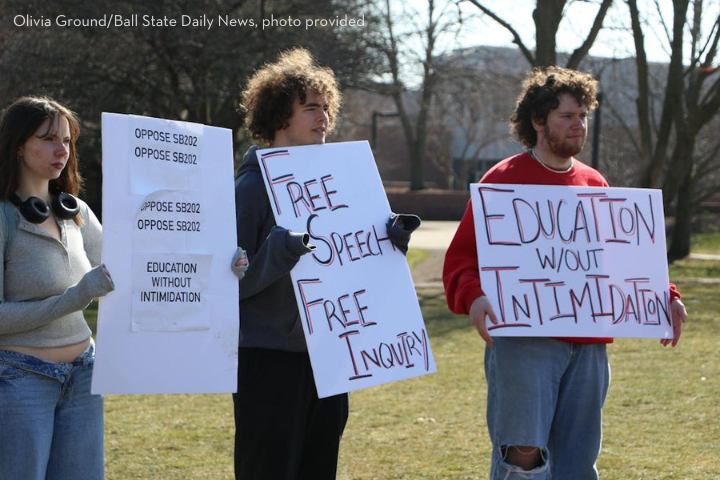
It is worth reiterating: the stated objective of greater diversity of thought on campus is consistent with visions of a pluralistic and democratic society; but these policies aren’t about achieving that. Instead, they impose a vague notion of viewpoint diversity, along with new mechanisms to scrutinize or punish faculty speech according to questionable and ambiguous standards. In Ohio, because of SB 1, faculty are now evaluated by students according to how well they “create a classroom atmosphere free of political, racial, gender, and religious bias,” and, as in Indiana, students at Kent State University, Bowling Green State University, and the University of Toledo can file complaints against professors they feel are not promoting intellectual diversity in the classroom. Defenders of Ohio’s SB 1 insist that it poses no threat to campus free speech, but this is not borne out by the facts. At the Ohio State University, the state’s flagship, the law has already been interpreted to prohibit the university, most departments, and individual faculty from offering land acknowledgements.
When faced with vague requirements to promote intellectual diversity and protocols that encourage students to file complaints, faculty in Ohio will likely couch ideas in ways that distort the educational process. As we have seen with educational gag orders for years, many educators will simply avoid classroom discussions that could land them in hot water. Those without that option will devote more time to discussing ideas that may not merit it, out of fear of not presenting all ideas equally. The same applies to outside speakers: Faced with a limited budget and crowded schedule, universities will prioritize speakers with contrary ideas over those whose ideas are simply best or the most interesting – or perhaps simply not invite anybody at all. As for which courses are approved for delivery and taught in a given semester, these decisions are normally made on the basis of academic quality and program need. No longer. Already, Ohio University and the Ohio State University are moving to make “intellectual diversity” a factor in deciding whether something makes it into the course catalog.
Kentucky HB 4, enacted in 2025, says nothing about intellectual diversity per se. However, this piece of Goldwater Institute-inspired legislation does impose a baffling new rule against “indoctrination,” which it defines as the “attempt to imbue another individual with an opinion, point of view, or principle without consideration of any alternative opinion, point of view, or principle.” Under the law, students cannot be required to take any course whose “primary purpose” is to indoctrinate students into believing a “discriminatory concept.” Should an academic program include such a course as one of its requirements, the Council on Postsecondary Education in Kentucky must move to eliminate the program in its entirety.
Language such as this – “primary purpose,” “without consideration of any alternative opinion,” and so forth – is extraordinarily vague. And that is likely the point. Such ill-defined marching orders encourage faculty to contort their teaching, either by indulging alternative opinions and points of view regardless of their academic merit, or else by skirting such allegedly “discriminatory concepts” all together – whichever is simpler and less likely to draw the ire of politicians. To be sure, those same politicians have taken pains to include in Kentucky HB 4 an exception for “academic freedom.” In theory, this would protect faculty rights. In reality, it will provide little protection and be virtually impossible to implement. Indeed, at the University of Louisville, faculty have been told that the Office of University Counsel will evaluate their course materials on a case-by-case basis to see if they fall under any of the exceptions enumerated in the statute – as in whether their course material will in fact qualify for the academic freedom exception in the law. This is no way to run a university, especially one ostensibly committed to open inquiry, debate and the freedom to learn, as the inevitable result will be the chilling of academic speech.
Civic Thought Centers
While some bills aim to promote intellectual diversity by punishing its absence, another strategy is to create spaces that will ensure that certain ideas are present on campus. That is the motive behind state-established “civic thought” centers now popping up in universities across the United States. The first of these was the School of Civic and Economic Thought and Leadership (SCETL) at Arizona State University, which lawmakers established in 2016 as a “stand-alone academic entity.” Others soon followed, including in Florida, Mississippi, North Carolina, Ohio, Tennessee, and Utah. And in 2025, laws established civic thought centers in Iowa and West Virginia. Of course, the federal government has also sought to put its thumb on the scale, with the Department of Education announcing a new grant opportunity in July 2025 aimed to support schools that have civic thought centers.
Taken as a whole, these centers are difficult to describe and should not all be tarred with the same brush. Some are perfectly respectable and uphold the core values of academic freedom and shared governance. The Institute of American Civics at UT-Knoxville, for instance, was established on a bipartisan basis, is subject to normal faculty oversight, and is by all accounts a valued addition to the university. But others are much more alarming, and it is this second type that we focus on below.
They share two key characteristics. First, they have all been created either by law or through direct involvement by politicians. Rather than arising out of and through the normal academic process of program proposal, debate, and establishment, most of these centers are foisted on universities by politicians. Once installed, they tend to be subject to direct political control and must continually justify their activities to lawmakers.
Ohio’s centers for “civics, culture, and society” are a typical example. Five of these centers were created by the legislature in 2023, and all are overseen by a board of trustees handpicked by the governor and state senate. Each year, the centers’ directors must submit a report to the statehouse detailing their achievements and progress towards the state-mandated goal of “expanding the intellectual diversity of the university’s academic community.” Even more extreme is the Washington Center for Civics, Culture, and Statesmanship, newly formed by the West Virginia legislature in early 2025. Under the terms drawn up by lawmakers, the Center’s director has authority over curriculum, hiring and firing, organizing lecture series, inviting guest speakers, and virtually every other facet of academic life. The director, meanwhile, is nominated by the governor and approved by the state senate, an arrangement virtually without precedent at any university in the country.
Other centers have not been explicitly created by law, but nevertheless are so reliant on government appropriations for their day-to-day activities that political interference is inevitable. For instance, the Hamilton Center for Classical and Civic Education was established at the University of Florida following a lobbying blitz by an obscure conservative nonprofit called the Council on Public University Reform. Little is known about this organization, but its efforts were closely followed by Gov. Ron DeSantis and championed by his Republican allies in the legislature. Since its founding, the Hamilton Center (now the Hamilton School) has benefitted from support from the statehouse and has a separate budget line in state appropriations bills.
Wary of the watchful eye of the legislature, which controls the purse strings and calls the shots, administrators and faculty alike may well feel browbeaten into submission. The result is not an intellectually diverse campus environment but merely a facade.
The second characteristic common to these centers is their mission: Ostensibly, their mission is to increase the viewpoint diversity of their universities, but – as discussed above – this really amounts to favoring certain ideas and not others. The laws establishing “civic thought” centers are admirably direct. According to legislators, they exist to change the ideological composition of the professoriate and “balance” the types of viewpoints expressed on campus. “There’s a considerable left-wing bias at the university educationally, in terms of the faculty, student organizations, colloquiums and presentations,” explained a lawmaker in Arizona who spearheaded the founding of SCETL, adding, “A small amount of money to get some balance is well-worth the expense.” Bill Lee, the governor of Tennessee, made a similar pitch for what became the Institute of American Civics at UT-Knoxville, which he hoped would help promote an “informed patriotism” to counter the spread of “anti-American thought” on campuses. And during the rollout for UNC-Chapel Hill’s School of Civic Life and Leadership, the chair of its board of trustees explained to a Fox News host that the purpose of the school was to “remedy” the left-wing bias of the professoriate.
Combining these two features – governmental control and mandated “viewpoint diversity” – is a recipe for disaster. Universities will have to anticipate what politicians consider to be a desirable (but under-represented) viewpoint on campus, and then make hiring decisions on that basis. And once hired, faculty will be expected to hold to and articulate that underrepresented view, even against their better judgment or evolving personal beliefs. If not, how can these centers continue to justify themselves to state lawmakers in their annual reports and keep the appropriations flowing?
This is not idle speculation. PEN America described earlier this year the crisis at the University of Florida, where senior administrators had attempted to strong-arm faculty into supporting the Hamilton School and extract pledges of loyalty from would-be opponents.
And something arguably worse played out this past year at UNC-Chapel Hill’s School of Civic Life and Leadership (SCiLL). The deep origins of SCiLL lie in the disappointment of the John William Pope Foundation, a conservative nonprofit that had endowed a lecture series focused on “renewing the Western tradition” at UNC-Chapel Hill in 2009. After just three lectures, critics close to the Pope Foundation began to complain that the invited speakers, which at that point included the philosopher Kwame Anthony Appiah and Shakespeare scholar Stephen Greenblatt, were insufficiently enamored with the “Western tradition.” Around the same time, the Pope Foundation published a report describing what it saw as attempts by universities to subvert the wishes of conservative donors. Rather than give money directly, the report argued, conservatives should create autonomous university centers to act as “nodes of conservative or libertarian research and teaching within universities that may otherwise be dominated by liberal orthodoxies.”
Fast-forward to 2023, when the North Carolina legislature passed its annual Appropriations Act. Included in that 645-page act is language creating the School of Civic Life and Leadership, the one whose board chair had vowed it would be a “remedy” for left-wing bias. Not even two years later, the school’s supporters proclaimed it to be an “unmitigated disaster,” with accusations of politicized interference and mass resignations by senior leadership. At the heart of it all is SCiLL’s dean, Jed Atkins, who is required by law to update the legislature annually on the School’s activities. Two former members of SCiLL (who otherwise remain very supportive of its mission) have accused Atkins of bias and improper manipulation of the faculty hiring process; a third said Atkins has “an extremely narrow conception of acceptable viewpoints” and “has fostered a dysfunctional anti-intellectual culture at SCiLL.” Atkins rejects these charges, but no one can deny that the faculty he has hired are overwhelmingly conservative and that the center is generously funded by the political Right. Its critics allege that SCiLL operates as its own fiefdom, nominally within the College of Arts and Sciences but in reality unaccountable to anyone in the university besides the provost. And even the provost’s hands seem perhaps to be tied – the provost was forced to resign last April shortly after clashing with Atkins over his hiring decisions.
This, then, is one of the principal problems with mandating so-called intellectual diversity. In theory, it is a means to “balance” whatever positions are believed to prevail on campus; in practice, it has resulted in the establishment of centers without proper faculty input and oversight. Even if not implemented in such a heavy-handed way, true intellectual diversity cannot be achieved by fiat, or by subordinating academic merit to ideological or political viewpoint. Faculty hired under such a regime may certainly be expected – and may feel an obligation – to play a part, articulating a specific political position in contradistinction to others, and end up narrowly bound by external expectations. Wary of the watchful eye of the legislature, which controls the purse strings and calls the shots, administrators and faculty alike may well feel browbeaten into submission. The result is not an intellectually diverse campus environment but merely a facade.
Federal Policy: Policing Viewpoint Diversity
In 2025, the federal government joined the viewpoint diversity bandwagon, using it as a convenient rationale for explicitly favoring some ideas and punishing others. For example, the Department of Energy stopped funding numerous scientific research programs at Harvard, in part because of what the government calls a lack of “viewpoint diversity.” The Departments of Agriculture, Transportation, and Health and Human Services and NIH have also used similar justification for canceling other grants.
The willingness of the government to use the concept of viewpoint diversity as a cudgel to suppress speech it does not like has been especially clear in the actions of the Joint Task Force to Combat Anti-Semitism. As its name suggests, the multi-agency task force was established in February 2025 to address antisemitism in schools and on college campuses, ostensibly in reaction to the very real trends on campuses (discussed above, in Section III). However, in the weeks and months following its creation, the task force staked out a far more expansive mission for itself that includes fighting everything from “anti-American” ideas in the classroom to plagiarism and declining mathematical rigor. An earlier investigation of campus antisemitism by the U.S. House of Representatives had already identified viewpoint diversity as a necessary reform. The task force then made viewpoint diversity the centerpiece of its complaints against targeted universities, including Columbia and Harvard. On closer examination, these efforts are revealed to be about exerting as much direct government control over these institutions as possible.
Columbia University
The opening salvo against Columbia came on March 13, when three of the task force’s central members (representing the General Services Administration, the Department of Health and Human Services, and the Department of Education) sent a joint letter to Columbia University. One week earlier, their agencies had taken hostage $400 million in federal research funding; now they were issuing their list of demands. Among them: “Begin the process of placing the Middle East, South Asian, and African Studies department [MESAAS] under academic receivership for a minimum of five years.”
MESAAS is the home department of several faculty who have been accused of antisemitism in teaching about Palestine, Israel, and Middle Eastern history, including Joseph Massad, a professor of modern Arab history who had drawn the ire of Congress for his criticism of Israel after the October 7, 2023 attack by Hamas. There is little doubt that the demand that their program be placed in “receivership” sought not so much viewpoint diversity as the censoring of certain viewpoints.
Columbia seems to have clearly understood the task force’s message. On March 21, it released a white paper called “Advancing Our Work to Combat Discrimination, Harassment, and Antisemitism at Columbia,” showing the task force that it was on board and capable of reforming itself. Among its promises was a review of all the university’s “regional studies” programs, starting with MESAAS, the Center for Palestine Studies, and others with a Middle East focus.
These concessions must have pleased the task force, because they were eventually incorporated into the formal legal settlement entered into by Columbia in July. Per the terms of the settlement, Columbia must ensure that its Middle East courses are “comprehensive and balanced,” and must also commit to making new faculty hires to the Institute for Israeli and Jewish Studies who will “contribute to a robust and intellectually diverse academic environment.” For its part, Columbia interprets this as a mandate to “address issues of intellectual breadth, or a lack thereof,” in its Middle East programs. Again, our concern is not with the laudable goal of intellectual diversity, but with the loss of autonomy and the stifling of free expression when the government imposes and polices such policies. The Columbia settlement makes the threat explicit: Should the federal government conclude that Columbia has failed to meet these obligations (and notwithstanding language in the settlement insisting that none of its provisions “shall be construed as giving the United States authority to dictate faculty hiring”), it may seek a binding injunction from a federal judge.
The task force’s victory over Columbia was hailed by would-be censors of higher education. Linda McMahon, the secretary of education, called it a “template for other universities around the country”.
Harvard University
Harvard was the task force’s next target. In March, Harvard president Alan Garber was informed that the university’s research grants and contracts with the federal government were being placed under review. This was followed on April 3 by a longer letter from the task force that included a list of reforms it demanded the university undertake as a condition of remaining “a responsible recipient of federal taxpayer dollars.”
The very first item on that list: “Programs and departments that fuel antisemitic harassment must be reviewed and necessary changes made to address bias, improve viewpoint diversity, and end ideological capture” (emphasis added).
Harvard quickly scrambled to address the task force’s demands. On March 25, Hopi E. Hoekstra, dean of the Harvard Faculty of Arts and Sciences, ordered departmental leaders to submit to her a summary of how their programs promote “exposure to different ideas, perspectives, and topics.” One day later, Harvard’s interim dean of Social Science David M. Cutler dismissed the director and associate director of its Center for Middle Eastern Studies, which critics had alleged was biased against Israel. And at just around the same time, Harvard ended its academic partnership with Birzeit University in the West Bank.
If these preemptive moves were meant to placate the task force, the April 3 letter proves they were unsuccessful. Even worse was a follow-up letter sent by the task force on April 11. It demanded that the university seek viewpoint diversity at every level – from the student body to faculty and each “teaching unit” – specifying that any units who do not meet this benchmark will be “reformed” by an influx of new faculty and students. This is an unprecedented effort by the government to assert its control over the internal operations of a university, a level of ideological control that is, in fact, inimical to the goal of viewpoint diversity and the principles of institutional autonomy and academic freedom.
Excerpt from the task force’s April 11 letter to Harvard University:
Viewpoint Diversity in Admissions and Hiring. By August 2025, the University shall commission an external party, which shall satisfy the federal government as to its competence and good faith, to audit the student body, faculty, staff, and leadership for viewpoint diversity, such that each department, field, or teaching unit must be individually viewpoint diverse. This audit shall begin no later than the summer of 2025 and shall proceed on a department-by-department, field-by-field, or teaching-unit-by-teaching-unit basis as appropriate. The report of the external party shall be submitted to University leadership and the federal government no later than the end of 2025. Harvard must abolish all criteria, preferences, and practices, whether mandatory or optional, throughout its admissions and hiring practices, that function as ideological litmus tests. Every department or field found to lack viewpoint diversity must be reformed by hiring a critical mass of new faculty within that department or field who will provide viewpoint diversity; every teaching unit found to lack viewpoint diversity must be reformed by admitting a critical mass of students who will provide viewpoint diversity. If the review finds that the existing faculty in the relevant department or field are not capable of hiring for viewpoint diversity, or that the relevant teaching unit is not capable of admitting a critical mass of students with diverse viewpoints, hiring or admissions within that department, field, or teaching unit shall be transferred to the closest cognate department, field, or teaching unit that is capable of achieving viewpoint diversity. This audit shall be performed and the same steps taken to establish viewpoint diversity every year during the period in which reforms are being implemented, which shall be at least until the end of 2028. (emphasis added)
This is how viewpoint diversity – a laudable goal – becomes a vehicle for the government to enact ideological surveillance and censorship in higher education. To satisfy the demands of this letter, Harvard would have to ask current and prospective faculty, as well as students, about their political beliefs, or at least surreptitiously investigate them. How often does the professor express those beliefs on campus? Too much and they’ll be accused of indoctrination. Too little and they won’t be contributing to viewpoint diversity. What if their political beliefs change over time, for instance shifting from an unusual viewpoint to one more commonly held? Does that make them less attractive as a colleague? Less worthy of tenure or renewal? This is even more preposterous when applied to students – who in theory are attending university to expand their understanding and, yes, potentially change their minds. And always behind it all would lurk the central and unanswerable question: What does it mean for a department to have the “right” ideological mix?
At one level, there is something absurd about the federal government trying to determine a university’s ideological composition. Do we really want elected officials or bureaucrats to tell faculty what to say, who to hire, and how to think?
Yet it seems as far as the task force is concerned, that is their purview. Indeed, if influential officials in Washington, DC, are to be believed, lacking viewpoint diversity, as they define it, is against the law. So said Republican Senator John Kennedy, who explained to the media in June that Harvard was violating federal civil rights laws because it does not “practice viewpoint diversity” but instead practices “ideological capture” – for example by supporting diversity, equity, and inclusion.
Secretary McMahon made a similar claim in response to questioning by Democratic Senator Chris Murphy. What federal statute, Murphy wanted to know, required Harvard’s faculty to be viewpoint diverse? “The statute is Title VI [of the Civil Rights Act of 1964]. These were civil rights violations.” Title VI’s prohibition on discrimination on the basis of race, color or national origin, while not referencing religion expressly, has been interpreted to apply to discrimination based on real or perceived shared ancestry or ethnic characteristics, thereby protecting religious groups, including Jews, in certain instances. However, as the Supreme Court has held, anti-discrimination laws cannot be used – or in this case, clearly misused – either to censor expression the government opposes or to require the inclusion of speech it supports, including by requiring a university to adopt a particular balance of viewpoints.
No wonder that Harvard felt there was little sense in further negotiations. “The university,” Harvard’s lawyers wrote in response to the task force’s letter, “will not surrender its independence or relinquish its constitutional rights. Neither Harvard nor any other private university can allow itself to be taken over by the federal government. Accordingly, Harvard will not accept the government’s terms as an agreement in principle.”
Harvard followed this up a few days later with a lawsuit (a second would follow) that spells out in simple terms why viewpoint diversity, though undoubtedly important for the health of the university, must not be imposed by the state. As they wrote:
The Government threatened Harvard’s federal funding unless Harvard restructured its internal governance, changed its hiring and admissions practices to strike Defendants’ preferred balance of viewpoints, and modified what it teaches its students to align with Defendants’ views. For example, the demands required Harvard to modify its hiring and admissions practices to achieve a particular balance of viewpoints in every “department,” “field,” and “teaching unit.” In other words, the Government wielded the threat of withholding federal funds in an attempt to coerce Harvard to conform with the Government’s preferred mix of viewpoints and ideologies.
The rest of the story is still unfolding. Over the course of May, every grant and contract that Harvard had with the federal government – totalling a little over $3.2 billion – was cancelled. The harm to research is incalculable. Even if Harvard prevails in court or negotiates a deal with the task force (talks are ongoing), the damage is done. And all in the name of “viewpoint diversity.”
Hypocrisy on Display: Repressing Diverse Viewpoints
The grant dollars at play in the administration’s attacks on Columbia and Harvard are certainly jaw-dropping, but such astonishing hypocrisy has become the administration’s calling card – particularly when it comes to its blatant efforts to repress some viewpoints.
Beyond the investigations of and agreements struck with specific universities, this repression can be seen in the implicit rejection of diversity of thought evident in numerous executive orders issued last year. For example, the administration’s executive order from March, “Restoring Truth and Sanity to American History,” which is primarily directed at the Smithsonian Institution and museums and the Department of the Interior, includes the provision that public monuments “not contain descriptions… that inappropriately disparage Americans past or living… and instead focus on the greatness of the achievements and progress of the American people.” Similarly, an executive order from August, “Improving Oversight of Federal Grantmaking,” stipulates that discretionary awards of any kind shall not be used to fund programs that promote “anti-American values” or “the notion that sex is a chosen or mutable characteristic.”
Hypocrisy has become the administration’s calling card – particularly when it comes to its blatant efforts to repress some viewpoints.
In these and other cases, we see an administration that does not actually value viewpoint diversity. Rather, the Trump administration is trying to use federal funding to impose a particular ideological viewpoint through intermediaries, like monuments or various federal grant recipients, or even the schools and universities it operates. We see this same ideological rigidity on display at the military academies, where orders to ban books, eliminate majors, and restrict curricula have been repeatedly reported in the past year. Scheduled lectures by writers and appearances by public figures, including Tom Hanks, have been canceled because of the speakers’ views. When hundreds of books addressing issues of race and gender diversity were pulled from library shelves at military base schools operated by the Department of Defense, 12 students from 5 schools sued. In October, a federal judge issued a preliminary injunction, ordering the books to be restored in those particular schools. Targeted efforts to restrict the circulation of certain ideas about race and gender like these hardly signal a federal administration committed to the open exchange of a diversity of views. Rather, they reflect blatant efforts by the federal government to exert control over the transmission of education and knowledge broadly.
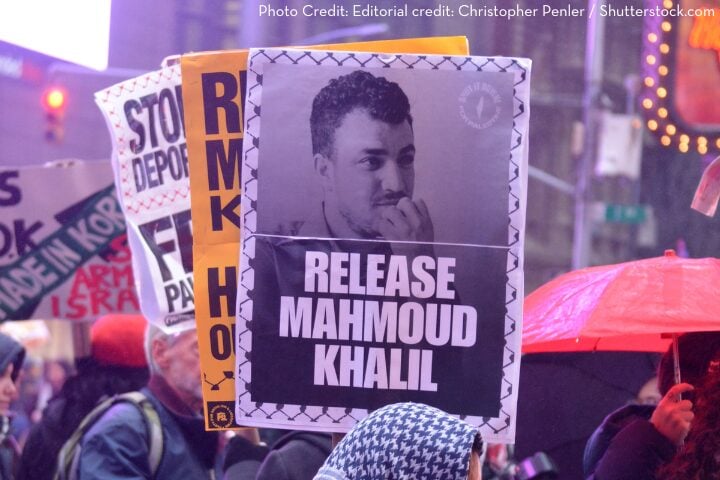
A final example of this hypocrisy is evident in the targeting of international students for detainment or deportation for their speech. Over the past year, the Department of Homeland Security has leveraged its control over the visa process to censor pro-Palestinian activists, threatening them with arrest and deportation for speech that the government says might have “adverse foreign policy consequences for the United States.” That includes Mahmoud Khalil, a former graduate student at Columbia and U.S. permanent resident who was arrested and detained under threat of deportation, and Mohsen Mahdawi, a current Columbia graduate student who was picked up by ICE at his immigration hearing. And then there’s Rümeysa Öztürk, a Turkish student enrolled at Tufts University who was snatched off the streets by federal agents in March 2025. Her offense? As later revealed at trial, it consisted in its entirety of an op-ed she co-wrote for the Tufts student newspaper that criticized how the university responded to student senate resolutions concerning the Gaza War. She joins many other international students targeted by Homeland Security for pro-Palestinian speech and peaceful activism, as well as thousands of international students who have been told that DHS is screening their social media posts.
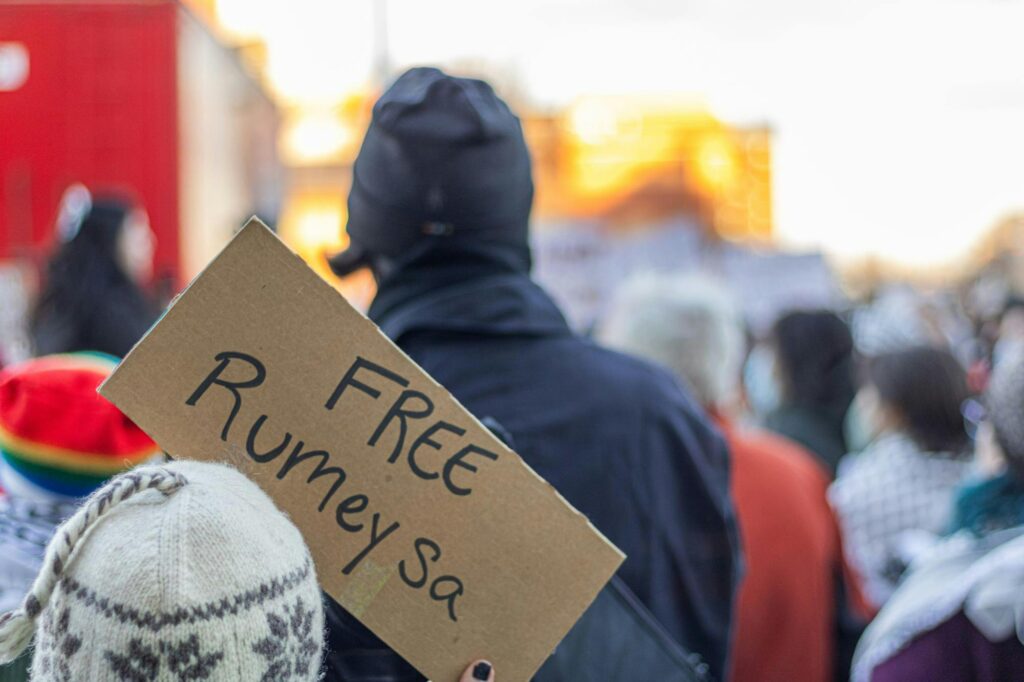
In light of these many and varied actions against international students, universities, military academies, and more, this administration’s statements about viewpoint diversity in colleges and universities ring hollow. In fact, time and time again, the administration has moved to stamp out true diversity of thought on campuses, to impose its own ideological agenda, and to intimidate or punish people for voicing views with which it disagrees. Thus, when the administration stipulated in an executive order in April that it is going to reform accreditation to “prioritize intellectual diversity amongst faculty,” there is valid reason for concern that once again, this will prove to be another way to censor some views and promote others, and expand its web of control over the higher education sector.
Section VI: Jawboning
This past September, Melissa McCoul found herself caught in a political firestorm. Her semester at Texas A&M had begun like any other: preparing classes and welcoming a new class of Aggies. During the summer term a student had accused her of injecting notions of gender diversity into a course about children’s literature – but the university’s president, Mark Welsh, had defended her and the issue had apparently blown over.
Then, on the morning of September 8, a Texas state representative named Brian Harrison posted on social media a short clip of that incident, which the student had secretly recorded. It shows the student accusing McCoul of breaking a federal law that requires professors to teach that there are only two genders (there is no such law) and insisting that exposing her to the idea of gender diversity violates her religious freedom. McCoul attempts to defuse the situation quietly, but when the student refuses to stop interrupting, the professor suggests she should leave.
“CAUGHT ON TAPE,” blared Harrison’s post. “TEXAS A&M STUDENT KICKED OUT OF CLASS AFTER OBJECTING TO TRANSGENDER INDOCTRINATION . . . and A&M President defends ‘LGBTQ Studies.’” In a 23-part thread, Harrison also shared a clip of President Welsh explaining to the student that McCoul had academic freedom in the classroom (the student had secretly recorded that meeting too), and then announced that he had referred the matter to the governor and the federal government for immediate action. In just a matter of days, the thread was reposted 16,000 times and attracted more than 5 million views.
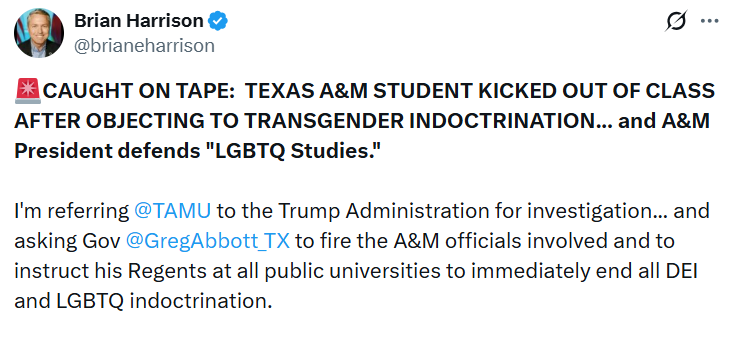
One day later, McCoul was fired, and her department chair and dean were removed from their positions. Three days after that, Welsh stepped down as president. All this despite the fact that no such law had been violated – just the principle of academic freedom.
This is jawboning: the use of official speech to compel private action. It occurs whenever a lawmaker or political official browbeats, bullies, or otherwise coerces somebody into action. While state legislatures may provide general oversight and make high-level funding decisions, it is inappropriate for a legislator to intervene so vociferously in the day-to-day operations of a university – particularly outside of formal lawmaking processes. Unfortunately, Harrison’s recourse to social media to target an individual faculty member, and ultimately the university president, is representative of a wider and frankly dangerous pattern. PEN America has been raising the alarm about jawboning in higher education for some time now and recently predicted that it would be a major feature of the second Trump administration. But it is only since September, after the assassination of Charlie Kirk, that jawboning as censorship truly came into its own.
For further reading:
Jawboning: When Educational Censors Don’t Bother Passing a Law
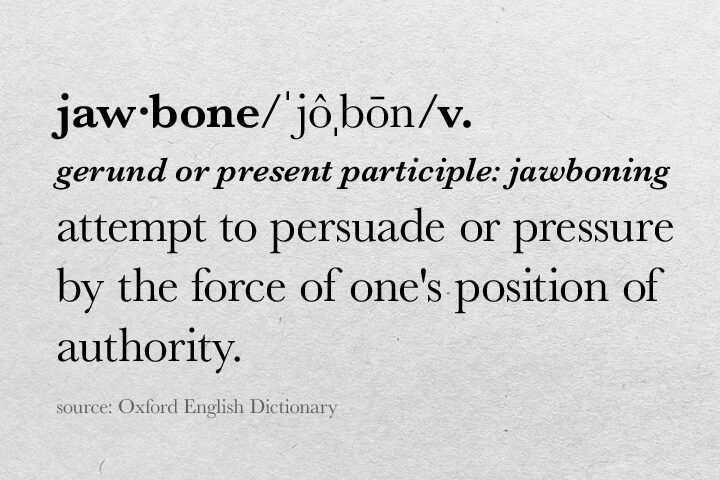
Of course, the most obvious and immediate threat to free expression posed by Kirk’s murder was the murder itself. For over a decade, Kirk had been a force within campus activism. Through Turning Point USA, which he co-founded in 2012, Kirk introduced tens of thousands of young people to conservatism and helped organize more than 800 TPUSA chapters at colleges and universities across the country. Political violence undermines freedom of expression, full stop. Kirk’s killing while speaking at a university was both a deplorable act of violence and a direct attack on the ideal of a campus as a space for open discourse and debate.
In the wake of Kirk’s murder, however, there have also been calls to further limit free expression on campuses. Some public officials, citing public safety concerns, have called on universities to cancel Turning Point USA events. Free speech advocates, including FIRE, have pushed back on this, urging schools to resist “the heckler’s veto.” Also known as “the assassin’s veto,” this refers both to the outright cancellation of events and to the throwing up of roadblocks, new rules, or fees that make it difficult for events to go forward due to safety concerns. In a joint letter to the nation’s higher ed leaders, 17 state attorneys general reminded universities that they must not let concerns about safety, however well-founded, metastasize into censorship. “Particularly at this moment, when free speech itself was attacked, our universities must show through their actions that they will defend free speech and resist the ‘Assassin’s Veto.’” Sadly, that is not what has played out on campuses across the country.
The Bully Pulpit
In the weeks following Kirk’s murder, a new and quite different threat to academic freedom and free speech emerged: pressure from public officials to investigate, suspend, and even fire university faculty for their criticism of Kirk on social media. As of the end of December 2025, PEN America has found that at least 25 faculty have been fired, suspended, or otherwise sanctioned by their colleges or universities for comments on Instagram, Facebook, TikTok, and other online spaces.
This sort of jawboning is a serious problem and ripe for abuse. We have already seen it in a range of cases – for example, the removal of a Louisiana researcher who found that a local energy project is poisoning the water supply, or the suspension of a professor in Texas who voiced criticism of how state leaders are handling the opioid crisis. The growing pattern is a reminder that universities must stand firm against external attempts to pressure them into punishing their faculty for protected speech, because the future of academic research and teaching is at stake.
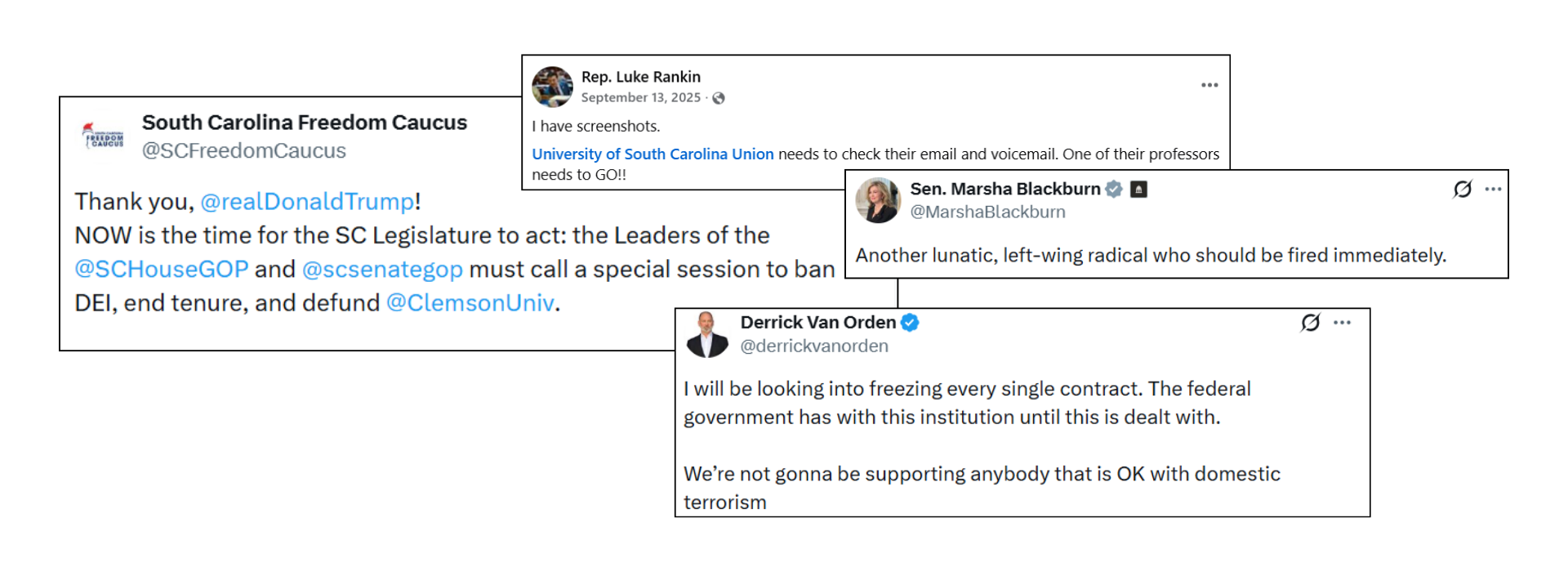
In the case of Charlie Kirk’s murder, the speech for which faculty have been punished varies widely, including posts that were more innocuous and others that were more inflammatory. For instance, a North Idaho College professor wrote of Kirk on his personal Facebook page, “Thoughts and prayers you make it to hell.” The outrage was immediate. The Kootenai County Republican Central Committee, a powerful political force in the college’s corner of Idaho, demanded “full accountability and [the professor’s] firing. NOW!” Shortly after, he was fired. So was a professor at Tennessee’s Austin Peay State University, for merely posting on Facebook a screenshot of a 2023 newspaper headline that read “Charlie Kirk Says Gun Deaths ‘Unfortunately’ Worth It to Keep 2nd Amendment.” A professor at Louisiana’s Southern University Law Center, meanwhile, posted on social media about how she “will 1000% wish death on people like [Kirk]. He is the epitome of evil, and I have no compassion, not even a minute ounce of it for people like him who go around spewing hate the way he does.” Louisiana’s attorney general responded by darkly warning that the professor “has a constitutional right to have opinions,” but that “she does not have a right to teach at a public law school.” The professor has now been suspended pending the outcome of the school’s disciplinary process. And Mississippi College suspended a professor whose only offense was writing, “This is the only thing I’ll share publicly on the subject,” above another person’s Facebook post that likened Kirk’s death to a Greek tragedy.
Faculty Punished for Kirk-Related Speech
| State | Outcome | Evidence of Jawboning |
|---|---|---|
| Alabama | 1 fired (Auburn University) | Yes |
| Alabama | 1 fired (Enterprise State Community College) | Yes |
| Arkansas | 1 fired (University of Arkansas Little Rock) | Yes |
| Florida | 1 suspended (Florida Atlantic University) | No |
| Florida | 1 suspended (Florida Atlantic University) | No |
| Florida | 1 suspended (subsequently reinstated) (Florida Atlantic University) | No |
| Florida | 1 stripped of emeritus status (University of Florida) | No |
| Georgia | 1 fired (Emory University) | Yes |
| Idaho | 1 fired (North Idaho College) | Yes |
| Iowa | 1 investigated (Iowa State University) | Yes |
| Louisiana | 1 suspended (termination pending) (Southern University) | Yes |
| Mississippi | 1 suspended (Mississippi College) | No |
| Montana | 1 suspended (Montana State University – Northern) | Yes |
| New Jersey | 1 fired (Rider University) | No |
| New York | 1 suspended (Syracuse University) | Yes |
| New York | 1 suspended (Syracuse University) | Yes |
| South Carolina | 1 fired (Clemson University) | Yes |
| South Carolina | 1 fired (later allowed to resign in May 2026) (Clemson University) | Yes |
| South Carolina | 1 removed from teaching (University of South Carolina) | Yes |
| South Dakota | 1 fired (later reinstated) (University of South Dakota) | Yes |
| Tennessee | 1 fired (later reinstated) (Austin Peay State University) | Yes |
| Tennessee | 1 fired (Cumberland University) | Yes |
| Tennessee | 1 suspended (later retired) (East Tennessee State University) | Yes |
| Tennessee | 1 suspended (later resigned) (East Tennessee State University) | Yes |
| Tennessee | 1 suspended (termination pending) (University of Tennessee) | Yes |
Note: The information in this table was compiled from multiple media sources and cross-checked against tracking from The Chronicle of Higher Education. PEN America’s numbers differ somewhat from that tracker because we include only faculty (excluding students or administrators) and because we focus solely on sanctions that resulted from social media posts (excluding those that resulted from classroom speech).
We consider a faculty member to have been “fired” or “suspended” based on the action taken immediately following their expressive activity (even if it was later reversed, whether by a court or some other body). Because not all situations are resolved, we have tried to account for their status as of the time of publication.
To evaluate evidence of jawboning, we considered whether there were widely circulated comments on social media and/or letters to college and university officials from politicians that called for punishments for faculty for their comments about Charlie Kirk.
Four other faculty members were punished for their Kirk-related speech in the days following his death, but they are excluded from this table because their speech took place in the classroom. These include a case each at Fresno State University (resulting in suspension), the College of the Sequoias (termination), the University of North Florida (termination), and Guilford Technical Community College (termination). Because they took place in a classroom, these episodes raise a distinct set of political and legal concerns related to academic freedom and campus policies, and cannot be easily lumped together with those involving speech on social media.
This table was modified after original publication, on January 17, 2026.
In at least 19 of these 25 cases involving speech on social media about Kirk, there was some sort of significant jawboning by a public official. In many of these cases, officials threatened to cut funding to the university if their demands for retribution were not met. “If the University continues to employ [these professors],” said U.S. Rep. Claudia Tenney of two Syracuse University faculty members, “it should forfeit every dollar of federal funding.” In North Carolina, State Rep. Lee Reeves warned that if a professor at East Tennessee State University was not fired, “then ETSU should lose all federal funding.” And after an Emory professor pointedly refused to mourn Kirk’s death on Facebook (“Good riddance,” she wrote, before reciting some of his words she found most offensive), U.S. Rep. Derrick Van Orden vowed that he would “be looking into freezing every single contract [the] federal government has with this institution until this is dealt with.”
But none of these examples compare with the full-court press brought to bear on Clemson University in South Carolina. Political figures were virtually tripping over one another in the mad rush to bully Clemson into firing two professors for their speech. Republican lawmakers “must call a special session to ban DEI, end tenure, and defund Clemson,” said one group of state lawmakers. “Look forward to seeing you in your upcoming budget hearings,” said another. If Clemson refused to act, warned a U.S. congressman and candidate for governor, the institution might soon receive a clear message from the legislature: “We will strip you of every red cent the hardworking taxpayers have given you.” Perhaps most shocking of all, state Attorney General Alan Wilson took the time to send Clemson a three-page legal analysis detailing why the university has the authority under state and federal law to fire its faculty members. In fact, Wilson went so far as to personally assure Clemson that if it did fire any professors for their Kirk-related speech, he would make sure that the university was not prosecuted. “We will not criminalize or tie the hands of Clemson officials or other university officials through the criminal process. Instead, we will allow them to run the University in a manner in keeping with the high standards of that Institution.”
In each of these cases, the professors were fired.
In a relatively short period of time, then, protections for academic freedom for faculty were suspended, as institution after institution ignored them in the face of political pressure.
A Telling Silence
But what of the exceptions? There were six cases of faculty being fired or suspended where no apparent jawboning took place. What are we to make of them?
Each of these cases is unique. For example, in the case of an adjunct instructor at Rider University in New Jersey, her dismissal was not the result of a politician’s response to her post, per se, but because of subsequent threats against university personnel made by Kirk’s supporters.
Yet there is a pattern: Four of these six cases occurred in Florida, a state where higher education has been increasingly politicized for years. This is instructive because jawboning through public demands is how politicians get things done outside of the legislative process. In Florida, then, jawboning doesn’t appear to have been necessary – or isn’t visible – because the political takeover of higher education there has already laid the groundwork for campus administrators to fall into line. Increasingly, politicians and political appointees are able to impose educational policy while circumventing paper trails, conveying their orders behind closed doors. Campus leaders do not need public demands to sanction professors for their speech; nor do they seem reluctant to whittle away at the protections of academic freedom. Rather, they appear to have done so without needing to be told.
Take Adam Hasner, the president of Florida Atlantic University. A former Republican majority leader in the state’s House of Representatives and a private prison executive, Hasner had no academic experience when he was appointed to the post earlier in 2025. Within just hours of the news breaking that one of the faculty members at his university had criticized Kirk (more precisely, that she shared posts by other people criticizing him), he announced that she had been placed on administrative leave pending investigation. No state official hectored him publicly. Instead, comments from state officials came only after the fact in the form of attaboys for taking action.
Donald Landry, the interim president of the University of Florida, offers another case. Landry has a sterling academic pedigree, having served as the chair of the Department of Medicine at Columbia University. He is also an ardent critic of DEI. Less than 24 hours after a prominent conservative activist identified an emeritus professor as the author of a Facebook post critical of Kirk, Landry gave the order to strip him of his emeritus status. Again, no state officials weighed in publicly before his demotion. Perhaps they didn’t have to.
The contrast with Tennessee is telling. Tennessee also had five instances in which faculty were punished for Kirk-related speech. But unlike in Florida, these were all preceded by loud and, in some cases, direct intervention by state officials. In Tennessee, none of the leaders of the state’s eleven public universities have held elected office. In Florida, where there are twelve public universities, four are led by former lawmakers (all Republican), and a fifth is led by a close ally of Gov. Ron DeSantis who served on his gubernatorial transition team. Further, the chancellor of the entire State University System of Florida used to be the House majority leader (also Republican).
In other words, the silence in Florida speaks louder than a chorus of outraged press releases or social media posts ever could.
Ultimately, jawboning – whether glaringly public or behind closed doors – is likely to continue to spread because it gets results. At a time of budget cuts and declining enrollment, universities cannot afford to be seen by lawmakers as uncooperative. Already in Indiana, we saw a shocking expansion of jawboning when a sitting U.S. senator’s intervention led to the removal of a professor from a social work class because a lesson discussing white supremacy apparently made a student uncomfortable. And Gov. Kevin Stitt weighed in on a case at the University of Oklahoma, after a student reached out to him directly to allege religious discrimination in the grading of an essay by her teaching assistant. The same day the university released a statement indicating that they were investigating the complaint, Governor Stitt posted, “I’m calling on the OU regents to review the results of the investigation & ensure other students aren’t unfairly penalized for their beliefs.” Before the day was out, the teaching assistant was suspended from the course and placed on leave for the remainder of the semester; on December 22, OU announced the teaching assistant would “no longer have instructional duties at the University.”
Kirk’s assassination was a deplorable act of violence and a significant assault on free speech. But in their furious response, his supporters have released a genie from its bottle.
This loud minority is repeatedly dictating the terms of national conversation, both inside and outside of college classrooms. Ironically, when politicians’ outrage leads directly to the firing of faculty, even for their extramural speech, they are violating the ideal of “viewpoint diversity,” explicitly imposing a rigid litmus test for what kinds of opinions are acceptable among professors. When faculty are subsequently suspended or dismissed without due process, this also violates principles of shared governance, compounding the trends discussed above in Section IV. It no longer seems to matter whether ideological control of the academy is achieved through state or federal laws and investigations or through politicians’ direct threats. Jawboning has become an essential mechanism of censorship in the expanding web of control over higher education.
As for Melissa McCoul, the Texas A&M instructor who lost her job, the case is still unfolding. In November, a faculty committee determined, in a series of unanimous votes, that Texas A&M was not justified in her firing. Nevertheless, in December, the university announced that it would not reinstate her. According to Dr. McCoul’s attorney, the case will likely now head to the courts. McCoul herself may ultimately find herself to be one of the last faculty members to be jawboned for discussing gender in a Texas classroom – but not because Texas lawmakers have lost their taste for censorship. Rather, this is because their informal threats are being replaced with formal policies censoring classroom speech, which are already being used to bar readings and topics from academic courses.
In other words, Texas may be going the way of Florida: no more jawboning, no more bluster, no more angry 23-part tweets. Instead, there will be only silence and a parade of professors being removed from their positions.
Conclusion
As bad as things were in 2025, there is no reason to suppose they cannot get worse. But before turning to predictions, it is important to review the victories. As state and federal governments have expanded the web of ideological control over higher education, their actions have been met with important resistance.
In court, the federal government has suffered a string of embarrassing defeats. In September, a judge ordered the government to restore the flow of federal research dollars to Harvard. Later that same month, another judge ruled that the Department of Homeland Security’s attempt to deport international students and faculty for their pro-Palestine advocacy violated the First Amendment. The American Association of University Professors (AAUP) was instrumental in bringing both of these cases to trial, making them victories not just for universities, but for free expression more generally.
Significant battles were also won at the state level. SB 2972, the Texas law passed this year that prohibits “expressive activities” on campus after 10:00 p.m. or in the last two weeks of the semester, has been temporarily blocked by the courts. In June, the Oklahoma Supreme Court blocked the state from applying HB 1775 – the first “divisive concepts” educational gag order to be adopted in the United States – to Oklahoma’s colleges and universities. Its defeat in court is an important milestone in the fight against censorship. And in January, a California court dismissed a challenge to a liberal educational gag order that required community college professors to weave DEI principles into their teaching – but only after the community colleges vowed to not enforce the requirement.
There are many encouraging signs outside the courtroom as well. The AAUP has seen significant growth in recent years, reportedly adding scores of new chapters and thousands of members. More members means more resources to continue their legal efforts. Higher education administrators are also beginning to mobilize. NADOHE (the National Association of Diversity Officers in Higher Education) has stepped up, advocating for our campuses and signing on as the lead plaintiff in a case against Trump’s anti-DEI orders. There is a recognition that if universities are to repair their tarnished image with the public, they will need to coordinate. And that has to mean more than just a new ad campaign, though that can be useful. It also has to mean unity in the face of government pressure.
There are some signs that such a unified response could be possible. In early October, the White House presented nine leading universities with an offer: Agree to support the Trump administration’s higher ed agenda – what it grandiosely called a “Compact for Academic Excellence in Higher Education” – and in return they would receive “preferential” access to federal research funds. To date, MIT, Brown, the University of Southern California, the University of Pennsylvania, the University of Arizona, Dartmouth and the University of Virginia have all rejected the compact, and Vanderbilt has expressed serious reservations. Only one, the University of Texas, has expressed any level of support, and even it has so far refused to endorse it. Without any takers, the White House has now extended the offer to any and all colleges and universities, but momentum is clearly not on the Trump administration’s side.
Organized resistance to the compact appears to have had an impact, and is continuing to grow. In a national day of action in November, the AAUP, Students Rise Up, and other advocacy groups coordinated 100 protests against Trump’s attack on higher education nationwide. In a public statement organized by the American Association of Colleges and Universities, 180 current and former university presidents denounced the compact and urged fellow higher education leaders to reject its terms. So has the American Council on Education, the Association of American Medical Colleges, and dozens of other national bodies. Even former Republican Senator Lamar Alexander, who sits on Vanderbilt’s governing board, is a past president of the University of Tennessee, and was the US secretary of education under President George H. W. Bush, decried the compact as “federal overreach.”
All told, these developments are heartening. But they must also be kept in perspective. Yes, Harvard has prevailed in court and the money already promised to it by the federal government is being restored. But there is nothing to stop the federal government from simply refraining to promise any money going forward. Nor is this the only way that it can financially punish Harvard or any other university that draws its ire. The White House has many other tools at its disposal, and it seems clear that we should expect to see more of them wielded in 2026.
What to Expect in 2026
And what will the threats against higher education look like going forward? We will, as is our tradition, end this America’s Censored Campuses report with our predictions for what the next year has in store, as we expect the web of control over higher education to continue to grow and tighten.
- First, we can expect many more attacks on shared governance. Texas, Indiana, and Ohio have shown the way; other states are likely to follow. The goal will be to render faculty senates toothless bodies with no real authority over academic programming. We can also expect a push to assert greater administrative control over faculty hiring, tenure, and promotion processes. If combined with greater governmental control over university leadership hiring (e.g., something along the lines of how Governor DeSantis put allies at the head of many of Florida’s public universities), faculty autonomy will be placed in enormous danger.
- Second, we can expect more jawboning by lawmakers. The bullying, the pressure tactics, the demands that professors be punished for their speech, and the use of social media to create a firestorm are all likely to accelerate, as they have for the last few years. The wake of Charlie Kirk’s assassination proved how fast and furious this kind of action can come. When paired with a politicized university leadership, this may prove fatal for academic freedom for faculty. And if it happens covertly, it will prove challenging for defenders of academic freedom to respond.
- Third, we can expect that states, with federal approval, will begin rolling out their own higher education accrediting bodies. In fact, this process has already begun. In April Trump signed an executive order aimed at “reforming accreditation,” and this past summer saw the formation of a new accreditor, the Commission for Public Higher Education (CPHE). Six state university systems across the South have preliminarily signed on to the new body: the State University System of Florida, the Texas A&M University System, the University System of Georgia, the University of North Carolina System, the University of South Carolina System, and the University of Tennessee System. And in November, an initial cohort of 10 institutions, including large research universities, a primarily two-year college, and an HBCU, indicated their intent to switch to the new accreditor. It is too soon to say what sort of academic freedom and shared governance standards the CPHE will adopt, but Gov, Ron DeSantis has been integral to its development, and given his track record with free expression in Florida schools and universities, that is a worrying sign.
- Fourth, we can expect the Trump administration’s weaponization of federal research dollars and visa approvals to continue. Courtroom victories notwithstanding, sooner or later Harvard will strike a deal. So, too, will many other universities, following Northwestern’s announcement that it had made an agreement just after Thanksgiving. The terms of those deals may vary, and depending on the political landscape coming out of the 2026 midterm elections, the Trump administration may have an incentive to pivot towards other ideological issues or censorial strategies. But purely from a financial point of view, no institution will be able to hold out indefinitely. It is only a question of when and under what terms administrators will wave the white flag. In the meantime, much depends on whether universities can build a unified front against the government’s assault. Such unity would provide a stronger foundation from which individual institutions could better defend their autonomy.
- Fifth, we can expect that so-called “civic thought centers” will proliferate, through either new laws or other political directives. Some may align with academic standards around shared governance and faculty autonomy, and serve as valuable additions to campus communities. But following the trend of the last few years, it is likely that many will not. These universities-within-universities, closely controlled by administrators and monitored by the state legislature, seem destined to create further bureaucratic and ideological challenges on campuses – including challenges to core academic freedom principles.
- Finally, there is a growing likelihood of a Supreme Court showdown. Right now, federal circuit courts are divided over whether scholarship and classroom speech by public university faculty are shielded by the First Amendment. At issue is a 2006 Supreme Court case called Garcetti v. Ceballos, which held that when a public employee speaks on some matter in the course of their professional duties, their speech is not protected. However, the Court in Garcetti acknowledged that there may be unique considerations related to professors’ speech in teaching or scholarship, but declined to decide whether the ruling applied to that academic context. This left the matter unresolved, essentially punting it for the time being to lower courts. So far, most have held that Garcetti does not apply, relying instead on an older line of jurisprudence that offers professors greater First Amendment freedom.
The problem is that there is a growing effort to exploit the Garcetti Court’s refusal to explicitly decide the question to undermine this line of jurisprudence affirming academic freedom. Florida and Indiana have done so in cases challenging educational gag orders in their states, arguing that when professors teach, they are doing so as government employees and therefore can be told what to say. This past August, in a decision to uphold an Alabama educational gag order, a federal judge affirmed that position, too. Meanwhile, in a 2023 case called Porter v. Board of Trustees of North Carolina State University, a panel of the Fourth Circuit Court of Appeals was asked to decide whether Garcetti applies to a professor’s intramural speech (in that instance, the professor had sent an email to colleagues criticizing a proposed student survey question and the outcome of a faculty job search.) In a 2-1 decision, the court found that because Porter was not teaching or engaging in scholarship, Garcetti applied. In other words, it ruled faculty can be punished for what they say in the course of a shared governance process.
Clearly, this debate is not going away. As more and more states seek to apply Garcetti to faculty speech in public universities, the odds of a significant circuit court split grows. Whether and how the matter might reach the Supreme Court is unknown, but any ruling on the question of academic freedom would have enormous implications for American higher education in the future.
There remain numerous challenges to free speech on campus, challenges that have clearly been difficult to resolve for a decade. But abandoning the core freedoms that make American higher education institutions unique – including the freedom to learn, think, and speak – will be a sure way to weaken their civic impact and potential to drive innovation. The growing web of political and ideological control extending over the sector poses a clear and present threat to these freedoms, undermining student learning, scholarly research, and the traditional autonomy of colleges and universities. To prevent the country’s scholars and institutions from becoming mere mouthpieces of the government, there will have to be more unified resistance to the reckless actions of state and federal politicians.
Appendix I: Typology of Educational Censorship
In order to track the proliferation of strategies state governments have employed to censor education since January 1, 2021, PEN America’s Index of Educational Gag Orders categorizes state bills and policies using a set of working definitions, divided between direct and indirect forms of educational censorship. While direct forms of educational censorship include proposed and enacted laws that apply to both K-12 schools or higher education, the typology of indirect forms of educational censorship used in this report applies only to the higher education sector. Many individual bills or policies contain multiple types of provisions, and depending on its wording, a single provision may fall under more than one category simultaneously.
Direct Forms of Educational Censorship
This category includes state-level measures directly limiting formal education in K-12 schools, universities, or colleges. In addition to bills considered by state legislatures, this category includes policies such as governors’ executive orders and formal regulations, policies, and guidance from state-level boards or offices, or from university or college system boards or offices.
Educational Gag Orders:
Provisions that directly censor education by restricting teaching about certain topics (including race, gender, and LGBTQ+ identity) in educational settings, such as classrooms or lecture halls.
Indirect Forms of Educational Censorship
This category includes state-level measures that indirectly censor higher education, by threatening the norms and mechanisms that protect academic freedom. These efforts erode the institutional autonomy of colleges and universities, and undermine their ability to fulfill their institutional missions free from political interference. In addition to bills considered by state legislatures, this category includes policies such as governors’ executive orders and formal regulations, policies, and guidance from state-level boards or offices. Policies issued by university or college system boards or offices are excluded from the Index.
Accreditation Restrictions:
Provisions that threaten the ability of accreditation agencies to serve as effective quality control arbiters and bulwarks against political interference. These efforts often revoke or threaten an institution’s ability to select or retain an accreditor or create a mechanism for retaliation against an accreditor, due to an action taken by an accreditor that results in harm to an accredited institution (such as an accreditation downgrade).
Curricular Control:
Provisions that assert state control over the process of determining curricula in public colleges and universities (traditionally, curricula has been the purview of faculty). This might include setting new limits on general education curricula; processes for the approval or retention of academic programs; or restrictions on the use of state funds to support certain kinds of academic activities.
DEI Restrictions:
Provisions that restrict or prohibit diversity, equity, and inclusion (DEI) programs and initiatives on campus, or any expenditures related to DEI. These may require institutions to close (or prevent them from establishing) a DEI office.
Governance Restrictions:
Provisions that significantly reduce the authority of faculty bodies (e.g. senates, departments) to shape institutional policy or make decisions on matters that affect curriculum, academic freedom, or free expression, such as efforts to limit the role of faculty in employment decisions, hiring and tenure decisions, the creation or closure of academic programs, and the determination of academic policies.
Institutional Neutrality Mandates:
Provisions that prohibit academic institutions or their subsidiary parts (e.g. academic departments) from adopting or expressing views on an issue or set of issues.
Tenure Restrictions:
Provisions that significantly threaten the institution of tenure, either by imposing new and strict conditions for awarding or retaining tenure, or by abolishing it altogether.
Appendix II: New Higher Education Censorship Laws and Policies in 2025
Of the 78 educational gag order bills impacting higher education introduced in 2025, seven bills, or nine percent, have become law. This is both the highest number and highest rate of passage of higher education gag orders since 2021. Additionally, one state-level executive order and four university systemwide policies that achieve similar ends have been issued or adopted. Finally, state legislatures enacted a staggering 20 new indirect censorship laws that include one or more features that restrict the activities and practices of higher education institutions. These laws and policies are summarized below. For further discussion of the trends illustrated by these numbers, please see “Section I: Higher Education Censorship by the Numbers.”
Educational Gag Order Laws
Arkansas HB 1512
- Targets: public colleges and universities
- Type of penalty: monetary fine/loss of state financial support
- Legal challenges: none
This law prohibits public colleges and universities from compelling a student, officer, agent, administrator, employee, teacher or contractor to personally affirm, adopt, or adhere to ideas in violation of Title IV or Title VI of the federal Civil Rights Act, including certain concepts related to race, ethnicity, sex, color, or national origin, or to personally affirm, adopt, or adhere to “a political, philosophical, religious, or other ideological viewpoint.”
Kansas SB 44
- Targets: public K–12 schools, public colleges and universities
- Type of penalty: none specified
- Legal challenges: none
This law declares “antisemitism,” defined using the IHRA working definition and examples, to be against the policy of the state, including in public education. The bill also classifies the following as antisemitism: incorporating or allowing funding of antisemitic curriculum and activities, including domestic and study abroad; wearing masks to conceal a person’s identity with the intent to harass or discriminate against Jewish students, faculty, or employees on school property; and “encouraging, supporting, praising, participating in or threatening violence or vandalism against Jewish people or property.”
Mississippi HB 1193
- Targets: public K–12 schools, public colleges and universities
- Type of penalty: monetary fine/loss of state financial support, private right of action, civil suit by state attorney general
- Legal challenges: Jackson Federation of Teachers et al. vs Lynn Fitch et al.
This law prohibits public K-12 school, college, and university programs and courses from endorsing certain “divisive concepts” related to race, sex, color, ethnicity, gender identity, sexual orientation, religion, or national origin, and prohibits endorsing any concepts “promoting transgender ideology, gender neutral pronouns, heteronormativity, gender theory, sexual privilege or any related formulation of the concepts.” Schools, colleges and universities must also teach a statutorily-prescribed definition of “sex” that is limited to “the biological indication of male and female.” The law also prohibits promoting diversity, equity, and inclusion and requiring “diversity training.” The definition of “diversity training” includes any formal or informal education focused on “increasing awareness or understanding of issues related to race, sex, color, ethnicity, gender identity, sexual orientation, religion or national origin.”
New Hampshire HB 2
- Targets: public K–12 schools, public colleges and universities
- Type of penalty: monetary fine/loss of state financial support
- Legal challenges: National Education Association New Hampshire et al v. NH Attorney General et al.
This law prohibits public K–12 schools, colleges, and universities from using state funds to implement, promote, or otherwise engage in “DEI-related activities,” including for “critical race theory.”
Ohio SB 1
- Targets: public colleges and universities
- Type of penalty: none specified
- Legal challenges: none
This law prohibits public colleges and universities from “encourag[ing], discourag[ing], requir[ing], or forbidd[ing] students, faculty, or administrators to endorse, assent to, or publicly express a given ideology, political stance, or view of a social policy.” Faculty and staff must encourage students to reach their own conclusions on all “controversial beliefs or policies” and not seek to “indoctrinate” a social, political, or religious point of view.
The law also mandates public universities and colleges demonstrate “intellectual diversity,” defined as “multiple, divergent, and varied perspectives on an extensive range of public policy issues,” for course approval, approval of general education courses, annual reviews, and strategic department goals. The law specifies that the exercise of professional judgement may not be “misused” when determining how to “accomplish intellectual diversity” or on whether to endorse the “consensus or foundational beliefs of an academic discipline.” Students, student groups, and faculty members may file complaints alleging a violation of the prohibitions and requirements or that an administrator, faculty member, staff, or even a student has interfered with the enumerated “intellectual diversity rights” of “another.”
West Virginia SB 474
- Targets: public K-12 schools, public colleges and universities
- Type of penalty: none specified
- Legal challenges: none
This law prohibits public K-12 schools, colleges and universities from requiring instruction in certain concepts relating to race, ethnicity, and sex, including the prohibited concepts in any required course curriculum, or requiring a statement or affirmation that the concepts are factual and accurate or must be held as a belief.
Wyoming HB 147
- Targets: public K-12 schools, public colleges and universities
- Type of penalty: none specified
- Legal challenges: none
This law prohibits the University of Wyoming, community colleges and school districts from “engaging in institutional discrimination” or “requiring instruction promoting institutional discrimination.” The law defines “institutional discrimination” as certain concepts relating to race, color, religion, sex, ethnicity, or national origin. Schools, colleges, and universities are also prohibited from “engaging in any diversity, equity or inclusion” which is defined as a program, activity, or policy that promotes differential or preferential treatment of individuals or classifies individuals on the basis of race, color, religion, sex, ethnicity, or national origin.
Educational Gag Order Policies
Iowa Board of Regents Policy 3.10 on Academic Freedom
- Targets: public universities
- Type of penalty: none specified
- Legal challenges: none
This policy requires public university faculty, in the context of “controversial subjects,” to present coursework in a way that reflects the range of scholarly views and ongoing debate in the field.
Texas A&M University System Policy 08.01 on Civil Rights Protections and Compliance
- Targets: public universities
- Type of penalty: none specified
- Legal challenges: none
This policy prohibits Texas A&M University System courses from advocating “race or gender ideology,” as defined in the policy, or “topics related to sexual orientation or gender identity.” A university CEO may exempt a non-core curriculum course or graduate course from this prohibition if, after reviewing the course and course materials, there is demonstration of a necessary educational purpose.
Texas Tech University System Memorandum to University Presidents Regarding Compliance
- Targets: public universities
- Type of penalty: none specified
- Legal challenges: none
This policy requires faculty within the Texas Tech University System to recognize only two human sexes within the scope and course of their employment.
Texas Tech University System Memorandum to University Presidents on Course Content Oversight and Review
This policy prohibits faculty within the Texas Tech University System from including or advocating any course content that promotes or inculcates certain concepts related to race or sex. The prohibition also applies to course content that “promotes activism on issues related to race or sex.” Faculty must also recognize only two sexes, male and female, when instructing students. Faculty may only include relevant and necessary instruction or materials that “implicate” a prohibited topic or are “related to gender identity or sexual orientation” if the course undergoes a content review process that requires a series of administrative approvals and final approval or disapproval by the System Board of Regents.
- Targets: public universities
- Type of penalty: professional discipline
- Legal challenges: none
West Virginia Executive Order No. 3-25
- Targets: public K-12 schools, public colleges and universities
- Type of penalty: none specified
- Legal challenges: none
This executive order prohibits any entity receiving state funds, which would include K-12 public schools, colleges, and universities, from mandating “any person participate in, listen to, or receive education, training activities, procedures or programming to the extent [it] promotes or encourages the granting of preferences based on person’s particular race, color, sex, ethnicity, or national origin over that of another.”
Higher Education Indirect Censorship Laws
Arkansas HB 1512
- Targets: public colleges and universities
- Restriction type: accreditation, governance
- Legal challenges: none
This law prohibits public colleges and universities from complying with any accreditation requirement “related to DEI,” defined as a unit, program, activity, or training that promotes preferences or differential treatment based on race, color, sex, ethnicity, or national origin. Institutions are also prohibited from reporting information related to “DEI” for accreditation purposes and from complying with accreditation requirements that would violate prohibitions on certain concepts. The law also prohibits public universities and colleges from granting excused absences or authorizing walkouts for the purposes of political protest, social or public policy advocacy, or attempts to influence policymaking.
Idaho SB 1048
- Targets: public colleges and universities
- Restriction type: DEI restriction, curricular control
- Legal challenges: none
This law prohibits public colleges and universities from establishing a diversity, equity, and inclusion office, defined as a unit responsible for: nonacademic programming, policies, and activities derived from or promoting a list of specific concepts, such as settler colonialism, patriarchy, othering, and allyship; promoting differential treatment based on certain characteristics; or promoting policies designed or implemented to provide preferential treatment.
Public colleges and universities are also prohibited from requiring or compelling a student to enroll in a “DEI-related course,” which is defined as a course whose “subject matter or pedagogical methodology is based on or utilizes any concepts of critical theory or DEI.”
Indiana HB 1001
- Targets: public colleges and universities
- Restriction type: governance restriction
- Legal challenges: none
This law relegates public university and college faculty senates to advisory-only and requires all meetings at which members make a motion or vote to be open to the public. Requires a public university or college to request permission from the governor-appointed State Commission for Higher Education to continue a degree program that does not meet specified enrollment thresholds over a 3-year period.
Iowa HF 295
- Targets: public colleges and universities
- Restriction type: accreditation restriction
- Legal challenges: none
This law prohibits an accrediting agency from taking adverse action against a public university or college for complying with, or refusing to violate, state law. A negatively-affected public university or college may take civil action against the accrediting agency if authorized by the Attorney General and may seek injunctive relief and damages.
Iowa HF 437
- Targets: public colleges and universities
- Restriction type: governance restriction
- Legal challenges: none
This law establishes the “School of Intellectual Freedom” within the University of Iowa’s College of Liberal Arts and Sciences to teach and research “the historical ideas, traditions, and texts that have shaped the American constitutional order and society.” The board-appointed dean is granted “sole and exclusive authority” over recruitment, hiring, and termination of employment and the invitation of guest speakers on behalf of the school. The dean also oversees, develops, and approves the school’s curriculum, courses, and programs, and reports directly to the university president. Only one university employee can serve on the council charged with providing a list of finalists to the board for the dean’s position.
Iowa HF 856
- Targets: public colleges
- Restriction type: DEI restriction, institutional neutrality mandate
- Legal challenges: none
This law applies the 2024 SF 2435 DEI ban and institutional neutrality mandate, which applied only to public universities, to community colleges.
Kansas SB 78
- Targets: public and private colleges and universities
- Restriction type: accreditation restriction
- Legal challenges: none
This law prohibits accrediting agencies from compelling either public or private colleges and universities to violate state law. Allows institutions to sue if they are negatively affected by an accrediting agency violating the prohibition.
Kansas SB 125
- Targets: public colleges and universities
- Restriction type: DEI restriction
- Legal challenges: none
This law requires the Secretary of Administration to certify that all state agencies, including public universities and colleges, have eliminated diversity, equity, and inclusion positions, policies, and programs and canceled state grants or contracts relating to diversity, equity and inclusion. Pronouns and “gender ideology” must also be removed from state employees’ email accounts and “any other form of communication.” The law does not define “DEI.”
Kentucky HB 4
- Targets: public colleges and universities
- Restriction type: DEI restriction, curricular control restriction
- Legal challenges: none
This law prohibits a public university or college from requiring a student to enroll in or complete an academic course of which the primary purpose is to “indoctrinate participants with a concept that justifies or promotes differential treatment or benefits conferred on the basis of religion, race, sex, color, or national origin.” The Kentucky Council on Postsecondary Education must eliminate any program that includes a required course or training with that primary purpose.
Public colleges and universities, including student governments are also prohibited from maintaining a DEI office or engaging in certain activities related to DEI. “DEI” is defined as promoting or providing differential treatment or benefits on the basis of religion, race, sex, color, or national origin, or promoting a concept that justifies or promotes differential treatment.
Mississippi HB 1193
- Targets: public colleges and universities
- Restriction type: DEI restriction
- Legal challenges: Jackson Federation of Teachers et al. vs Lynn Fitch et al.
This law prohibits public K-12 schools, colleges, and universities from maintaining a DEI office, defined as a unit promoting employment or admissions practices that favor individuals based on race, sex, color, or national origin, or promoting policies and conducting programs and activities designed or implemented to favor individuals based on these characteristics.
Missouri HB 3
- Targets: public colleges and universities
- Restriction type: DEI restriction
- Legal challenges: none
This law prohibits public colleges and universities from using fiscal year 2026 appropriations for contracts, programs or positions focused solely on diversity, equity, and inclusion, or “similar initiatives.” The definition of diversity, equity, and inclusion includes promoting or promulgating any policies designed or implemented with reference to race, color, or ethnicity, and any employment training, programming, or activity related to race, color, ethnicity, gender identity, or sexual orientation.
New Hampshire HB 2
- Targets: public colleges and universities
- Restriction type: DEI restriction
- Legal challenges: National Education Association New Hampshire et al v. NH Attorney General et al.
This law prohibits public universities and colleges from engaging in any DEI-related initiatives, programs, training, or policies, defined as initiatives that “classif[y] individuals based on certain characteristics for the purpose of achieving demographic outcomes, rather than treating individuals equally under the law.” State funds may also not be expended for “implicit bias training, DEI assessments, critical race theory, or race-based hiring, promotion, or contracting preferences.”
North Dakota HB 1437
- Targets: public colleges and universities
- Restriction type: tenure restriction
- Legal challenges: none
This law requires public universities and colleges to adopt tenure policies that meet prescribed requirements, including that a “culminating post-tenure evaluation committee” must be appointed by the institution’s president. The committee must include at least one administrator and the appropriate faculty member administrative supervisor. Between one third and one half of the committee may be other faculty.
Ohio SB 1
- Targets: public colleges and universities
- Restriction type: DEI restriction, institutional neutrality mandate, curricular control, governance
- Legal challenges: none
This law prohibits public colleges and universities from maintaining diversity, equity, and inclusion offices, departments, orientations, and training courses, and any initiatives that replace those under “a different designation that serves the same or similar purposes, or that uses the same or similar means.” The law does not define “DEI.”
The law also mandates institutional neutrality on “controversial beliefs or policies,” except on matters directly impacting funding or a mission of discovery, improvement, and dissemination of knowledge. Public colleges and universities must demonstrate “intellectual diversity” for approval of general education courses and strategic department goals, and must require an American civic literacy course that teaches specified topics and readings for a bachelor’s degree. In annual evaluations of all full-time faculty, student evaluations must account for 25 percent of the teaching portion of the evaluation.
Ohio HB 96
- Targets: public colleges and universities
- Restriction type: governance restriction
- Legal challenges: none
This law grants public college and university boards of trustees the “ultimate authority” to establish new programs, schools, colleges, and other units and prohibits delegation of approving academic programs. Faculty senates are relegated to advisory only roles in decisions on academic programs, curricula, courses, general education requirements, and degree programs.
Texas SB 37
- Targets: public colleges and universities
- Restriction type: governance
- Legal challenges: none
This law allows public college and university faculty senates or councils to be established only by a board of governors, and relegates their role to advisory-only. The institution’s president must appoint one representative from each college or school, and the remainder are elected by the faculty of each respective college or school. Appointed members may serve up to six consecutive one-year terms, while elected members may serve a single two-year term and may not be reelected until two years after the conclusion of their previous term.
The law also establishes an Office of Excellence in Higher Education, helmed by an appointed director serving at the pleasure of the governor, to investigate reports of noncompliance with certain statutes and to recommend action to the Attorney General and legislature.
Utah SB 334
- Targets: public colleges and universities
- Restriction type: curricular control restriction, governance restriction
- Legal challenges: none
This law centralizes all of Utah State University’s general education under a new “Civic Excellence” Center as a pilot program until 2030. The Center must establish a “coherent curriculum” for the general education program that meets certain objectives to replace the current model. All faculty teaching general education classes are appointed, governed, and evaluated by the Center, which is run by a provost-appointed vice provost who also is charged with approving the affiliate instructors’ syllabi. The general education curriculum must include a humanities course that focuses on specified topics, specified “primary texts predominantly from Western civilization,” and texts, such as those by specified authors, that are of “lasting literary, philosophical, and historical influence.” The curriculum must also include an American institutions course that focuses on specified “founding principles” and uses primary source materials such as those listed.
West Virginia HB 474
- Targets: public colleges and universities
- Restriction type: DEI restriction, institutional neutrality
- Legal challenges: none
This law prohibits public colleges and universities from maintaining DEI offices, employees, or contractors. Administrations and administrative units must be officially neutral regarding “widely contested opinions in the state regarding” certain topics.
West Virginia HB 3297
- Targets: public colleges and universities
- Restriction type: governance restriction
- Legal challenges: none
This law establishes the Washington Center for Civics, Culture, and Statesmanship at West Virginia University to create and disseminate knowledge about classical Western history and culture and American constitutional thought. The Center is led by a governor-appointed director with a term of five years and guaranteed protection of tenure. The director appoints an academic council of scholars, only one of which can be a university employee.
The director has the authority, exercised in consultation with the president and provost, over all employment, termination, and tenure decisions, as well as the Center’s curriculum, conferences, speakers, and budget. The Center must adhere to institutional policies and procedures, including for how personnel are hired and reviewed. The Center’s curriculum must be reviewed through “regular Board of Governor’s-level processes” including “expectations for faculty to perform meaningful assessment of learning.
Wyoming HB 147
- Targets: public K-12 schools, public colleges and universities
- Type of restriction: DEI restriction
- Legal challenges: none
This law prohibits the public K-12 schools, public colleges, and the University of Wyoming from “engaging in a DEI program, activity, or policy,” and defines “DEI” as a program, activity, or policy that promotes differential or preferential treatment of individuals or classifies individuals on the basis of race, color, religion, sex, ethnicity, or national origin.
Acknowledgments
This report was written by Jeffrey Adam Sachs, Amy Reid, and Jonathan Friedman, with state legislative and policy analysis led by Laura Benitez. Clare Carter and Daniel Shank Cruz provided significant research and editorial assistance, and additional contributions were made by Kristen Shahverdian, Aileen Favilla, Nicholas Perez, Eileen Hershenov, Elly Brinkley, and Hanna Khosravi. Legislative tracking for this report was also supported by Ariona Cook.
PEN America is grateful to the Mellon Foundation, Lumina Foundation, the Henry Luce Foundation, the Higher Education Forward Fund, the Open Society Foundations, the Kresge Foundation, and the Endeavor Foundation for their generous support of this research, as well as to three external reviewers who provided helpful feedback, and to Rita Carlberg for editorial support. This report and its conclusions reflect the views of PEN America alone.
Learn More
-
Expanding the Web of Control
Government censorship of free speech and academic freedom has reached unprecedented heights on U.S. campuses as lawmakers extend a web of political and ideological control…
-
The Blueprint State
A wave of education laws in Florida has had a detrimental impact on the state’s schools, chilling the climate for teaching and learning.
-
America’s Censored Classrooms 2024
Since 2021, PEN America has tracked state-level educational censorship legislation in our Index of Educational Gag Orders. In this report, we analyze the educational censorship…
-
America’s Censored Classrooms 2023
Over the past three years, state legislators have launched an onslaught of educational gag orders—state legislative and policy efforts to restrict teaching about topics such…
-
Educational Intimidation
“Educational intimidation” provisions empower the use of intimidation tactics to cast a broad chilling effect over K–12 classrooms by mandating new and intrusive forms of…
-
America’s Censored Classrooms 2022
This year, proposed educational gag orders have increased 250 percent compared to 2021. Thirty-six different states have introduced 137 gag order bills in 2022, compared to…